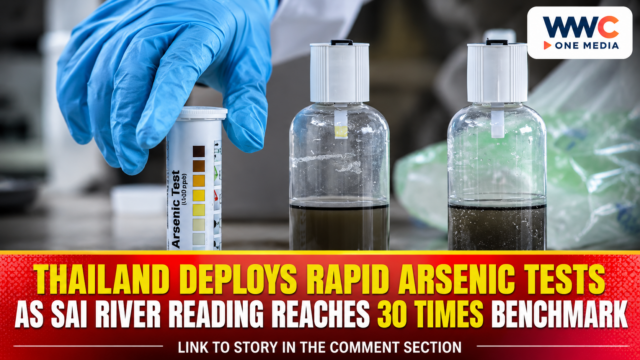
Thailand is expanding its response to heavy-metal concerns in northern water sources, bringing portable detection equipment and longer-term treatment plans into the effort to protect communities in Chiang Rai.
The latest developments show that authorities are moving beyond river sampling towards a broader system of water monitoring, alternative supplies and community-level treatment. But the key challenge remains: ensuring that the water reaching households is safe, consistently tested and supported by reliable public information.
The renewed response follows a November 5–6 incident in which unusually high turbidity and arsenic levels in the Sai River disrupted a water-production system serving communities in Mae Sai district. Thailand’s Environmental and Pollution Control Office 1 reported that 14 villages across two subdistricts were affected by a temporary interruption to water services.
Sai River arsenic reading triggered a temporary water-supply disruption
The Pollution Control Department’s regional office reported that raw water from the Sai River recorded arsenic at 0.30 milligrams per litre during the November 5–6 episode. Turbidity also exceeded 10,000 nephelometric turbidity units, indicating extremely cloudy water.
The figures are important, but they need to be understood in context. The 0.30 mg/L measurement was recorded in the river’s raw water. It is not evidence that treated tap water delivered to every household contained the same arsenic concentration.
The incident nevertheless affected the Provincial Waterworks Authority’s Mae Sai operations. The regional environmental office said production was reduced or temporarily stopped from November 5 at 5:30 p.m. until November 6 at 5:30 p.m.
The agency’s field report said 14 villages in Wiang Phang Kham and Mae Sai subdistricts experienced an interruption to water services. Its account recorded that production and distribution had returned to normal after the temporary shutdown and operational adjustments. epo01.pcd.go.th+1
That distinction matters for residents and readers. The available official report documents a specific disruption on those dates; it does not establish that the same communities remain without piped water on November 18.
Thailand arsenic crisis response adds portable testing equipment
A significant development came on November 15, when Deputy Prime Minister and Minister of Higher Education, Science, Research and Innovation Yodchanan Wongsawat visited Mae Sai to review the water-quality situation.
The National Nanotechnology Center, or NANOTEC, said a portable M-Sense heavy-metal detection kit was handed to the Chiang Rai Provincial Public Health Office to support field monitoring.
The device is designed to detect four metals associated with water contamination: arsenic, lead, cadmium and mercury. NANOTEC said it uses electrochemical sensing and can provide quantitative readings in the parts-per-billion to parts-per-million range, with results available in approximately three to five minutes.
The technology could help local personnel screen water at sampling locations rather than wait for every initial test to be processed at a central laboratory. However, NANOTEC describes the kit as a screening tool: results can help identify samples requiring further confirmation through standard laboratory testing. National Nanotechnology Center+1
This distinction is important. Faster screening can improve the speed of a response, but it does not replace laboratory confirmation, transparent reporting or a treatment system capable of consistently meeting drinking-water standards.
Seven monitoring stations and wider testing remain part of the plan
Thailand’s regional environmental office also reported progress on a broader monitoring programme covering the Kok, Sai, Ruak and Mekong rivers.
At a November 9 committee meeting, officials reviewed the 23rd round of surface-water monitoring and the 13th round of sediment monitoring. The office also reported preparations for seven automatic water-quality monitoring stations.
The same meeting covered testing for heavy metals in village tap water, fish, vegetables, agricultural products, irrigation water and soil. Health surveillance was also included in the response.
The Mae Sai waterworks branch discussed the November 5 raw-water incident and the possible use of a mobile water-treatment system to strengthen production capacity. Officials also considered emergency water supplies, alternative sources and further coordination among relevant agencies. epo01.pcd.go.th
These measures address different parts of the risk. River monitoring can help identify changes in source-water conditions. Testing village systems can provide information about water after local treatment and distribution. Food and soil sampling can help assess whether contamination concerns extend beyond the river itself.
The public value of the programme will depend on whether results are released clearly, including the sampling location, date, contaminant measured and applicable standard.
Community filtration systems offer another line of defence
Thailand had already begun testing community-level treatment approaches before the latest Mae Sai equipment handover.
In an August 30 government announcement, the Prime Minister’s Office described a prototype village water-treatment system developed with Thai research institutions to remove arsenic and heavy metals from water in communities along the Kok River.
The government said the initial systems had been delivered to riverside communities, with one pilot arrangement reported to cover more than 700 households. It also described other installations intended to serve a community and a school.
Those figures and performance claims are government-reported programme details, not an independent assessment of how well every installation performs under all operating conditions. Thai Government
NANOTEC’s November 16 update also described a prototype community water-supply system developed with the National Science and Technology Development Agency and the National Research Council of Thailand. The agency said the project is designed to serve more than 1,180 households in the Kok River Basin.
The system combines existing community water infrastructure with a nanotechnology-based drinking-water treatment process and water-quality monitoring. Its stated objective is to connect detection, treatment and local capacity-building rather than rely on testing alone. National Nanotechnology Center
For the communities concerned, the next test is whether the systems can be maintained, monitored and operated consistently, with clear evidence that treated water meets the required standards.
Alternative water sources could strengthen Mae Sai’s long-term security
The regional environmental office reported that the Provincial Waterworks Authority was considering additional supply options after the Sai River disruption.
These included emergency groundwater sources, a proposed pipeline to bring water from the Mekong River to Mae Sai, and other medium- and long-term sources such as the Mae Kham and Mae Salap reservoirs.
The Mekong transfer project was reported as being under development, with a projected completion target in 2028. That makes it a longer-term infrastructure proposal, not an immediate solution to every short-term water-quality concern. epo01.pcd.go.th
Alternative sources can reduce dependence on a single river, but they also require their own water-quality assessments, treatment capacity, distribution infrastructure and maintenance budgets.
Thailand’s wider water-security challenge is not unique to Chiang Rai. WWC ONE MEDIA has previously examined how infrastructure planning can affect local water resources in its coverage of the Klong Phrao Reservoir project in Thailand. The issue also connects with the practical problems of maintaining dependable household supplies, as seen in the emergency water response in Manay, Davao Oriental.
Cross-border cooperation remains part of the environmental challenge
The Sai River issue also sits within a wider transboundary water-quality concern. Rivers and watersheds do not follow national borders, making monitoring, information-sharing and coordination important when pollution risks may involve upstream sources.
Thailand and Myanmar have previously pursued a framework for cooperation on shared river water quality. WWC ONE MEDIA has reported on the diplomatic dimension in its coverage of Thailand’s push for Myanmar talks and ASEAN’s role.
However, the official records reviewed for this update do not establish that a specific mine or operator caused the November Sai River readings. Nor do they provide sufficient evidence to assign responsibility to a particular company or site. Any such conclusion would require verified source investigations and supporting technical findings.
The immediate priority is therefore to establish where contamination is present, how it changes over time and whether water supplied to households is safe.
What happens next
The most important indicators to watch are the results of continuing river and sediment monitoring, the installation and operation of the seven automatic stations, and the publication of tests from village water systems and other potentially affected sources.
Authorities also need to explain how mobile treatment equipment will be deployed, which communities will receive support, and how the proposed alternative water sources will progress.
For residents, the distinction between river water, village-supplied water and water treated by the Provincial Waterworks Authority should remain clear. A result from one sampling point cannot automatically describe every household’s supply.
The November incident shows how quickly raw-water conditions can disrupt essential services. Thailand’s new testing equipment and community treatment projects could strengthen its response, but lasting confidence will depend on transparent results, effective treatment and reliable access to safe water.
Frequently asked questions
1. What caused the latest water-supply disruption in Mae Sai?
Thailand’s regional environmental office reported unusually high turbidity and increased arsenic in raw water from the Sai River during November 5–6, 2026. The conditions disrupted the Mae Sai waterworks’ production and distribution operations. The reviewed official records do not establish a specific mine or operator as the cause. epo01.pcd.go.th
2. Was arsenic measured in household tap water at 0.30 mg/L?
No such conclusion can be drawn from the cited 0.30 mg/L reading. The reported measurement concerned raw water in the Sai River. Household tap-water safety requires separate sampling and testing of the relevant supply system. epo01.pcd.go.th
3. What is Thailand’s M-Sense detection kit?
It is a portable NANOTEC-developed device designed to screen for arsenic, lead, cadmium and mercury. The agency says it can provide readings in approximately three to five minutes. Screening results may require confirmation through standard laboratory analysis. National Nanotechnology Center
4. Are community water-treatment systems already being used?
The Thai government reported pilot systems for communities along the Kok River in August. NANOTEC’s November update described a prototype designed to serve more than 1,180 households in the Kok River Basin. These programme descriptions do not independently verify the performance of every installation. Thai Government+1
5. Is the Mekong River pipeline already supplying Mae Sai?
The regional environmental office described the Mekong transfer as a project under development, with a target completion in 2028. It should not be presented as an already operational source for Mae Sai.