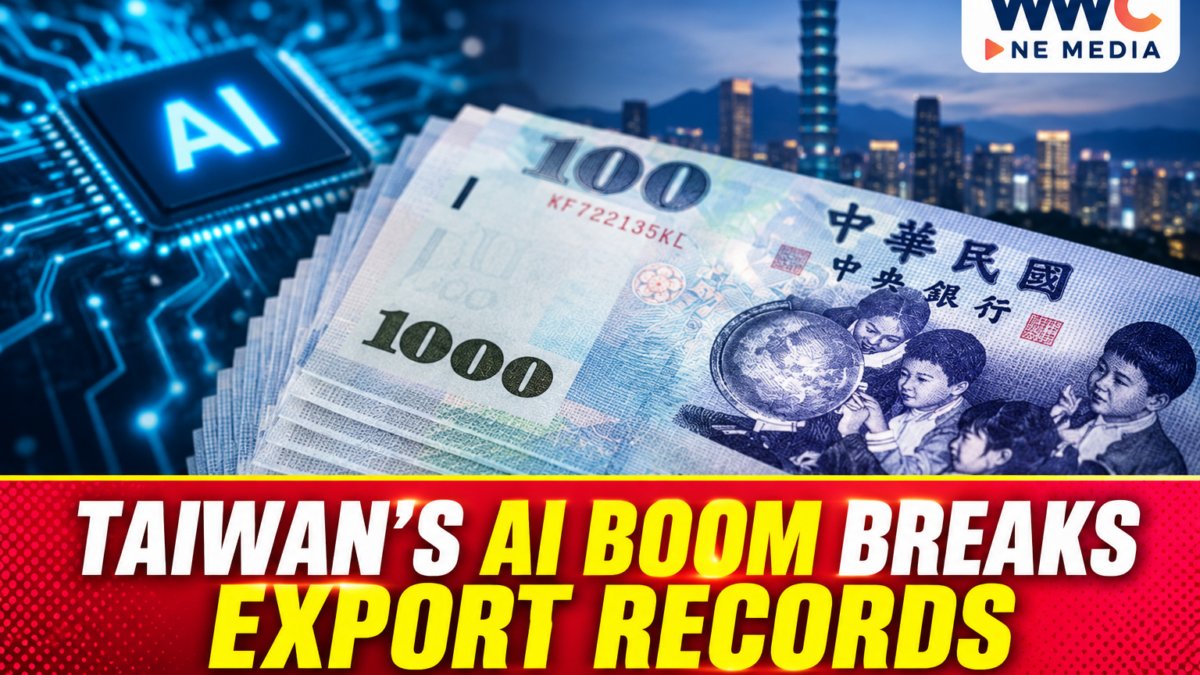
Taiwan is experiencing one of its strongest export surges in years, powered by global demand for artificial intelligence hardware. Yet the New Taiwan dollar has continued to weaken against the US dollar, exposing a financial contradiction: a booming technology industry does not automatically translate into a stronger currency.
The Central Bank of the Republic of China (Taiwan) addressed the pressure in an Oct. 19 statement, explaining that foreign investors had sold large amounts of Taiwanese shares and transferred funds overseas. By Nov. 17, the central bank’s published closing rate showed the US dollar trading at NT$32.850, compared with NT$31.895 on Oct. 12. Central Bank of China (Taiwan)+1
The contrast matters because Taiwan’s technology exports are benefiting from the worldwide expansion of AI infrastructure, but the movement of international investment capital can exert a different influence on its currency. The result is a reminder that export performance, stock-market activity and exchange rates do not always move in the same direction.
Taiwan’s AI exports are growing at an extraordinary pace
The latest trade figures show just how strong the technology-driven expansion has become.
Taiwan’s exports reached US$96.76 billion in October 2026, increasing 58.9% from the same month a year earlier. Imports also rose sharply, climbing 75.1% to US$68.89 billion. The resulting trade surplus was US$27.875 billion.
For January to October, exports totalled US$758.293 billion, up 47.7% year on year. service.mof.gov.tw
Technology products accounted for a substantial part of the October performance. Information, communication and audio-video products generated US$47.596 billion in exports, representing 49.2% of the monthly total and an annual increase of 72.9%.
Parts of electronic products contributed another US$32.683 billion, rising 61.4% from October 2025.
Together, those two categories accounted for more than four-fifths of Taiwan’s exports during the month. The figures underline how closely the country’s trade performance is tied to the global electronics and semiconductor supply chains.
WWC previously examined the scale of this expansion in its report on Taiwan’s record-breaking export growth driven by AI demand. The latest figures show that the momentum continued into October.
Why did the New Taiwan dollar weaken despite strong exports?
The central bank’s explanation points to international investment movements rather than a collapse in export demand.
In its Oct. 19 statement, the bank said the New Taiwan dollar weakened from NT$31.895 per US dollar on Oct. 12 to NT$32.338 on Oct. 16. That represented a depreciation of 1.37% over the period.
The bank identified foreign investors’ stock-market selling and the transfer of funds overseas as major factors behind the movement.
Between Oct. 12 and Oct. 16, foreign investors recorded net sales of US$19.402 billion in Taiwanese shares and net foreign-exchange outflows of US$17.961 billion, the central bank disclosed. Central Bank of China (Taiwan)
This distinction helps explain the apparent contradiction.
Exporters may generate substantial foreign-currency earnings when overseas customers purchase Taiwanese products. But those earnings do not necessarily remain in Taiwan’s financial system or immediately create demand for the New Taiwan dollar.
At the same time, international investors can sell local shares and convert their proceeds into foreign currencies. When those transactions generate substantial demand for US dollars, the local currency can come under pressure.
In other words, a strong trade surplus does not guarantee that the currency will appreciate every day.
AI investment concerns also affected market sentiment
The central bank’s October explanation also highlighted concerns surrounding the global technology sector.
It said international technology shares had experienced a correction from the beginning of October amid concerns about elevated valuations of AI-related stocks and rising financing risks within the AI industry.
The bank noted that the Philadelphia Semiconductor Index declined for eight consecutive trading sessions from Oct. 7 to Oct. 16, recording a cumulative fall of 15.7%.
Taiwan’s stock market declined by 5.4% over the same period, according to the statement. Central Bank of China (Taiwan)
This is an important part of the currency story. Taiwan’s technology industry can benefit from expanding AI demand while its financial markets remain exposed to changing expectations about the profitability, cost and pace of AI investment.
The distinction is particularly relevant because the AI boom involves enormous spending on data centres, computing equipment and advanced chips. Investors may remain optimistic about long-term demand while becoming more cautious about valuations or the financing required to sustain that expansion.
WWC’s earlier coverage of Central Taiwan Science Park’s record first-half revenue showed how AI demand has been supporting industrial activity and semiconductor-related businesses. However, strong operating results do not remove the risks associated with financial-market volatility.
Taiwan’s central bank operates a managed floating exchange-rate system
Taiwan does not maintain a fixed exchange rate against the US dollar.
The central bank describes its foreign-exchange framework as a managed float. Market forces generally determine the New Taiwan dollar’s value, while the bank can intervene when seasonal or irregular developments create excessive volatility or disorderly market conditions.
Its stated approach allows capital to move into and out of Taiwan, subject to applicable regulations. The bank says it may act when large short-term capital movements threaten financial and economic stability. Central Bank of China (Taiwan)
This means the authorities are not necessarily trying to force the currency in one direction. Their stated objective is to maintain an orderly market and limit destabilising movements.
The central bank’s foreign-exchange reserves provide another indicator of the country’s financial position. At the end of October, reserves stood at US$596.44 billion, down US$4.31 billion from the previous month.
The bank identified investment returns, movements in other reserve currencies against the US dollar and its own actions to smooth volatile capital flows as factors affecting the change. Central Bank of China (Taiwan)
The reserve figure should not be interpreted as a direct measure of how much money was spent defending the New Taiwan dollar. The central bank’s statement identifies several factors behind the monthly movement, not a single cause.
What the currency movement means for businesses and households
A weaker New Taiwan dollar can have different effects across the economy.
Exporters receiving payment in US dollars may benefit when those earnings are converted into local currency. Their overseas revenue can translate into a larger amount of New Taiwan dollars, although the actual benefit depends on production costs, foreign-currency expenses and financial hedging.
Importers face a different situation. Companies purchasing fuel, machinery, raw materials and other goods in US dollars may have to spend more in local currency when the exchange rate weakens.
That can increase operating costs, particularly for businesses that rely heavily on imported inputs. Whether those costs reach consumers depends on competition, pricing decisions and the ability of companies to absorb higher expenses.
Households may also feel the effects through imported products, overseas travel and other expenses linked to foreign currencies. However, exchange-rate changes do not automatically translate into immediate price increases across the economy.
For Philippine businesses, Taiwan’s experience is also worth watching. The Philippines imports electronics, machinery and other manufactured products from regional trading partners, while many local industries are connected to international technology supply chains.
Taiwan’s currency movements could therefore affect the cost of some transactions, depending on the currency used in contracts and the pricing decisions of suppliers. The broader lesson is that strong regional technology demand can coexist with financial-market uncertainty.
The Philippines has its own commercial links with Taiwanese technology companies, including those showcased during Taiwan’s technology exhibition in Manila.
What happens next?
The central bank has said it will continue monitoring international financial conditions and foreign-investment flows, adjusting its response when market supply and demand require action to maintain exchange-rate stability.
The next important signals will come from the direction of international investment, movements in the US dollar, technology-sector valuations and Taiwan’s export performance.
The Ministry of Finance’s next scheduled release of trade figures is Dec. 9, 2026. Those figures will help establish whether the strong export momentum continued into November. service.mof.gov.tw
For now, Taiwan’s economic picture contains two realities. Its AI-related industries are generating exceptional export growth, while movements in global investment capital are putting pressure on its currency.
The two developments are not mutually exclusive. They reflect different parts of an economy that is deeply connected to international trade and financial markets.
Frequently Asked Questions
Why is Taiwan’s currency weakening despite strong AI exports?
The central bank attributed the October depreciation partly to foreign investors selling Taiwanese shares and transferring funds overseas. Strong exports do not automatically offset capital outflows.
How much did Taiwan’s exports increase in October 2026?
Exports reached US$96.76 billion, up 58.9% from October 2025.
What caused the New Taiwan dollar to fall in October?
The central bank identified foreign investors’ net selling of Taiwanese shares and overseas fund transfers as major factors during Oct. 12–16. It also cited concerns about global technology-stock valuations and AI-industry financing risks.
Does Taiwan’s central bank control the exchange rate?
Taiwan operates a managed floating exchange-rate system. Market forces generally determine the currency’s value, while the central bank may intervene to address excessive volatility or disorderly movements.
Will a weaker New Taiwan dollar help Taiwan’s exporters?
It can increase the local-currency value of overseas earnings, but the benefit varies by company. Exporters that rely on imported materials, equipment or foreign-currency financing may also face higher costs.