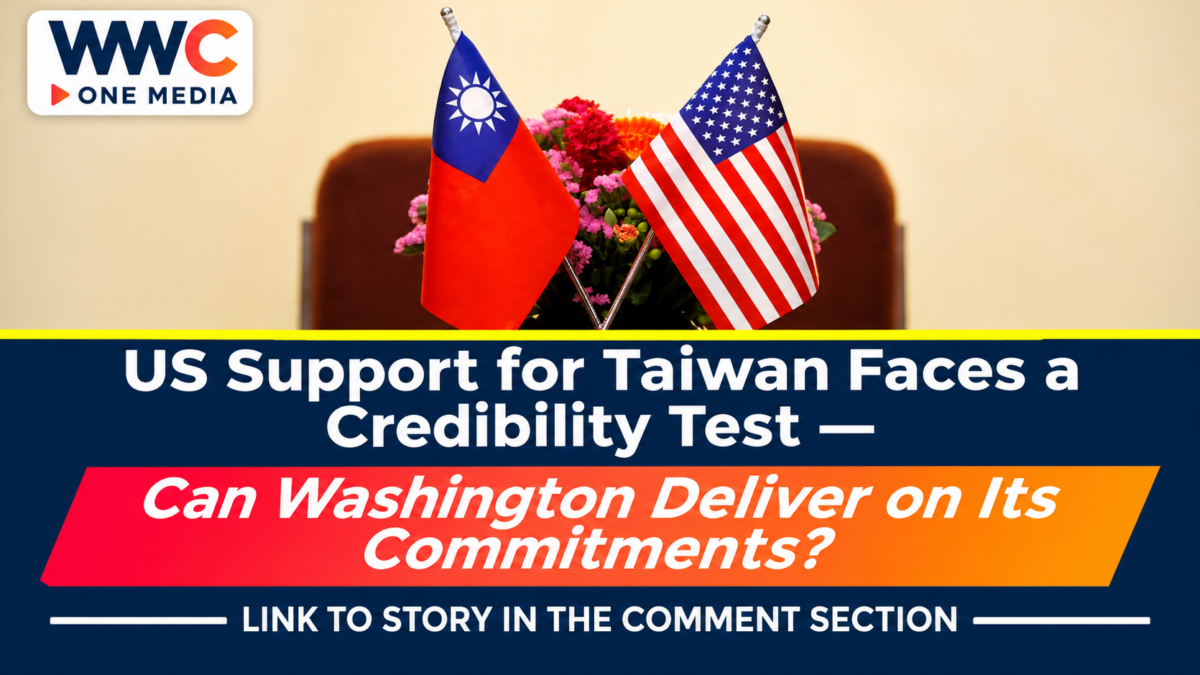
TAIPEI, Nov. 15, 2026 — US support for Taiwan remains anchored in American law, but public defence records reveal a more difficult practical test: turning policy commitments into equipment, training and usable capabilities. Taiwan’s defence ministry said in October that American arms-sales cases were still being reviewed, while deliveries of newly built F-16 fighters were behind schedule.
The distinction matters across the Indo-Pacific. A legal commitment, a diplomatic assurance and an aircraft arriving ready for service are three different things. The public record shows continued cooperation and identifiable obstacles, but it does not prove that American voters have abandoned Taiwan or that Washington has decided against defending it.
US Support for Taiwan: What American Law Actually Requires
The Taiwan Relations Act, enacted in 1979, establishes a US policy of maintaining peace and stability in the Western Pacific. Its provisions call for making defensive equipment and services available so that Taiwan can maintain sufficient self-defence capabilities.
The law also instructs the president to inform Congress promptly about threats to Taiwan’s security or its social and economic system. The president and Congress are to determine an appropriate response through constitutional processes.
Analysis: This is a consequential framework, but it should not be mistaken for an automatic promise to send US combat troops in every imaginable crisis. The statute describes assistance, decision-making and American capacity; it leaves specific military responses to political and constitutional decisions.
That difference between a standing policy and a future operational decision helps explain why credibility cannot be measured by official reassurance alone.
Fighter Deliveries Reveal the Implementation Problem
In an Oct. 6 statement, Taiwan’s Ministry of National Defense said that US arms-sales cases remained under review. Defence Minister Wellington Koo Li-hsiung said the American side had repeatedly affirmed that its arms-sales policy had not changed, while Taipei was awaiting the outcome of the review process.
Koo also addressed the delayed F-16 Block 70 programme. More than 60 aircraft were on the production line, he said, and completed aircraft would undergo testing before Taiwan and the United States arranged delivery. Taiwan was discussing non-cash compensation for the delays.
Those disclosures are more useful than assigning an unverified delivery date. Aircraft under production are not yet the same as aircraft in operational service, and an arms-sales review is not the same as a cancellation.
WWC’s earlier report on Taiwan’s recent assessment of its ties with Washington examines the diplomatic dimension of that uncertainty. The current test is narrower: whether acknowledged programmes progress through reviews, testing and delivery.
Taiwan Continues to Monitor Chinese Military Activity
Taiwan’s air force reported that, between 6 a.m. Nov. 14 and 6 a.m. Nov. 15, its forces detected one Chinese military aircraft sortie, eight Chinese naval vessels and three official ships operating around Taiwan. It said the aircraft entered Taiwan’s eastern air-defence identification zone and that Taiwanese forces monitored the activity.
A single day’s report is a snapshot, not proof of an imminent invasion. An air-defence identification zone is also not the same as sovereign territorial airspace. Describing these distinctions accurately matters when assessing regional security.
The activity nevertheless illustrates why Taipei places emphasis on surveillance, readiness and resilience. Its October presidential statements stressed strengthening self-defence, expanding industrial cooperation and preparing civilian institutions for disruption.
WWC’s coverage of Taiwan’s civilian preparedness and military exercises supplies context on that broader effort. Preparedness planning should not be presented as evidence that a conflict has already been scheduled.
Diplomatic Cooperation Extends Beyond Weapons
Taiwan’s presidential office said on Oct. 8 that President Lai Ching-te met US Senator Michael Bennet and emphasised cooperation on drones, space technology, industrial supply chains and whole-of-society defence resilience. These were stated priorities at an official meeting, not newly signed contracts for every proposed activity.
A separate September statement from Taiwan’s presidential office welcomed a joint message by the foreign ministers of the United States, Japan and South Korea favouring stability in the Taiwan Strait and opposing unilateral changes to the status quo.
Such diplomatic activity demonstrates continuing political engagement. But statements of concern are not operational guarantees, and cooperation on technology does not substitute for delivering contracted defensive equipment.
The relationship also includes civilian institutions. WWC recently examined new US–Taiwan government fellowship arrangements, an example of engagement distinct from combat commitments.
Why Public Opinion Cannot Be Inferred From Policy Delays
An opinion that Americans are becoming unwilling to support Taiwan would need representative survey data with clear question wording, dates and methods. Neither the military procurement notices nor the diplomatic statements establish that proposition.
Analysis: Support has several meanings. A respondent might favour supplying defensive weapons, economic sanctions or diplomatic assistance without supporting direct US military intervention. Combining those positions into a single measure of willingness to defend Taiwan risks misleading readers.
The same caution applies to describing the US government as abandoning Taiwan. Its legal framework remains in place, while Taiwan’s defence ministry has explicitly described ongoing cases and continuing American policy assurances. That does not erase procurement difficulties; it defines what can and cannot yet be concluded.
What Happens Next
The clearest measures will be formal US decisions on pending arms-sales cases, confirmed F-16 delivery milestones, and published progress on Taiwan’s defence and resilience initiatives. Fresh, transparent public-opinion research could separately clarify how Americans view different kinds of support.
For the Philippines, a nearby partner with direct interests in regional maritime stability, these developments warrant close attention. They should be judged through documented actions rather than speculation about a war date or assurances that any particular military response is guaranteed.
Frequently Asked Questions
Does the United States have to defend Taiwan militarily?
The Taiwan Relations Act supports Taiwan’s self-defence and sets out US policy and response procedures, but it does not automatically require US combat intervention in every contingency.
Has the United States stopped arms sales to Taiwan?
No blanket termination is established in the records reviewed. Taiwan’s defence minister said on Oct. 6 that cases remained under review and US arms-sales policy had not changed.
Why are Taiwan’s F-16 fighter deliveries delayed?
Taiwan’s defence ministry acknowledged delays, ongoing aircraft production and testing, and talks over non-cash compensation. The reviewed announcement does not establish a complete final delivery timetable.
Is a Chinese invasion of Taiwan imminent?
The official daily activity report documents aircraft and ships around Taiwan, not an invasion order or a confirmed attack date.