MANILA, Philippines — Nov. 14, 2026. US stock markets ended another turbulent trading week with sharply different outcomes for securities, even as the broad S&P 500 index remained ahead for the year. Original exchange and government records show that Wall Street volatility is being shaped by changing expectations for inflation, interest rates and the earnings needed to justify expensive investments.
The distinction matters to Philippine investors with global funds or dollar investments. An index’s positive annual return cannot establish that a particular trader profited, and a sharp loss in one stock does not prove that every sector has collapsed. This week’s figures offer a more useful way to separate market-wide risk from individual bets.
Wall Street Volatility: What the Official Index Shows
S&P Dow Jones Indices’ Nov. 13 dashboard recorded a 0.39% daily decline for its S&P 500 Total Return Index. The same series showed an 11.54% positive year-to-date return. Its figures measure a total-return index, which includes the effect of reinvested dividends, rather than the more familiar price-only index quoted in market headlines.
The time periods explain why seemingly contradictory statements can both be true. A broad stock benchmark can lose ground in one trading session but still be higher than it was at the end of the previous year. An investor who bought recently might be losing money even when someone who invested earlier remains ahead.
WWC previously examined the November Wall Street reversal following stronger US inflation data. This report instead examines what official index and options-market measurements actually say about risk.
The VIX Shows Caution, Not a Certain Crash
Cboe’s published Nov. 13 data showed its VIX volatility index at 19.30, compared with a previous close of 18.70. The exchange describes the index as a measure of the market’s expectation of near-term volatility derived from S&P 500 options prices.
A VIX reading is not a percentage prediction for how much stocks will fall. Options prices reflect expectations and the prices investors pay to manage uncertainty. They can rise when traders seek protection, even if an index finishes a period with gains.
WWC’s earlier examination of the November AI-related equity selloff provides a separate account of that sharp market decline. Its estimated market-capitalisation losses should not be described as equivalent cash losses realised by every shareholder.
Inflation Raises the Cost of Waiting for Profits
The US Bureau of Labor Statistics reported that the Consumer Price Index rose 0.4% in October, after a 0.6% increase in September, on a seasonally adjusted basis. The October index excluding food and energy increased 0.3%.
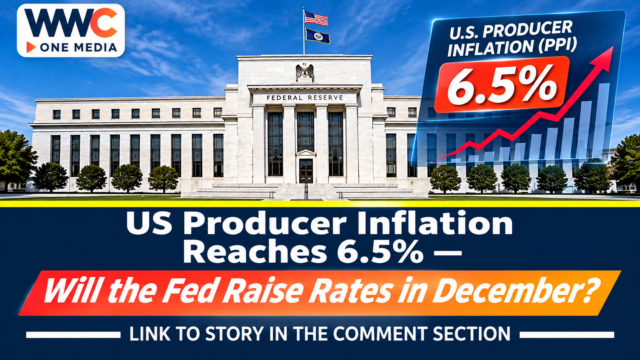
A second official release, issued Nov. 13, showed the Producer Price Index for final demand increasing 0.3% in October, following a 1.4% rise in September. Over the 12 months through October, that producer-price measure was up 6.5%. Consumer and producer inflation measure different transactions and must not be treated as interchangeable readings.
Higher inflation can complicate equity valuations. When investors require a greater return on bonds or demand greater compensation for uncertainty, expected company earnings many years into the future may be assigned a lower value today. This is one reason businesses promising future growth can be sensitive to changing interest-rate expectations.
That mechanism is financial analysis, not proof that one inflation release directly caused every share-price move. Individual stocks also react to company results, changes in competition, management decisions and business-specific expectations.
Federal Reserve Policy Has Not Been Settled for December
On Oct. 28, the Federal Open Market Committee voted 10–2 to maintain its federal funds target range at 3.75%–4.00%. Its statement identified inflation as elevated, while describing resilient spending and strong capital investment. Two voting policymakers preferred raising the target by a quarter of a percentage point.
The decision establishes the policy then in force, not a promise about the next meeting. Investors may debate another increase, but only a later formal committee vote can establish the next target range. An analyst forecast should not be presented as a policy announcement.
For stock valuations, the important variables are not just the headline policy rate. Treasury yields, expected inflation and the premium investors require for holding risky assets all affect the comparison between bonds and equities.
AI Investments Make Market Outcomes Uneven
Analysis: Artificial-intelligence investment creates different exposures across the stock market. Chip designers, cloud operators, data-centre developers and businesses buying AI software do not receive revenue at the same stage of the investment cycle. Their margins and funding needs can differ materially.
A construction commitment is not necessarily current revenue for the company financing a project. Likewise, an equipment supplier’s sale does not establish that every end user will earn a profitable return on its investment.
Investors assessing this sector should distinguish completed sales, forecasts, debt commitments and operating cash flow. A large financing headline can describe capital raised or pledged without demonstrating that the related facility is operating profitably.
WWC has examined retail traders’ response to the AI-market rout. That coverage provides context for changing risk appetite, while the official data in this article cannot verify individual retail investors’ realised gains or losses.
For Philippine investors, holdings in overseas index funds also introduce currency exposure. A dollar investment’s return in pesos may differ from the dollar-denominated benchmark because the exchange rate changes. There is no guaranteed direction for either market or currency movements.
What Happens Next
The next useful evidence will come from corporate results, later inflation releases and the Federal Reserve’s formal decisions. The Bureau of Labor Statistics schedules November consumer-price data for Dec. 10; that is a release date, not a forecast of the result.
For now, official data show positive year-to-date broad-index returns alongside meaningful day-to-day uncertainty. Whether the rally continues depends on information not yet known. The sound conclusion is that market gains and painful individual losses can coexist—not that every investor has enjoyed a payday or that a crash is inevitable.
Frequently Asked Questions
Was Wall Street up or down on Nov. 13, 2026?
S&P Dow Jones Indices reported a 0.39% fall in its S&P 500 Total Return Index for Nov. 13, while its year-to-date return remained positive at 11.54%. Those are different measurement periods.
What does a VIX reading of 19.30 mean?
It reflects market expectations of near-term volatility implied by S&P 500 options. It does not forecast a certain percentage fall in stocks.
Why does inflation affect share prices?
Inflation can influence interest-rate expectations and the returns investors demand. Those changes can affect the present value assigned to expected future company earnings.
Does a rising stock index guarantee investors make money?
No. Outcomes depend on the securities held, purchase and sale prices, fees, taxes, leverage and—in the Philippines—possible foreign-exchange movements.