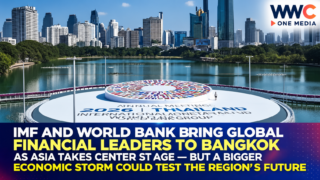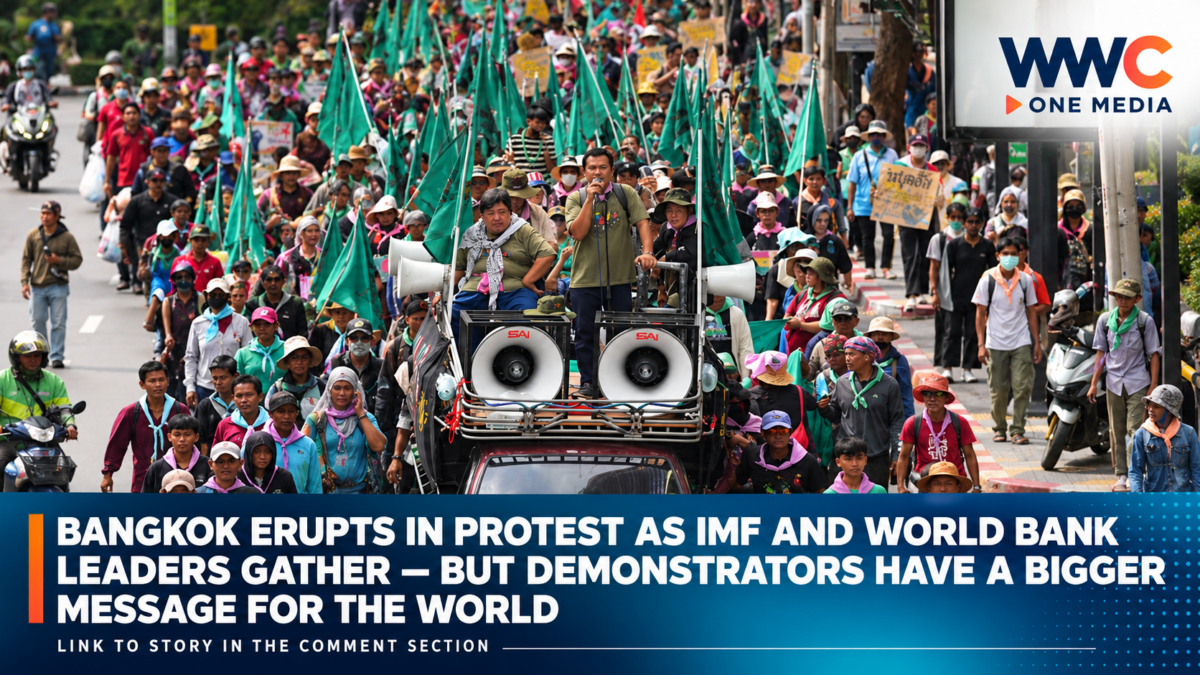
BANGKOK, Thailand — International financial leaders gathering in Bangkok for the 2026 annual meetings of the International Monetary Fund (IMF) and World Bank faced mounting public criticism as protesters took to the streets to challenge economic policies they say are worsening poverty, inequality and environmental destruction.
The demonstrations, held alongside the high-profile international meetings from October 12 to 18, brought together activists, farmers, workers and community representatives who demanded greater accountability from the world’s leading financial institutions.
Protesters argued that economic development policies supported by the IMF and World Bank have frequently benefited major corporations and investors while leaving vulnerable communities struggling with debt, displacement and deteriorating living conditions.
One of the demonstrations on October 15 involved dozens of protesters who marched toward the Queen Sirikit National Convention Center, where thousands of international delegates had gathered. Some demonstrators wore masks depicting prominent global leaders, including US President Donald Trump and IMF Managing Director Kristalina Georgieva.
They also brought a symbolic float featuring a large pink pig decorated with dollar signs, highlighting their criticism of financial institutions and the concentration of economic power.
The protesters raised concerns about Thailand’s growing household debt, poverty and environmental deterioration, arguing that ordinary citizens continue to bear the consequences of economic decisions made by powerful institutions.
The demonstration remained largely peaceful, although a brief confrontation occurred when some participants attempted to display banners near the meeting venue. Police maintained a strong security presence and prevented protesters from proceeding closer to the convention center.
Hundreds Demand Debt Relief and Economic Justice
The demonstrations continued on October 16, when the Assembly of the Poor, a grassroots movement representing affected communities, organized another march toward the international meeting venue.
Approximately 500 people participated in the gathering, calling on the IMF and World Bank to reconsider economic policies that they believe contribute to financial inequality and undermine local livelihoods.
Among their major demands were debt cancellation for low- and middle-income countries, progressive taxation, an end to corporate subsidies and stronger public oversight of economic policymaking.
The protesters also called for greater protection of farmers, workers and communities affected by development projects.
Their demands reflected wider concerns about how developing countries manage public debt, attract foreign investment and balance economic growth with environmental protection.
Thailand’s Economic Challenges Become Part of the Debate
Thailand’s role as host has placed the country’s economic and social challenges under an international spotlight.
The demonstrations highlighted concerns over household indebtedness, foreign investment and large-scale infrastructure projects, including developments associated with Thailand’s Eastern Economic Corridor.
Activists argued that some investment-driven projects have placed additional pressure on communities and the environment while raising questions about who ultimately benefits from economic expansion.
The protests also exposed tensions between government efforts to attract international investment and demands from local groups for stronger safeguards, transparency and public participation.
Bangkok authorities had already imposed restrictions on public gatherings around important meeting venues, including the Queen Sirikit National Convention Center, One Bangkok Forum and hotels accommodating international delegates. The restrictions were scheduled to remain in effect from October 10 to 20.
Global Economic Uncertainty Adds Pressure to IMF Meetings
The demonstrations came as international policymakers faced difficult discussions over the global economy.
The ongoing Middle East conflict, rising energy costs, inflationary pressures and elevated debt levels have created additional challenges for governments, particularly developing economies that are more vulnerable to external economic shocks.
The annual meetings brought together more than 15,000 participants from 191 countries, including finance ministers, central bank governors, policymakers, business executives and representatives of international organizations.
Discussions focused on global economic stability, development financing, debt sustainability and the challenges facing countries navigating an increasingly uncertain economic environment.
The IMF has also warned about slowing economic growth across Asia, with its projections indicating that regional growth could ease from 5 percent in 2025 to 4.4 percent in 2027.
The institution has emphasized the importance of responsible government spending and targeted assistance for vulnerable populations as countries confront economic pressures.
The situation has intensified debate over whether existing international financial arrangements are adequately addressing the needs of developing countries.
A Bigger Question About Who Benefits From Global Economic Growth
The Bangkok demonstrations have brought renewed attention to a long-running debate over the influence of international financial institutions on national economic policies.
Supporters of the IMF and World Bank argue that these organizations provide financial assistance, technical expertise and development funding that can help countries manage economic crises and improve living standards.
However, critics contend that certain lending conditions, development priorities and investment strategies can place excessive financial burdens on governments and communities.
For the demonstrators, the issue extends beyond the policies discussed inside conference rooms. They want international financial leaders to recognize the experiences of ordinary people affected by debt, environmental damage and unequal economic opportunities.
As the meetings conclude, the protests underscore a difficult challenge for global policymakers: economic growth and financial stability may remain central objectives, but growing public demands for fairness, accountability and environmental protection are becoming increasingly difficult to ignore.