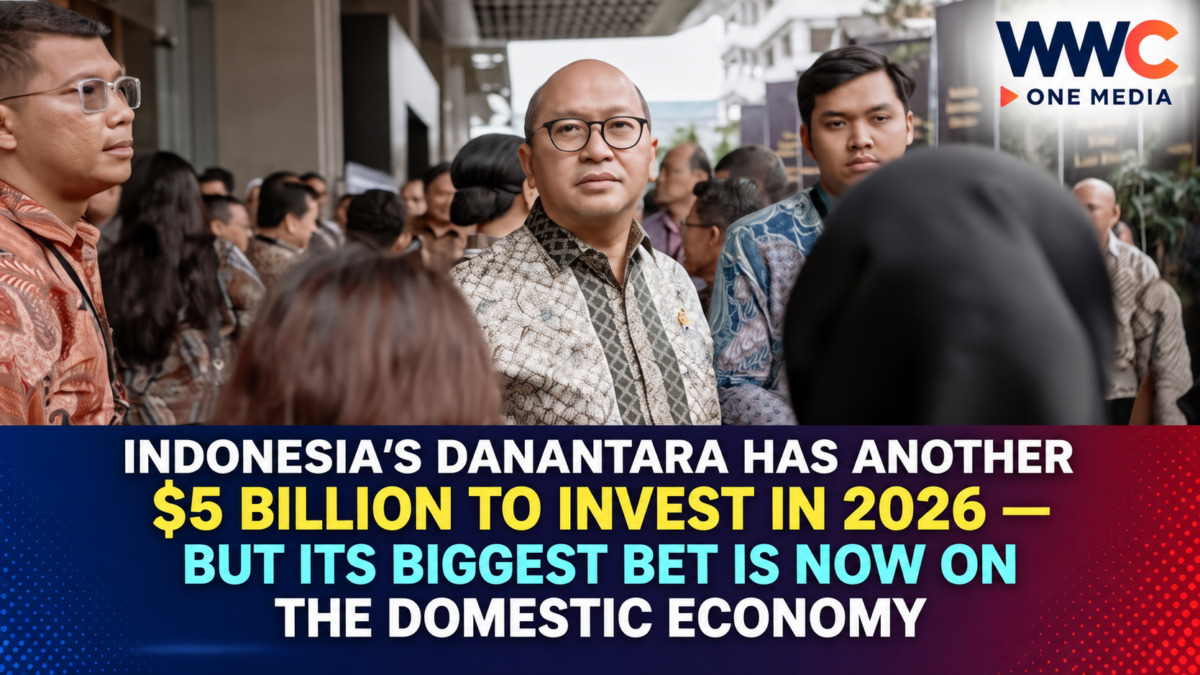
JAKARTA — Indonesia’s giant new sovereign investment fund is turning its attention back home, with Danantara Indonesia preparing to deploy another roughly $5 billion before the end of 2026 as President Prabowo Subianto accelerates one of Southeast Asia’s most ambitious experiments in state-backed capitalism.
The fund entered this year with an investment target of as much as $14 billion, significantly above the approximately $8 billion it committed in 2025.
Now, with only months left in the year, Danantara is signaling that much of its remaining capital will be directed toward domestic opportunities rather than overseas assets.
That shift matters because Danantara is not an ordinary sovereign wealth fund.
It simultaneously manages vast holdings in Indonesian state-owned enterprises, makes commercial investments, supports President Prabowo’s strategic industrial priorities and is increasingly being used as a tool to attract foreign capital into the country.
The bigger question is becoming unavoidable:
Can Danantara generate competitive investment returns while also serving as Indonesia’s national development engine?
Danantara could deploy as much as $14 billion this year
At the World Economic Forum in Davos in January, Chief Investment Officer Pandu Patria Sjahrir said Danantara was prepared to invest up to $14 billion in 2026.
That compared with around $8 billion committed in 2025.
The funding is largely being sourced from dividends generated by state-owned companies already under Danantara’s umbrella rather than relying entirely on new government budget allocations.
That funding model is central to Prabowo’s vision.
Instead of allowing profits from state enterprises to flow separately across dozens of government-controlled companies, Danantara is intended to aggregate capital and redeploy it into projects expected to deliver both financial returns and strategic economic benefits.
In theory, that turns Indonesia’s state assets into a compounding investment machine.
In practice, it creates enormous responsibility.
The remaining $5 billion appears increasingly focused on Indonesia
Bloomberg’s latest report says Danantara is looking “homeward” with another roughly $5 billion available to deploy before year-end.
That represents an important strategic emphasis.
Earlier in the year, Danantara had highlighted investment opportunities across:
the Middle East;
China;
India;
Japan;
South Korea;
and Europe.
Sjahrir also said roughly half of the fund’s 2026 capital could be allocated to public markets, primarily in Indonesia but with selective overseas exposure.
But the current focus increasingly appears to be domestic.
That could mean more capital for sectors where Jakarta believes Indonesia has a strategic advantage or urgent need.
Renewable energy is one of the top priorities
Danantara has repeatedly identified renewable energy as a core investment theme.
Indonesia has enormous energy demand and an electricity system still heavily dependent on coal.
At the same time, the country has large potential in:
solar;
geothermal;
hydropower;
battery storage;
and other clean-energy technologies.
Official Danantara plans also include utility-scale solar and energy-storage projects among national priorities.
That creates a huge financing requirement.
Building cleaner generation capacity is expensive.
Upgrading grids is expensive.
Battery infrastructure is expensive.
Danantara can potentially provide long-duration capital that commercial investors may be less willing to provide on their own.
Indonesia’s nickel empire is another major target
No discussion of Indonesia’s investment strategy is complete without nickel.
The country possesses the world’s largest nickel reserves and has spent years forcing the industry to move up the value chain.
Indonesia banned exports of raw nickel ore in 2020.
The objective was simple:
stop exporting cheap raw material;
force companies to build processing facilities locally;
create jobs;
and eventually develop a domestic electric-vehicle and battery industry.
The strategy has transformed Indonesia into the world’s dominant exporter of processed nickel products.
Reuters says the value of Indonesian nickel exports surged from roughly $3.3 billion in 2017 to more than $33 billion in 2024.
Danantara is now positioned to invest alongside that industrial transformation.
Prabowo wants the model expanded beyond nickel
At Danantara’s launch, President Prabowo said the fund’s first major investment wave would focus on about 20 strategic projects.
He specifically highlighted:
nickel downstreaming;
bauxite;
copper;
AI data centers;
oil refineries;
petrochemicals;
food and protein production;
aquaculture;
and renewable energy.
That list reveals the political logic behind Danantara.
The fund is not merely trying to maximize returns by buying global stocks and bonds.
It is being used to build industries Indonesia considers strategically important.
That makes it more similar in spirit to a hybrid of:
Singapore’s Temasek;
Saudi Arabia’s Public Investment Fund;
and a national development bank.
The AI and data-center opportunity is becoming increasingly important
Digital infrastructure is another major theme.
Indonesia has more than 280 million people and one of the largest internet populations in the world.
That creates enormous potential demand for:
cloud computing;
data centers;
AI infrastructure;
fiber networks;
and digital services.
Danantara has identified digital infrastructure among its 12-to-24-month investment priorities.
That fits the broader regional trend.
Southeast Asia is attracting billions of dollars in data-center investment as global technology companies search for additional capacity outside Singapore.
Indonesia has advantages:
large domestic demand;
abundant land;
growing renewable-energy potential;
and proximity to major Asian markets.
But it also faces challenges involving power reliability, regulation and infrastructure.
Danantara could help bridge some of those gaps.
The fund is also targeting food security
Food security has become another strategic priority under Prabowo.
Indonesia remains dependent on imports for some key agricultural and protein products.
Danantara has therefore looked at investments intended to strengthen domestic production and supply chains.
One major example came this year when Danantara announced a $2.5 billion strategic partnership with global meat giant JBS.
The agreement is designed to create investment opportunities tied to Indonesia’s protein sector while giving Danantara exposure to an established global business.
That illustrates the fund’s dual model.
It can invest overseas—
but with the expectation that the relationship ultimately benefits Indonesia.
This is what “homeward” may really mean
Danantara’s domestic turn does not necessarily mean abandoning international investment.
The fund has repeatedly emphasized partnerships with global capital.
Instead, the model increasingly appears to be:
invest internationally where useful;
bring expertise home;
co-invest with foreign partners;
and channel capital toward Indonesian development.
That is a different strategy from simply building a globally diversified financial portfolio.
It treats foreign investment as a tool for domestic transformation.
Danantara already made its first overseas move in Mecca
The fund has not ignored global opportunities.
Its first overseas transaction involved acquiring a 1,461-room Novotel hotel and around 4.4 hectares of land in Mecca, Saudi Arabia.
Financial terms were not disclosed.
The investment has an obvious Indonesian connection.
Indonesia has the world’s largest Muslim population, and millions of Indonesians travel to Saudi Arabia for Hajj and Umrah.
That creates strategic logic beyond pure real estate.
Danantara has said it intends to expand further in the Middle East, particularly in Saudi Arabia.
Sjahrir has said Danantara will keep investing abroad
Earlier this year, Sjahrir told Bloomberg that Danantara intended to increase its Middle East exposure despite regional conflict.
He specifically pointed to long-term opportunities around Mecca and energy security.
That shows the latest domestic push is not a retreat from globalization.
It is more likely a rebalancing.
Indonesia needs substantial investment at home.
And Danantara’s size gives the government a tool to provide it.
Danantara’s claimed asset base is enormous
At launch, officials said Danantara would oversee state assets worth more than $900 billion.
More recent public statements have sometimes put the headline figure closer to $1 trillion.
That would make it one of the largest state investment organizations in the world by assets under supervision.
But the number requires an important caveat.
Danantara’s headline assets include stakes in hundreds of state-owned enterprises.
They are not equivalent to $900 billion or $1 trillion of freely investable cash.
The actual pool available for new investments is far smaller.
That distinction matters.
The fund may supervise enormous assets without having the same liquid firepower as Norway’s sovereign wealth fund or Abu Dhabi’s largest investment vehicles.
It controls some of Indonesia’s most important companies
Danantara’s portfolio includes stakes connected to state-owned groups across:
banking;
telecommunications;
energy;
mining;
infrastructure;
aviation;
and utilities.
That gives it enormous influence over the Indonesian economy.
The stated goal is to make those companies:
more efficient;
more competitive;
better governed;
and more globally relevant.
President Prabowo has said he wants more Indonesian state enterprises to reach the Fortune Global 500.
That is ambitious.
Many state-owned enterprises globally suffer from political interference and weak capital allocation.
Danantara was created partly to change that.
Around 400 state companies have already been restructured
The Financial Times reported this week that Danantara has already restructured around 400 state-owned enterprises.
That shows the scale of the consolidation effort.
Managing so many businesses under one umbrella could create efficiencies.
Duplicate companies can be merged.
Weak management can be replaced.
Capital can be redirected toward stronger opportunities.
But concentration also creates risk.
If governance fails at the top, problems can spread across a huge portion of the state economy.
That is why transparency remains one of the biggest concerns.
Governance is the question Danantara cannot escape
Sjahrir himself has repeatedly emphasized governance.
Danantara’s official 2026 plan says investment decisions must be based on:
discipline;
risk mitigation;
due diligence;
transparency;
and long-term value creation.
That language is intentional.
Indonesia has a history of state-enterprise scandals.
And globally, sovereign investment vehicles can become dangerous when political objectives overwhelm commercial discipline.
The most infamous regional example remains Malaysia’s 1MDB.
Danantara’s leadership is acutely aware that investors will compare the two if transparency weakens.
International investors are already watching closely
The Financial Times reported that investor concern over Indonesian market transparency has intensified in 2026.
Indonesia’s stock market has fallen sharply this year, while global index provider MSCI has raised concerns about transparency and market accessibility.
Danantara is now being pulled directly into that debate.
Sjahrir has said the fund wants greater disclosure standards and is even considering taking a stake in the Indonesia Stock Exchange as part of an effort to improve market confidence.
That is an unusual role for a sovereign fund.
It would make Danantara both investor and reform catalyst.
Indonesia’s stock market badly needs confidence
The Jakarta market has suffered a severe decline.
The FT reported the benchmark index was down roughly 28% in 2026, making it one of the weakest major markets globally this year.
Weakness has reflected concerns around:
policy unpredictability;
fiscal discipline;
market governance;
foreign investor confidence;
and the broader global risk environment.
Danantara’s domestic investments could therefore provide an important source of capital.
But that creates another tension.
If the fund buys Indonesian assets partly to stabilize markets, investors may question whether decisions are being made for commercial returns or political purposes.
The government is also tightening spending elsewhere
Danantara’s expansion comes at a time when Indonesia’s central government is under pressure to maintain fiscal discipline.
Reuters reported that Finance Minister Suahasil Nazara ordered ministries and agencies to cut remaining travel budgets by 30% and freeze non-essential spending for the rest of 2026.
The government is trying to keep its budget deficit below the legal ceiling of 3% of GDP.
The latest deficit estimate is around 2.85% of GDP, above the original 2.68% target.
That makes Danantara particularly valuable politically.
It gives the government another way to finance strategic investment without putting every project directly on the national budget.
But investors will still treat Danantara as part of Indonesia’s public-sector risk
This is the crucial point.
Moving investment outside the formal government budget does not make the economic risk disappear.
Danantara manages state assets.
Its success or failure affects national wealth.
If investments generate strong returns, Indonesia benefits.
If they destroy capital, the public ultimately bears the opportunity cost.
That is why ratings agencies and international institutions have stressed transparency around the fund.
Danantara has an investment-grade rating
There are positive credibility signals.
Reuters reported that Fitch assigned Danantara a BBB rating, in line with Indonesia’s sovereign credit rating.
That matters because the fund plans to borrow in global markets.
A credible rating lowers funding costs and increases the pool of institutions that can buy its bonds.
It also provides an external assessment of Danantara’s financial position.
But investment-grade status does not remove governance risk.
Investors will still demand ongoing disclosure.
The Patriot Bonds have already raised billions
Danantara has created a domestic financing instrument known as Patriot Bonds.
Its initial issuance raised around 50 trillion rupiah, or roughly $3 billion.
A follow-on offering added another 12.6 trillion rupiah, or about $756 million, bringing the program above $3.7 billion.
The bonds carried unusually low coupons of around 2%.
They were marketed largely to some of Indonesia’s richest businesses and families.
That financing gives Danantara additional investment firepower.
But it also attracted debate because the yields were below conventional market levels.
Another Patriot Bond round has been considered
Danantara also discussed raising another approximately 20 trillion rupiah, or $1.2 billion, through additional Patriot Bonds in 2026.
That shows how quickly the fund is building its own capital-market machinery.
State-company dividends provide capital.
Domestic bonds add leverage.
International bonds may come later.
Co-investors provide additional financing.
Together, those sources can multiply Danantara’s investment capacity well beyond the cash originally transferred at launch.
Foreign partnerships could magnify every dollar
Danantara says it has established partnerships totaling roughly $45 billion with other sovereign and institutional investors, including Qatar.
That is strategically important.
Danantara does not need to finance every project alone.
It can contribute $1 billion to a project and potentially attract several billion more from foreign partners.
That creates a multiplier effect.
If successful, the fund becomes a magnet for capital rather than simply another government investor.
Industrial parks are being used to attract foreign money too
Indonesia is also using state-owned industrial parks as part of that strategy.
Reuters reported this week that state industrial parks will begin waiving certain land-rental fees from next year to attract foreign investment.
That policy fits perfectly with Danantara’s mission.
The government provides land.
Danantara provides capital.
Foreign companies provide technology and additional investment.
Indonesia gets factories, exports and employment.
That is the model Jakarta is trying to scale.
The nickel strategy shows both the opportunity and the danger
Indonesia’s nickel policy has clearly increased the value of exports.
But it has also created concerns involving:
environmental damage;
coal-intensive processing;
Chinese economic concentration;
and volatile nickel prices.
That offers a warning for Danantara.
Industrial policy can create new industries.
It can also create overcapacity.
China’s solar, steel and electric-vehicle sectors demonstrate how quickly government-supported investment can exceed market demand.
Danantara therefore needs to distinguish between strategic opportunity and strategic overinvestment.
The fund wants financial returns, not just development impact
Danantara consistently emphasizes that investments must be commercially viable.
Its official 2026 plan says projects should be “bankable” and value-accretive rather than merely politically desirable.
That distinction is essential.
A development agency can justify projects primarily through social benefits.
A sovereign investment fund must also preserve and grow national wealth.
If Danantara repeatedly accepts low-return projects because they are politically popular, its long-term financial credibility will deteriorate.
This is where comparisons with Temasek begin
Singapore’s Temasek is one obvious regional benchmark.
Temasek owns stakes in strategically important companies but operates with a strong commercial mandate.
Its portfolio includes domestic champions and global investments.
The institution has built credibility through decades of professional management and detailed reporting.
Danantara would like to achieve something similar.
But the Indonesian fund is far younger and operates under a much broader development mandate.
That makes its challenge harder.
Saudi Arabia’s PIF may be an even closer comparison
Saudi Arabia’s Public Investment Fund also combines:
national development;
international investing;
industrial policy;
and strategic transformation.
It invests globally while financing huge domestic projects.
Danantara’s roughly $900 billion-$1 trillion headline asset base also puts it in a similar scale category, at least superficially.
But Saudi Arabia has oil revenues capable of generating enormous recurring capital.
Indonesia’s funding structure is different.
Danantara depends more heavily on state-company dividends, bonds and partnerships.
That makes investment discipline even more important.
The fund could become Southeast Asia’s most influential state investor
Indonesia is already Southeast Asia’s largest economy.
It has:
280 million people;
huge commodity reserves;
rapid digital adoption;
large infrastructure needs;
and enormous consumer demand.
A professionally managed state investment vehicle sitting on top of those assets could become extraordinarily powerful.
Danantara could influence:
mining;
energy;
technology;
banking;
food;
industrial policy;
capital markets;
and foreign investment.
Few institutions in Southeast Asia have that reach.
That is exactly why scrutiny will intensify
The larger Danantara becomes, the less room it has for mistakes.
Every major investment will be examined.
Every political connection will be questioned.
Every below-market financing arrangement will attract attention.
Every loss will become a public issue.
The fund’s leadership understands this.
Sjahrir has repeatedly made governance and credibility central to his public messaging.
That is not merely branding.
It is fundamental to the business model.
Without trust, foreign investors will not co-invest.
Without foreign partners, Danantara’s capital multiplier becomes much weaker.
Indonesia is simultaneously trying to attract more private capital
Prabowo’s government has spent recent days emphasizing that foreign investment remains welcome.
At the opening of major battery, solar and aluminum projects in Weda Bay, the president promised that Indonesia would honor and protect investment.
Four newly announced industrial projects there total about $3.4 billion, while six more could attract another $6.8 billion.
That illustrates the scale of Indonesia’s ambitions.
Danantara’s $5 billion is large.
But Indonesia needs tens of billions more.
Its most important role may therefore be attracting other people’s capital.
Indonesia cannot fund its transformation alone
The country wants to:
industrialize its mineral resources;
build EV supply chains;
expand electricity generation;
upgrade ports;
develop AI infrastructure;
strengthen food security;
build smart cities;
and raise economic growth.
Doing all of that will require hundreds of billions of dollars over time.
Danantara can act as an anchor investor.
But private domestic and foreign investors will still be essential.
That means Danantara’s investment decisions need to inspire confidence rather than crowd private capital out.
There is also a national-growth target behind all of this
President Prabowo wants Indonesia to accelerate economic growth substantially.
State capital is expected to help create:
new industries;
employment;
exports;
infrastructure;
and private investment.
Danantara is one of the central institutional tools for delivering that strategy.
If it succeeds, the fund could become one of Prabowo’s most important economic legacies.
If it fails, it could become evidence that concentrating so much economic power in one state institution was a mistake.
The next $5 billion may therefore matter more than the first
The early phase of Danantara was about creation.
Setting up governance.
Consolidating state assets.
Raising bonds.
Building relationships.
Making initial investments.
Now comes the harder part:
deployment at scale.
Another $5 billion invested domestically can begin to demonstrate whether Danantara actually knows how to choose strong projects.
That matters much more than the headline size of the fund.
Investors will watch where every dollar goes
A commitment to renewable energy may be attractive.
But which project?
At what valuation?
With which partner?
What return?
What debt structure?
A commitment to AI infrastructure may sound compelling.
But is there sufficient demand?
Is electricity available?
Are the economics competitive?
A nickel project may strengthen industrial policy.
But what happens if nickel prices collapse?
These are the questions professional sovereign investors must answer.
Danantara is moving from story to scorecard
The concept is powerful.
Indonesia has vast state assets.
Pool them together.
Improve management.
Generate dividends.
Invest those dividends.
Attract outside capital.
Build industries.
Raise economic growth.
Repeat.
If the cycle works, national wealth compounds.
But every stage depends on execution.
Poor governance breaks it.
Bad investments break it.
Political interference breaks it.
Excessive borrowing breaks it.
That is why Danantara’s domestic investment push is so important.
Indonesia’s giant sovereign fund is entering its real test
For its first year, Danantara could be judged by ambition.
Now it will increasingly be judged by returns.
President Prabowo launched it with a promise that state companies would become engines of growth rather than passive government assets.
Danantara has since accumulated control over hundreds of businesses, raised billions in bonds, signed global partnerships and established a potential 2026 investment capacity of as much as $14 billion.
With roughly another $5 billion still available for deployment this year, the focus is moving back toward Indonesia.
That may ultimately make sense.
Few countries offer Danantara a larger combination of:
population growth;
industrial opportunity;
natural resources;
energy demand;
and infrastructure needs.
But it also concentrates the stakes.
Danantara is no longer merely managing Indonesia’s wealth.
It is increasingly being asked to help create the industries that determine Indonesia’s economic future.
And that means the real test is no longer how much money it controls—
but whether it can invest billions at home without sacrificing the commercial discipline required to protect that wealth for the next generation.