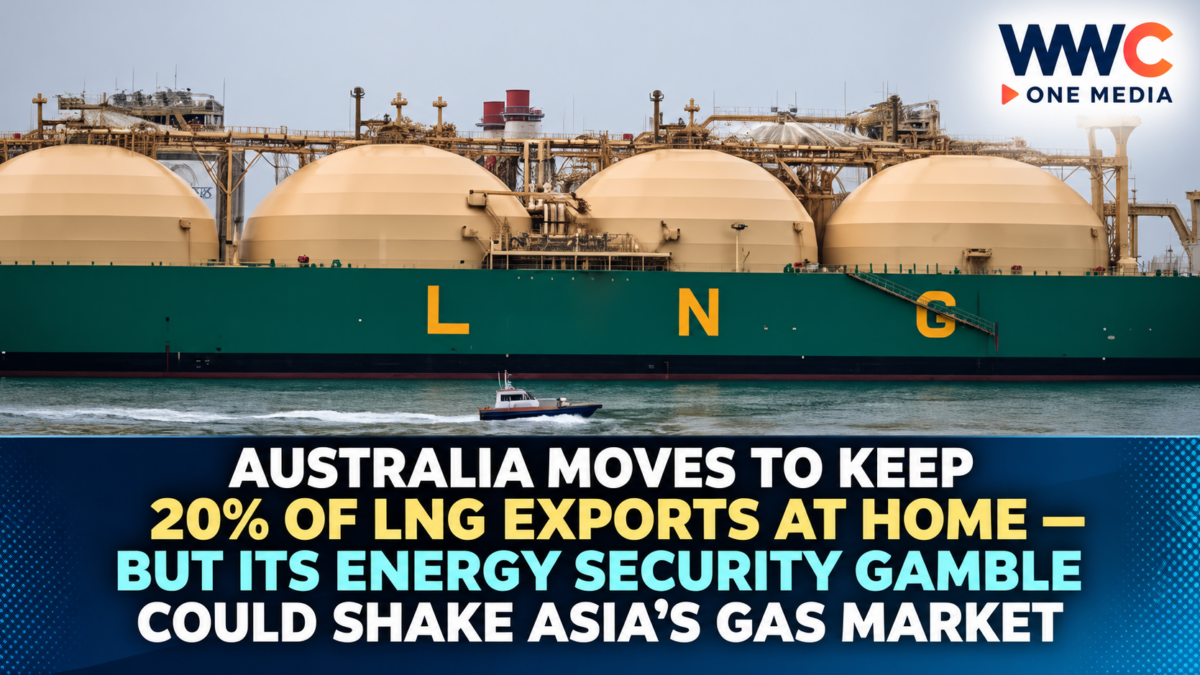
CANBERRA, AUSTRALIA — One of the world’s biggest liquefied natural gas (LNG) exporters is preparing for a major shift in energy policy, as the Australian government moves to finalize a controversial plan requiring gas producers to keep a portion of export-bound supplies available for domestic consumers.
The proposed Domestic Gas Reservation Scheme would require LNG exporters to supply Australian buyers with gas equivalent to as much as 20% of their export volumes, with the precise obligation adjusted according to domestic demand.
The initiative is intended to protect households, manufacturers and power producers from potential gas shortages and sharp price increases, even as Australia remains a critical energy supplier to Japan, China, South Korea and other Asian markets.
According to Bloomberg’s October 9 report, the government is preparing to unveil its final plan, following months of consultations and mounting opposition from parts of the energy industry.
Australia’s LNG Paradox: An Energy Giant Facing Shortages at Home
Australia is among the world’s leading LNG exporters, shipping substantial volumes of natural gas overseas while confronting concerns about future shortages in its own domestic market.
The country’s east coast has been particularly exposed because major export facilities in Queensland compete for supplies with local industrial customers, electricity generators and households.
An Australian government review found that approximately three-quarters of the nation’s gas production is exported, while existing regulatory measures are insufficient to guarantee long-term domestic supply and stable pricing.
That contradiction has become central to Prime Minister Anthony Albanese’s energy strategy: how can a resource-rich country remain a global gas powerhouse while ensuring its own businesses and consumers can afford the fuel?
Energy Minister Chris Bowen argues that reserving more gas for Australians would improve supply security and put downward pressure on domestic prices.
Up to 20% Reserved for Australia — But Not Every Producer Faces the Same Obligation
Under the revised framework announced in September, the government moved away from a rigid 20% reservation requirement toward a more flexible system.
The Australian Energy Regulator would determine the domestic supply obligation, using demand forecasts and a target of maintaining supply equivalent to approximately 110% of projected domestic requirements.
The plan includes several significant safeguards and obligations:
- Up to 20% domestic gas reservation: Exporters could be required to supply the domestic market with gas equivalent to a fifth of their export volumes.
- Annual adjustments: The regulator would be able to reduce the required percentage if domestic demand did not justify the maximum obligation.
- Protection for existing contracts: Export agreements signed before December 22, 2025, would generally be protected under the proposed transition arrangements.
- Actual domestic supply: Exporters would be expected to deliver gas into the Australian market, rather than merely offering it for sale.
The government estimated that the measures could unlock up to 200 petajoules of additional gas annually for domestic buyers, compared with potential shortfalls of up to 140 petajoules identified in energy market forecasts.
Under the September legislative proposal, export licensing arrangements were scheduled to begin January 1, 2027, with domestic supply obligations starting January 1, 2028. These remain proposed arrangements pending finalization.
Energy Companies Warn the Policy Could Backfire
Despite the government’s assurances, major industry participants are warning that forcing additional gas into the domestic market could discourage future exploration and production.
Companies associated with Australia’s export industry, including Santos, Shell and Origin Energy, face uncertainty over how reservation obligations will affect development spending, long-term contracts and project economics.
Reuters reported in September that producers welcomed greater flexibility in the revised framework but continued to question whether the rules would discourage investment.
More recently, Beach Energy and AGL Energy raised concerns about the proposed 10% domestic supply buffer.
Beach Energy argued that incremental investments in existing fields should qualify as new production under the rules, while AGL warned that excessive supply could distort both gas and electricity markets.
The central industry concern is that artificially low prices could make future gas projects less attractive, potentially undermining the very supply security the government wants to achieve.
Meanwhile, the Santos-backed Gladstone LNG venture has sought clarity about how existing contract extensions would be treated, including arrangements linked to South Korea’s Kogas.
Why Japan, China and South Korea Are Watching Closely
Australia’s LNG policy carries consequences beyond its borders.
Japan and South Korea depend heavily on imported energy, while China remains a major global gas buyer. Australian LNG has long been a key component of regional energy security.
The proposed domestic reservation rules do not automatically mean that Australia will immediately cut existing LNG shipments by 20%.
However, restrictions affecting future export volumes, renewed contracts or project economics could influence how Asian utilities negotiate long-term supply deals.
These concerns have become more significant amid geopolitical disruptions to global energy markets.
Reuters reported that LNG traffic through the Strait of Hormuz recovered in September but remained vulnerable to security threats associated with the Middle East conflict.
For Asian energy importers, uncertainty surrounding Australian supplies could reinforce the incentive to diversify purchases among suppliers in the United States, Qatar and other producing countries.
The Bigger Challenge: Cheaper Gas Today Versus Energy Security Tomorrow
The Albanese government faces a difficult economic balancing act.
Affordable gas supports Australian manufacturing, electricity generation and industries that cannot easily replace natural gas with renewable electricity.
But maintaining domestic supply also requires capital-intensive exploration, pipelines, processing infrastructure and production projects.
Too little intervention could expose households and businesses to future shortages and international price shocks.
Too much intervention, industry critics contend, could weaken returns on new gas investments and limit future production.
The debate also intersects with Australia’s broader transition toward renewable energy. Gas continues to play a role in providing flexible power generation and supporting industrial processes that cannot yet be readily electrified.
The final policy will therefore be judged not simply by how much gas is reserved for Australian buyers, but by whether it can deliver reliable supplies without weakening investment or Australia’s reputation as an LNG exporter.
What Happens Next?
Australia’s final reservation framework will be closely examined for its treatment of existing LNG contracts, exemptions, domestic supply targets, export approvals and regulatory enforcement.
Investors will also watch whether the government maintains its proposed January 2028 start date for domestic supply obligations.
For households and manufacturers, the principal question is whether additional gas supply translates into meaningful relief from energy costs.
For LNG producers, the focus is whether the new regime leaves sufficient commercial incentives to develop additional resources.
And for Australia’s Asian trading partners, the most consequential question may be whether the country can protect its domestic energy security without disrupting the long-term supply relationships that made it a global LNG leader.
Australia wants to keep more of its energy wealth at home. The real test will be whether doing so makes the entire regional gas market more secure — or creates a new source of uncertainty.