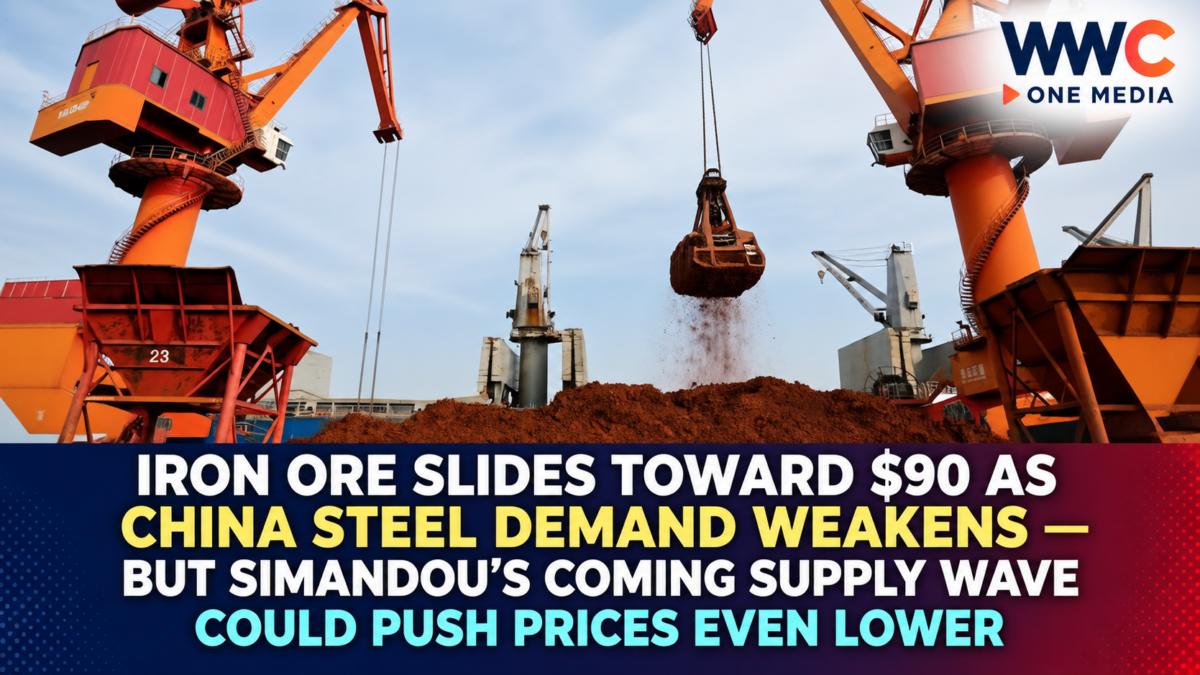
SINGAPORE/BEIJING — Iron ore is heading for another weekly decline as the commodity faces one of its toughest combinations in years: weak Chinese steel demand, collapsing mill profitability and a new wave of supply from some of the world’s biggest mining projects.
Prices extended losses after China returned from its week-long National Day holiday, with traders confronting mounting evidence that the world’s biggest steel industry simply does not need as much ore as producers are preparing to deliver.
On Thursday, the most-traded iron ore contract on China’s Dalian Commodity Exchange closed 3.1% lower at 682.5 yuan a metric ton, its weakest level since April 2025.
The benchmark November contract in Singapore traded around $91 a ton after touching $90.95 earlier in the week, its lowest since September 2024.
The pressure comes from both sides of the market.
Demand is weakening.
Supply is increasing.
And that is rarely a good combination for commodity prices.
China’s steel mills are barely making money
The most alarming number may not be the iron ore price itself.
It is the profitability of the companies buying it.
Only around 7% of Chinese steel mills were operating profitably by the end of September, according to Mysteel data cited by Reuters.
That means roughly 93% of surveyed mills were either losing money or operating around break-even.
When steelmakers are losing money, they do not rush to buy expensive raw materials.
They cut production.
Schedule maintenance.
Reduce inventories.
And bargain aggressively with suppliers.
That is exactly what appears to be happening.
Chinese mills are already slowing production
Some steelmakers have begun or are planning equipment maintenance because margins have deteriorated.
Average daily hot-metal output—a closely watched indicator of blast-furnace activity and therefore iron ore consumption—fell to around 2.34 million tons, a six-month low.
That directly affects iron ore demand.
Blast furnaces consume iron ore to produce pig iron.
If hot-metal output falls, raw-material purchases generally fall with it.
The weakness therefore reflects more than financial-market speculation.
There is a physical demand problem behind the futures decline.
Steel inventories also increased during the holiday
China’s National Day holiday made the situation worse.
Factories and construction activity slowed while steel inventories accumulated.
When trading resumed, major steel products immediately fell.
Rebar dropped.
Hot-rolled coil declined.
Stainless steel weakened.
That told commodity traders that downstream demand was not strong enough to absorb existing supply quickly.
If finished steel is difficult to sell profitably, steelmakers have very little incentive to buy additional iron ore.
China’s property crisis remains the biggest structural problem
Iron ore’s long-term demand story is still inseparable from Chinese real estate.
For decades, China’s property boom consumed enormous quantities of:
rebar;
structural steel;
machinery;
appliances;
and construction materials.
That turned China into the dominant buyer of seaborne iron ore.
But the property sector remains deeply damaged.
Housing sales are weak.
Developers are highly indebted.
New construction has fallen sharply from the peak.
And Beijing has deliberately resisted recreating the speculative property boom that powered previous cycles.
That removes one of the largest historical engines of steel demand.
Recent Chinese economic analysis continues to describe the property market as a central drag on investment, credit demand and household confidence.
Beijing is stimulating—but not with another giant housing boom
China is still supporting the economy.
Infrastructure spending continues.
Authorities are directing financing toward strategic industries.
Technology investment remains strong.
But this stimulus looks very different from the post-2008 model.
The government increasingly prefers:
advanced manufacturing;
AI;
semiconductors;
electric vehicles;
renewable energy;
and infrastructure
over speculative housing construction.
That matters for iron ore.
A semiconductor fab uses steel.
A solar factory uses steel.
An AI data center uses steel.
But none consumes steel at the scale of building millions of apartments, roads and entirely new urban districts simultaneously.
China is also deliberately cutting steel capacity
Beijing has another reason to restrain production.
China already makes more steel than any other country by an enormous margin.
Excess capacity has become politically sensitive both at home and abroad.
The U.S., EU, Japan and other major economies have increasingly complained that Chinese industrial overcapacity depresses global prices and damages foreign producers.
China rejects many of those accusations.
But its government has still pushed steelmakers to improve efficiency and reduce outdated capacity.
That means iron ore demand can face pressure even if overall manufacturing remains relatively strong.
Weak steel margins change the type of ore mills want
When steelmakers are highly profitable, they are often willing to pay premiums for high-grade iron ore.
Higher-quality ore can:
increase furnace productivity;
reduce coke consumption;
and lower emissions.
When margins collapse, mills become more price-sensitive.
They may choose cheaper lower-grade material instead.
That matters for miners because different grades of iron ore trade at different premiums and discounts.
The market is therefore not simply about how many tons China buys.
It is also about what quality those mills can afford.
Supply is becoming the bigger threat
Weak demand alone would already pressure prices.
But producers are simultaneously preparing to deliver more ore.
Brazilian exports remain strong.
Australian miners continue producing enormous volumes.
And one of the biggest new mining projects in generations has finally begun adding supply:
Simandou in Guinea.
That could fundamentally reshape the iron ore market.
Simandou is no longer a future story
For years, Simandou was one of mining’s great promises.
It contains one of the world’s largest undeveloped deposits of high-grade iron ore.
The problem was infrastructure.
The mines are located hundreds of kilometers inland in Guinea.
Developing them required:
massive railways;
bridges;
ports;
mines;
and billions of dollars of investment.
After years of delays, the ore is finally entering the global market.
Rio Tinto says the first shipment left Guinea in December 2025.
The project has now moved firmly from construction story to supply story.
Exports are ramping faster
Shipments from Guinea’s Morebaya port hit around 2.2 million tons in May, up sharply from approximately 1.3 million tons in April.
During the first three months of 2026, monthly exports had generally been around 600,000 tons or less.
That acceleration matters.
Each additional cargo competes with ore from:
Australia;
Brazil;
South Africa;
and other exporters.
And Simandou is still nowhere near full capacity.
SimFer shipped 2.2 million tons in the first half alone
Rio Tinto’s SimFer venture reported 2.2 million tons of iron ore shipments during the first half of 2026, including 1.6 million tons in the second quarter.
Mine and port construction were already more than three-quarters complete, while the railway had been fully commissioned.
Those volumes are relatively modest compared with the giant Pilbara operations today.
But they are only the beginning.
Simandou could eventually supply 120 million tons a year
At full development, the wider Simandou complex is expected to produce around 120 million metric tons annually.
That would be equivalent to roughly 8% to 9% of the global seaborne iron ore market, based on previous industry estimates.
That is enormous.
Commodity markets often move dramatically when supply changes by only a few percentage points.
Adding something approaching 120 million tons into a market where China’s steel demand is no longer expanding rapidly creates a major structural challenge.
Rio Tinto’s part alone is targeting 60 million tons annually
Rio says the SimFer mine is expected to ramp toward 60 million tons per year, with the ramp-up taking approximately 30 months once common rail and port infrastructure is fully commissioned.
The other half of the Simandou development is controlled by a Chinese-led consortium.
Together, the projects could eventually transform Guinea into one of the world’s most important iron ore exporters.
That gives China something it has wanted for years:
a major source of high-grade ore outside Australia and Brazil.
Simandou weakens Australia’s pricing power
China imports enormous volumes of iron ore from Australia.
That has created a strange geopolitical dependency.
Australia relies heavily on Chinese commodity demand.
China relies heavily on Australian iron ore.
Simandou gives Beijing another source.
That diversification has strategic value.
S&P Global has described the project as part of China’s long-running effort to improve resource security and reduce reliance on Australian and Brazilian supply.
That does not mean China will stop buying Australian ore.
The Pilbara remains one of the cheapest and most efficient mining regions in the world.
But alternative supply improves Beijing’s bargaining position.
China is already flexing its bargaining power
That shift may already be visible.
China Mineral Resources Group, or CMRG, is increasingly centralizing iron ore purchasing negotiations.
Reuters reported in August that CMRG instructed some steel mills to halt negotiations with Rio Tinto over certain September cargoes as part of a broader pricing dispute.
CMRG now negotiates for more than half of China’s annual iron ore imports, according to Wood Mackenzie estimates cited by Reuters.
That gives the buyer enormous leverage.
China is no longer merely the world’s largest customer.
It is trying to behave like one coordinated customer.
Fortescue is already feeling the pressure
Fortescue’s recent results offer another warning.
The Australian miner reported weaker sales for the September quarter as a pricing dispute with Chinese buyers affected volumes.
Sales fell to about 42.9 million tons, around 4 million tons below production.
The company’s realized iron ore price also declined to around $80 per dry metric ton, down from $84 in the previous quarter.
That gap between production and sales illustrates what oversupply can look like.
Mining ore is one thing.
Selling it profitably is another.
Falling prices threaten the miners’ enormous cash machines
Iron ore has historically generated extraordinary profits for:
BHP;
Rio Tinto;
Fortescue;
and Brazil’s Vale.
The economics are powerful because the biggest producers operate mines with very low unit costs.
When iron ore trades at $120 or $130 a ton, margins can be enormous.
Even around $90, major producers can remain profitable.
But the difference dramatically affects:
cash flow;
dividends;
government royalties;
and mining-company valuations.
Iron ore falling from $120 to $90 is not simply a 25% price move.
For high-margin miners, it can erase a much larger percentage of incremental profit.
Australia has a national interest in the price too
Iron ore is one of Australia’s most important exports.
Higher prices generate:
corporate profits;
tax revenue;
royalty payments;
foreign-exchange earnings;
and stronger government budgets.
Lower prices do the opposite.
That means weakness in Chinese steel demand can eventually affect Australian fiscal policy.
A prolonged iron ore bear market would matter well beyond mining-company shareholders.
Brazil has its own reason to keep producing
Vale is also expanding high-quality ore supply.
Brazilian production competes directly with Australia.
The company has advantages because some Brazilian ore has relatively high iron content, allowing steelmakers to reduce emissions and improve furnace efficiency.
That makes the coming competition especially intense.
Simandou is also high grade.
China could increasingly choose among:
Australian volume;
Brazilian quality;
and Guinean high-grade ore.
More options usually mean less pricing power for miners.
High-grade ore could still command a premium
This is one of the more important nuances.
Simandou does not simply add tons.
It adds high-quality tons.
Rio describes the resource as high-grade ore capable of helping lower the carbon intensity of steelmaking.
That matters as steel companies face increasing pressure to reduce carbon emissions.
Higher-grade ore can reduce the amount of coal required per ton of steel.
It can also support lower-emission steelmaking technologies.
So Simandou could take market share from lower-grade producers even if total iron ore demand stagnates.
That may put Fortescue under greater pressure than Rio or BHP
Fortescue historically produces more lower-grade material than some competitors.
Lower-grade ore typically sells at a discount.
When high-grade supply increases, the discount can widen.
That creates a potential double pressure:
the benchmark price falls;
and lower-quality ore trades at a larger discount to that benchmark.
Fortescue has been investing in higher-grade products and green-steel ambitions partly to address this structural challenge.
But the Simandou ramp-up makes the competitive environment tougher.
Freight costs are adding pressure too
Iron ore prices are also being affected by shipping economics.
Reuters reported that falling freight rates, partly linked to easing energy prices, have reduced the delivered cost of ore into China.
That may sound positive.
For suppliers, it can actually intensify competition.
If freight becomes cheaper, distant producers such as Brazil can compete more effectively with nearby Australian mines.
Guinea also becomes more competitive.
Lower shipping costs therefore increase the number of viable suppliers into China.
Again, that improves buyer leverage.
Iron ore imports are not actually collapsing
This is another important point.
China’s iron ore imports have remained extremely strong.
Reuters analysis showed imports in the first eight months of 2026 rose about 5% to a record 870 million tons.
That might appear inconsistent with falling prices.
It is not.
Commodity prices depend on balance at the margin.
China can import record volumes while prices fall if supply increases even faster than consumption.
Some imports can also move into inventories rather than immediate steel production.
The market is therefore increasingly focused on stocks sitting at ports.
Inventory becomes dangerous when demand is weak
When large quantities of ore accumulate at Chinese ports, buyers have less urgency.
Steel mills know material is readily available.
They can delay purchases.
Negotiate discounts.
And draw down inventories when needed.
That changes the psychology of the market.
A tight commodity market rewards sellers.
A heavily stocked market rewards buyers.
The recent price action increasingly suggests buyers are gaining the upper hand.
China’s steel exports have previously absorbed some excess output
Chinese steelmakers have partially offset weak domestic demand by exporting more finished steel.
That helped support iron ore consumption even while property construction weakened.
But this strategy creates another problem.
Foreign governments increasingly accuse China of flooding global markets with cheap steel.
Countries have responded with:
anti-dumping investigations;
tariffs;
import quotas;
and political pressure.
If Chinese steel exports eventually become harder to sustain, domestic steel production may need to fall further.
That would be another bearish development for iron ore.
Washington and its allies are now targeting excess capacity
This week, trade ministers from 15 market-oriented economies signed a U.S.-led statement criticizing structural industrial overcapacity.
China was clearly one of the main targets, although it was not a signatory.
The group warned that persistent overproduction could force countries to take defensive trade measures.
Steel is one of the industries most frequently at the center of that debate.
If additional barriers restrict Chinese steel exports, mills could lose an important outlet for production.
The $100 level has lost psychological importance
For years, traders often treated $100 a ton as a rough psychological threshold.
Iron ore could dip below it.
But rallies frequently brought the market back above.
In 2026, prices have spent increasingly long periods beneath that level.
The Singapore benchmark was already trading below $95 in August and recently dropped close to $90.
That suggests the market is adjusting to a lower equilibrium.
The question is how much lower.
Could iron ore fall below $80?
That is increasingly the bearish scenario.
If:
Chinese steel production weakens further;
property construction remains depressed;
Simandou ramps faster;
Australia and Brazil maintain exports;
and port inventories rise,
prices could face significant additional pressure.
But commodity markets rarely move in straight lines.
Supply disruptions can quickly reverse sentiment.
Cyclones in Australia.
Heavy rain in Brazil.
Infrastructure problems in Guinea.
Mine accidents.
Policy stimulus in China.
Any of those could produce short-term rallies.
China could still surprise with stronger stimulus
The biggest bullish risk remains Beijing.
If the Chinese government launches a much larger infrastructure or housing-support package, steel demand could recover.
China has previously used major fiscal stimulus to stabilize commodity demand during downturns.
But current policy signals suggest Beijing remains reluctant to recreate the leverage-heavy property model of earlier decades.
That means any stimulus may be more targeted.
Good for steel.
But perhaps not enough to recreate the supercycle.
India offers a longer-term demand story
There is another potential source of global steel growth:
India.
Its finished steel consumption rose 7.5% year on year in the first half of its 2027 fiscal year, according to provisional government data reported by industry media.
India is building:
cities;
railways;
roads;
factories;
power infrastructure;
and housing.
Over time, it could become a far more important iron ore demand center.
But India also possesses substantial domestic iron ore reserves.
And even rapid Indian growth would struggle to replace China’s extraordinary historical scale anytime soon.
China remains the market that matters most
That is why iron ore traders watch Chinese data obsessively.
Property starts.
Steel margins.
Blast-furnace utilization.
Port inventories.
Construction activity.
Infrastructure spending.
Manufacturing output.
All can move prices quickly.
China still dominates seaborne iron ore demand.
So long as that remains true, weak Chinese steel profitability will overshadow growth elsewhere.
The current selloff is more structural than speculative
This distinction matters.
Iron ore is not falling simply because traders suddenly turned bearish.
The physical fundamentals increasingly justify the decline.
Steel mills are losing money.
Production is slowing.
Inventories are comfortable.
New supply is arriving.
Major buyers are becoming more coordinated.
And China’s traditional property-driven steel model is weaker than it was.
That combination can persist much longer than a typical market correction.
This could mark the end of the old iron ore supercycle
The extraordinary iron ore boom of the past two decades was built on one central story:
China was urbanizing at unprecedented speed.
It required enormous quantities of steel.
Steel required enormous quantities of iron ore.
Australia and Brazil supplied it.
Prices and profits surged.
That model transformed mining companies and national economies.
But China is now older.
More urbanized.
More indebted.
And far less dependent on building new apartments to generate economic growth.
Meanwhile, supply capacity created during the boom continues operating.
And Simandou is adding more.
That is how supercycles end:
not necessarily because demand collapses,
but because supply finally catches up after demand stops accelerating.
The miners with the lowest costs will survive best
A lower-price environment does not mean the iron ore industry disappears.
It means competition intensifies.
The companies with:
the lowest costs;
highest-quality ore;
best logistics;
and strongest balance sheets
gain market share.
Higher-cost producers suffer first.
That is how commodity markets rebalance.
If prices remain around $90—or fall further—marginal mines may eventually close.
That would remove supply and stabilize prices.
But getting there can be painful.
Simandou could become the market’s biggest swing factor
The project is unusual because its ramp-up is happening precisely when demand is becoming uncertain.
If Simandou struggled with infrastructure delays, the global market would remain tighter.
If it reaches planned capacity quickly, the supply outlook changes dramatically.
That means traders will increasingly monitor Guinea alongside traditional mining regions in:
Western Australia;
Brazil;
and China.
A country that previously mattered little to the global iron ore benchmark could soon become one of its most important drivers.
For China, that is strategically useful
Beijing has spent years trying to reduce its dependence on a handful of giant miners.
It created CMRG.
It invested in Simandou.
Chinese state companies became deeply involved in the project.
And initial cargoes have been shipped directly to Chinese buyers.
If the project succeeds, China gains:
more supply;
more bargaining power;
greater geographic diversification;
and greater influence over the seaborne market.
That could permanently alter the relationship between Chinese steelmakers and Australian miners.
For producers, $90 may be only the beginning of the negotiation
At high iron ore prices, miners decide which customers receive material.
At low prices with abundant supply, customers decide which producers deserve premium pricing.
That shift appears to be underway.
CMRG’s disputes with Rio Tinto and Fortescue show that China is increasingly willing to test supplier pricing power.
Simandou will only strengthen that negotiating position.
The bigger story is not this week’s decline
Iron ore could rebound next week.
China could announce stimulus.
Shipping could tighten.
A mine could face disruption.
Short-term commodity moves are notoriously unpredictable.
The deeper story is structural.
For the first time in years, the global iron ore market is facing the realistic prospect that new supply could grow faster than China’s underlying steel demand for an extended period.
That changes the entire pricing equation.
China built the iron ore boom — now its slowdown may define the next era
For more than two decades, the world’s mining industry was reshaped around China.
Australian mines expanded.
Brazilian exports surged.
Global miners generated record cash flows.
Ports, railways and cities were built around Chinese demand.
Now the same country may be driving the opposite transition.
Property demand is weaker.
Steel margins are collapsing.
Mills are cutting production.
Buyers are negotiating harder.
And alternative supply is finally arriving.
Iron ore’s slide toward $90 is therefore more than another commodity-market correction.
It may be the market’s first serious adjustment to a new reality:
China no longer needs ever-rising quantities of steel at the same moment the world is preparing to send it more iron ore than ever.
And with Simandou still only beginning its ramp-up, the toughest supply shock may not have arrived yet.