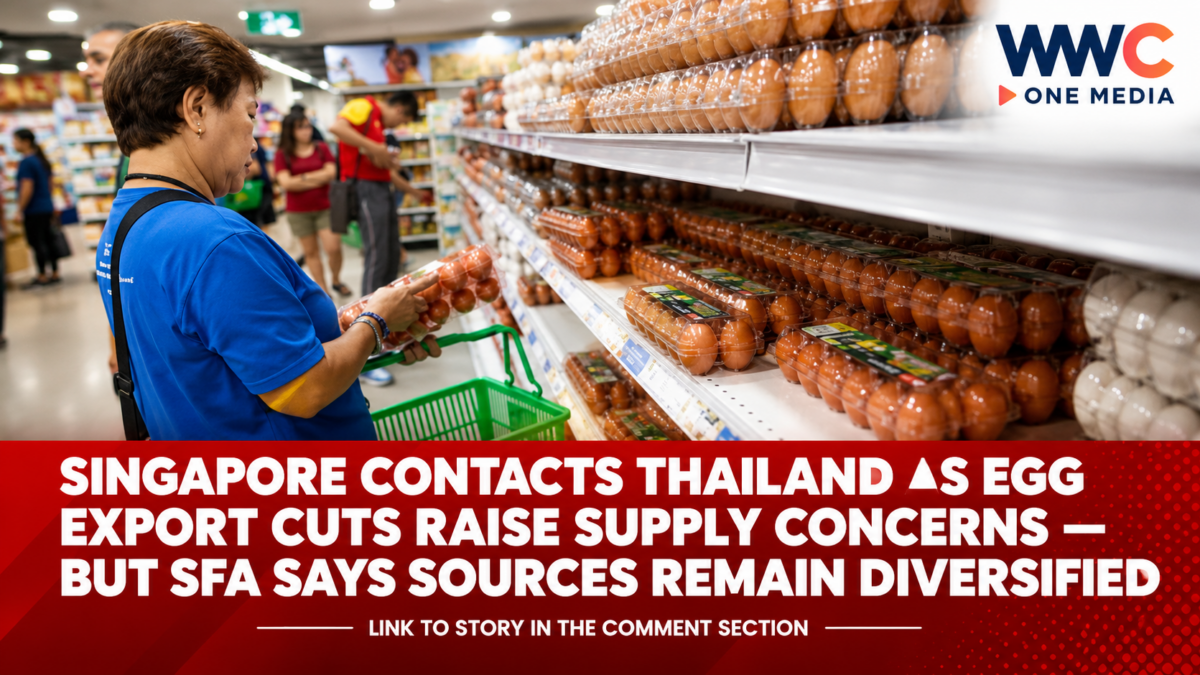
SINGAPORE — Singapore is closely monitoring the potential impact of Thailand’s decision to reduce egg exports after severe flooding disrupted production, with the Singapore Food Agency (SFA) contacting Thai authorities and local importers to assess the situation.
Thailand has asked egg exporters to reduce shipments by 30% to 50% until December 2026 as the country deals with supply disruptions following widespread flooding. About 3 million hens were reportedly killed at flood-hit farms in Chachoengsao province.
The development has drawn attention in Singapore because Thailand is an important egg supplier. However, SFA said Thai imports account for less than 15% of Singapore’s total egg supply, meaning the country is not dependent on Thailand alone.
SFA Engages Thai Authorities and Importers
SFA said it has contacted the relevant Thai authorities and is engaging Singapore’s local egg importers while monitoring developments.
The agency stressed that Singapore’s egg supply is well diversified, with imports coming from more than 10 countries, including Malaysia, Indonesia and Ukraine.
Local egg production also provides another source during periods of overseas disruption.
SFA said the industry is therefore able to obtain eggs from alternative sources if necessary, although it warned that global food supplies can face disruptions from time to time.
Thai Floods Hit Egg Production
Thailand’s export restrictions come after weeks of severe flooding that have affected dozens of provinces.
The flooding has damaged farms and transportation networks, with authorities reporting that around 3 million laying hens were killed in affected areas.
Thai officials are working to source eggs from areas that escaped the worst of the flooding. They are also seeking to extend the productive lifespan of laying hens from 80 weeks to 85 weeks to help maintain supplies.
Thailand exported eggs worth approximately 1.7 billion baht in 2025, with Singapore accounting for about 79% of those exports and Hong Kong receiving another 9%, according to Thai agriculture ministry data.
Singapore Retailers Monitoring the Situation
At least one major Singapore supermarket chain said it was not directly affected by the Thai export restrictions.
A Sheng Siong spokesperson told CNA that the company does not import eggs from Thailand and that its egg supply and prices remained stable at the time of the report. The retailer said it would continue monitoring its suppliers.
That suggests the immediate effect on Singapore consumers may vary depending on the source countries used by individual retailers and food businesses.
Singapore Relies on Multiple Egg Sources
The latest development highlights Singapore’s broader strategy of diversifying its food imports.
SFA’s rules require imported shell eggs to come from approved sources, with each consignment subject to animal-health and food-safety requirements.
Singapore has repeatedly emphasized diversification as a key part of maintaining food resilience because disruptions can arise from extreme weather, disease outbreaks, transportation problems and other unexpected events.
The agency has also urged the local food industry to diversify supply sources and consumers to remain flexible in their food choices when disruptions occur.
What Happens Next?
For now, Singapore is not reporting an egg shortage, and SFA says the country’s diversified supply network provides alternatives if Thai exports remain restricted.
But Thailand’s situation remains closely watched, particularly because the export cuts are expected to continue through December and further heavy rainfall was forecast for parts of Thailand in early October.
The immediate question is no longer whether Thailand can maintain its usual egg exports — but whether Singapore’s alternative suppliers can absorb any gap if the disruption lasts longer than expected.
WWC ONE MEDIA G,A