SINGAPORE — Singapore’s liquefied natural gas (LNG) infrastructure is drawing renewed attention as the city-state works to expand lower-carbon marine fuels and strengthen its position as a global bunkering hub.
The development is significant as shipping companies face growing pressure to reduce greenhouse gas emissions and comply with stricter environmental rules. Sustainability certification can help establish whether alternative fuels meet recognised standards and qualify for treatment under relevant regulations.
However, conventional LNG and lower-carbon fuels such as liquefied biomethane are not interchangeable. Their environmental benefits depend on how the fuel is produced, transported and accounted for across the supply chain.
Why EU sustainability certification matters
The International Sustainability and Carbon Certification system, known as ISCC EU, verifies that covered materials and fuels meet sustainability and greenhouse-gas requirements under the European Union’s renewable-energy framework.
For the maritime sector, certification and traceability can help shipping companies demonstrate compliance with regulations governing the use of renewable fuels and the accounting of emissions.
The Maritime and Port Authority of Singapore (MPA) has previously worked with international partners on sustainability certification for liquefied biomethane bunkering. A pilot under the Rotterdam-Singapore Green and Digital Shipping Corridor used a proof-of-sustainability certificate and a mass-balance approach to track certified fuel through the supply chain.
The mass-balance method allows certified and conventional materials to move through shared infrastructure while maintaining documented records of the sustainable portion. It does not mean that every molecule delivered to a vessel is physically distinguishable as renewable fuel.
Singapore expands its LNG infrastructure
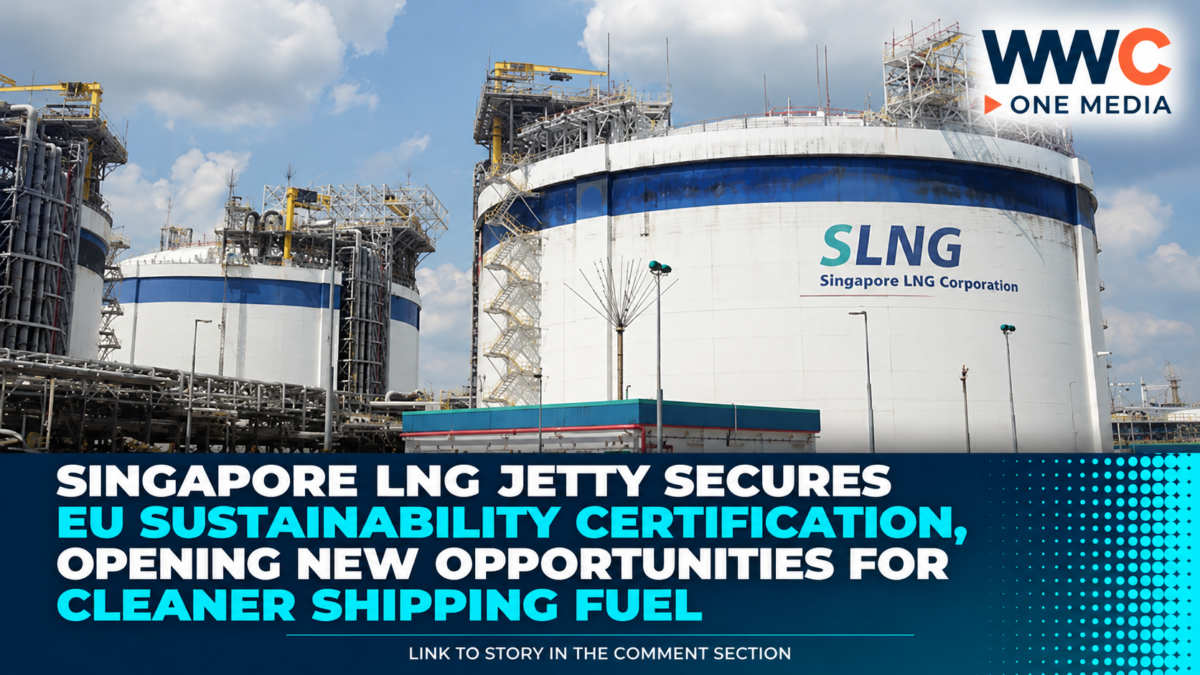
Singapore LNG Corporation operates the LNG terminal at the southern end of Jurong Island. The facility began commercial operations in May 2013 and currently has two jetties and four storage tanks. Its peak gas send-out capacity is around 11 million tonnes per annum.
The terminal plays an important role in Singapore’s energy security. Natural gas accounts for around 95 per cent of the country’s electricity generation, making reliable access to imported gas essential to the power sector.
Singapore LNG is also developing a third jetty to support small-scale LNG unloading and reloading. The facility is intended to create additional capacity for LNG bunkering, in which vessels receive fuel while in port. The engineering, procurement and construction contract was awarded to Rotary Engineering in April 2026.
The expansion comes as Singapore seeks to maintain its role as a major international shipping and energy hub while preparing for changes in marine-fuel demand.
The push towards lower-emission shipping
The shipping industry is exploring a range of alternative fuels, including liquefied biomethane, methanol, ammonia and hydrogen. Each has different requirements for production, storage, handling and vessel technology.
Liquefied biomethane can be produced from biogenic sources, such as organic waste, and may offer lower lifecycle emissions than fossil natural gas when production and supply-chain emissions are properly managed.
LNG, by contrast, is predominantly a fossil fuel. Although it can produce lower carbon dioxide emissions at combustion than some conventional marine fuels, methane leakage and methane slip from engines can reduce or undermine its climate benefits.
This distinction makes reliable certification and emissions accounting important. Shipowners and fuel suppliers need to demonstrate not only what fuel is supplied but also how its environmental characteristics are verified.
Singapore’s work with Rotterdam and other international partners reflects an effort to establish credible systems for documenting alternative marine fuels across ports and supply chains.
What it means for Singapore
For Singapore, expanding LNG facilities and supporting lower-carbon fuel pathways could help preserve its competitiveness as shipping companies adapt to changing regulations and fuel requirements.
Additional jetty capacity may improve operational flexibility by allowing more LNG unloading and reloading activity. It could also support the development of small-scale LNG bunkering services as demand evolves.
At the same time, certification alone does not guarantee that a fuel is zero-emission or that it will be commercially competitive. The wider transition depends on fuel availability, cost, infrastructure investment, reliable emissions data and the rules adopted by international regulators.
Singapore will therefore need to balance its immediate energy-security requirements with longer-term efforts to decarbonise shipping and the wider economy.
A step in a wider energy transition
The development highlights how port infrastructure, fuel certification and international cooperation are becoming increasingly connected as the maritime industry looks for ways to reduce emissions.
For Singapore, the challenge is not simply to handle more fuel, but to ensure that the fuels moving through its ports can meet the technical, environmental and commercial requirements of a changing global shipping sector.
Editorial note: The available sources confirm Singapore LNG’s jetty expansion and Singapore’s participation in certified liquefied-biomethane bunkering initiatives. They do not independently establish that the specific jetty referenced in the AsiaOne headline has received ISCC EU certification. That detail should be confirmed against the original report or the certification record before publication.