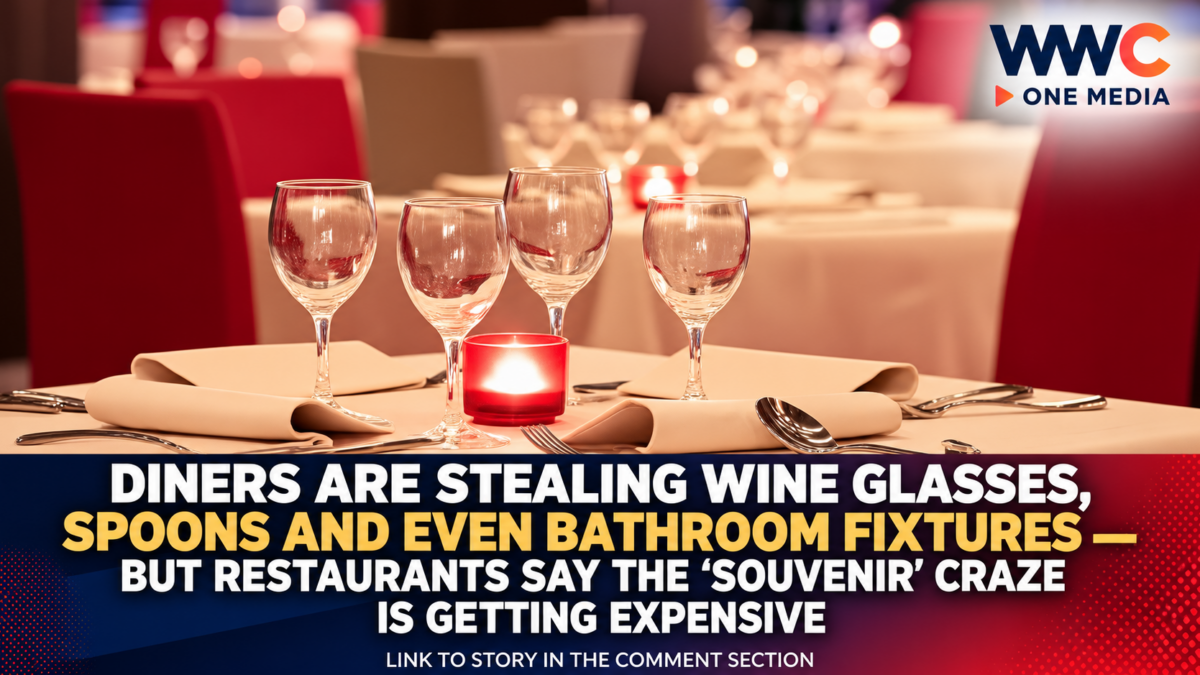
LONDON — The wine is finished, the bill has been paid and the table is being cleared. Then something strange happens.
A tiny spoon disappears into a handbag.
A cocktail glass slips into a coat pocket.
A chopstick holder somehow makes its way home.
And in more extreme cases, diners have allegedly walked out with candles, flowerpots, artwork—and even fittings removed from restaurant bathrooms.
What once looked like the occasional drunken souvenir has become common enough that restaurants across Britain, France, North America and parts of Asia are openly talking about the cost.
A recent survey by catering supplier Nisbets found that 27% of British adults admitted taking tableware from a restaurant, bar or pub.
Among 18- to 24-year-olds, the proportion reportedly rose to 34%.
Some respondents even claimed that nearly all of the crockery, glassware, cutlery and table linen they owned had come from hospitality venues rather than shops.
That makes the phenomenon difficult to dismiss as a few eccentric thieves.
For many restaurants, disappearing glasses and spoons have effectively become another operating expense.
And with restaurants already battling high wages, expensive food and razor-thin margins, the joke is becoming increasingly expensive.
A quarter of British adults admit taking something
The Nisbets findings are among the clearest indicators of how normalized the behavior has become.
The Guardian also cited the survey, noting that 27% of British adults acknowledged stealing something from a pub or restaurant.
That does not mean 27% are habitual thieves.
It means an extraordinary number of people appear willing to make an exception to their normal moral rules when the item is:
small;
attractive;
easy to conceal;
and sitting on a restaurant table.
A teaspoon may not feel psychologically equivalent to stealing a phone.
A branded glass may feel more like a souvenir than property.
Legally, however, the distinction is much simpler.
If the restaurant has not given it away, taking it is theft.
The most desirable objects are often the smallest
Restaurant operators repeatedly identify the same categories.
Wine glasses.
Shot glasses.
Espresso cups.
Tiny spoons.
Steak knives.
Chopstick holders.
Salt cellars.
Ramekins.
Miniature sauce dishes.
The pattern makes practical sense.
Small objects are easy to conceal.
Distinctive objects are more desirable.
And inexpensive-looking items create the impression that nobody will care.
In India, restaurateurs interviewed this year said dessert spoons, small bowls and condiment dishes vanish so frequently that some businesses deliberately order two or three times more small cutlery than they otherwise would need.
Theft therefore becomes part of inventory planning.
That is an unusual sentence for an industry already obsessed with food waste, labor efficiency and ingredient costs.
One British chef keeps replacing 28 spoons at a time
At Michelin-starred Wilsons in Bristol, chef Jan Ostle said his mother-of-pearl spoons have become a particular target.
He told the BBC that every few months he has to buy another 28 of them because they keep disappearing.
The objects are attractive.
They are unusual.
They are connected with a memorable dining experience.
That makes them perfect souvenirs.
It also makes them expensive to keep replacing.
For a large restaurant group, losing a spoon may be insignificant.
For an independent restaurant, repeated losses of specialty tableware can become material.
Independent restaurants feel it most
Monocle reported in 2025 that a catering-industry survey suggested roughly 17 million British adults had taken tableware from hospitality businesses.
The publication cited estimates that lost glassware alone had cost the industry about €220 million in 2023.
Those figures should be treated as industry estimates rather than audited national crime statistics.
But the underlying economic logic is clear.
An individual glass may cost £5.
A custom glass may cost £20.
A handmade spoon may cost far more.
Multiply that by hundreds of disappearances across thousands of restaurants and the numbers stop looking trivial.
And the businesses with the most interesting objects are often the independents with the least financial room to absorb losses.
Some Michelin restaurants have lost far more than spoons
French restaurant owners recently reported an extraordinary range of stolen objects.
According to British coverage of the trend, diners have allegedly taken:
designer knives;
candles;
flowerpots;
decorative items;
and bathroom fixtures.
At one restaurant near Lyon, a customer reportedly dismantled an entire toilet-roll holder.
The screws and wall plugs disappeared too.
Another restaurant said someone emptied a flowerpot into the bathroom and took the pot.
Another diner allegedly attempted to smuggle out a water jug underneath a shirt.
At that point, the idea that diners are simply confused about what constitutes a complimentary souvenir becomes much harder to defend.
Gordon Ramsay lost hundreds of lucky cats
Celebrity restaurants are not immune.
The Independent reported that Gordon Ramsay said 477 small maneki-neko figurines disappeared from Lucky Cat at 22 Bishopsgate during a single week.
The figurines reportedly cost £4.50 each.
That means the losses exceeded £2,000 in seven days.
One missing ornament can be funny.
Hundreds become inventory shrinkage.
And once a distinctive restaurant object becomes famous online, the theft can accelerate because taking one becomes part of the experience itself.
One stolen frog was almost priceless to its owner
Not every loss can simply be replaced.
In 2023, chef Michel Roux Jr reported that a handmade frog sculpture created from old pieces of cutlery disappeared from Le Gavroche.
It had reportedly been in the restaurant for around three decades.
The theft happened during a dinner honoring Roux’s late father, Albert.
Its financial value was estimated at close to £1,000.
Its sentimental value was obviously much greater.
That illustrates why restaurants become frustrated when customers dismiss these thefts as harmless.
The diner may see a funny object.
The restaurant may see history.
Social media has changed the psychology
Restaurant stealing existed long before TikTok.
But social platforms have added a new incentive.
People now show off their collections.
Fast Company documented viral videos in which users proudly displayed stolen restaurant bowls, cutlery, sauce dishes, glasses and even a cheese grater.
One video asking viewers to share the “best thing” they had ever taken from a restaurant generated responses from users admitting to collecting spoons and other small objects.
Instead of shame, the tone was often playful.
That matters psychologically.
If an online community treats stealing a spoon as funny rather than antisocial, the behavior becomes easier to rationalize.
It becomes a story.
A joke.
A challenge.
A souvenir hunt.
Social proof can normalize behavior quickly
People frequently judge behavior partly by what they believe everyone else is doing.
If nobody talks about stealing glasses, it feels taboo.
If hundreds of TikTok comments boast about it, the same act can start feeling normal.
The legal rule did not change.
The perceived social rule did.
That difference is important.
Restaurants are not merely confronting individual temptation.
They may now be confronting a culture in which theft itself becomes shareable content.
Dining inflation may also encourage an “I paid enough” mentality
Another possible explanation is the cost of eating out.
Restaurant prices have risen sharply in many countries.
That can create a subtle sense of entitlement.
A diner pays £150 for dinner and thinks:
surely the restaurant can afford to lose a £6 glass.
Hospitality commentators have long described an “I’ve paid for it” mentality as one factor behind restaurant theft.
Psychologically, the customer mentally folds the glass into the bill.
The problem is that the restaurant did not.
And restaurants themselves are dealing with many of the same inflation pressures.
They are paying more for:
food;
labor;
rent;
energy;
insurance;
and equipment.
Restaurants are already financially stretched
The James Beard Foundation’s 2026 independent restaurant survey described an industry still facing persistent cost pressure, unstable demand and operating unpredictability.
British hospitality operators report similar concerns.
A 2025 survey of 750 UK leisure and hospitality leaders found 87% cited rising food costs as a major near-term risk and 81% cited rising staff costs.
Against that backdrop, replacing stolen tableware is hardly the biggest line item.
But it is one of the most frustrating.
Unlike higher beef prices, it is avoidable.
Why does a spoon feel less wrong than shoplifting?
This may be the most interesting part of the phenomenon.
Many people who would never walk into a department store and steal a glass will take exactly the same glass from a restaurant.
The physical act is nearly identical.
The social setting changes the moral perception.
At a restaurant:
the object is already in your personal space;
you have already paid money;
staff may not notice;
alcohol may be involved;
and the item may seem connected to your experience.
Those factors reduce the psychological barrier.
The glass begins feeling less like inventory and more like part of the evening.
Alcohol almost certainly helps
Restaurants and bars also create an obvious ingredient that ordinary shops do not:
alcohol.
Alcohol lowers inhibition.
It can increase impulsivity.
It can encourage group bravado.
A sober customer may think:
that is a nice glass.
A group after several bottles of wine may think:
put it in your bag.
Hospitality observers have cited that combination of alcohol, opportunity and a sense of having already spent heavily as a common driver of restaurant theft.
Group behavior makes stealing easier
There is also safety in numbers.
A person dining alone may feel conspicuous slipping a glass into a bag.
At a table of eight, the act can become part of group entertainment.
Friends laugh.
Someone dares somebody else.
Nobody challenges it.
Responsibility diffuses across the group.
By the end of the night, the theft becomes a shared story rather than an individual act.
That helps explain why expensive hospitality environments can paradoxically encourage petty theft by customers who could easily afford to buy the item themselves.
It is usually not kleptomania
This distinction matters.
Kleptomania is a recognized mental-health disorder.
According to Mayo Clinic, people with kleptomania experience recurrent powerful urges to steal objects they generally do not need and may feel mounting tension before stealing followed by pleasure or relief afterward.
They typically are not stealing primarily for:
financial gain;
revenge;
a dare;
or practical use.
That is very different from someone deciding a restaurant glass would look good in their kitchen.
It would therefore be misleading to describe widespread tableware theft as a wave of kleptomania.
Most restaurant theft appears to be ordinary opportunistic behavior.
Wealth does not prevent it
One recurring feature of hospitality theft is that the people involved often could easily afford the objects.
Older psychological reporting on hotel and restaurant theft has repeatedly described well-off travelers stealing inexpensive souvenirs despite having no financial need to do so.
That suggests the economic value of the item is not always the attraction.
The attraction may be:
thrill;
memory;
status;
rebellion;
or the feeling of getting away with something.
A stolen spoon is different from a purchased spoon because it carries a story.
That story may be the real product.
The stolen object can become proof of an experience
Modern luxury consumption increasingly revolves around experiences.
People want proof that they visited a famous restaurant.
Normally that proof is a photograph.
A branded or highly recognizable physical object offers something more tangible.
It says:
I was there.
That gives restaurant tableware a souvenir function even though it was never intended to leave the premises.
In that sense, some diners treat restaurants like hotels where miniature shampoo bottles are legitimately complimentary.
The problem is that wine glasses are not shampoo bottles.
Design may actually make the problem worse
Restaurants spend heavily creating memorable interiors.
Custom ceramics.
Beautiful cutlery.
Distinctive glassware.
Artist-designed table objects.
Those details strengthen the brand.
They also create temptation.
The more Instagrammable the table setting becomes, the more desirable the objects may become.
Hospitality businesses therefore face a strange trade-off.
Distinctive objects can make a restaurant unforgettable.
They can also make it easier for guests to decide they need one at home.
Some restaurants deliberately lean into it
Not every operator sees stolen merchandise purely as a loss.
London restaurant Sexy Fish has reportedly marked some chopstick holders with the phrase:
“Stolen from Sexy Fish.”
The Ivy Asia has used a similar joke on decorative items.
The logic is clever.
If an item inevitably disappears, turn it into advertising.
The stolen object sits in someone’s home.
Friends notice it.
The restaurant name spreads.
In theory, the marketing value may outweigh replacement cost.
Quaglino’s famously treated theft as marketing
This idea is not new.
Designer Sebastian Conran said his father, restaurateur Terence Conran, deliberately expected diners to steal the famous Q-shaped ashtrays at Quaglino’s.
According to his account, roughly 20,000 disappeared over 10 years.
The objects effectively became unofficial promotional merchandise.
That strategy works only when:
the objects are inexpensive;
the restaurant anticipates the losses;
and brand exposure has value.
It does not work when someone steals an irreplaceable artwork.
Wahaca turned stolen spoons into a promotion
Mexican restaurant group Wahaca has taken a similarly playful approach.
Its colorful spoons became famous for disappearing.
The company once ran amnesties in which diners could return stolen spoons and receive free tacos.
That converted theft into:
marketing;
customer engagement;
and publicity.
It also acknowledged a truth many operators already know.
Simply telling people not to steal may not stop them.
Sometimes businesses decide it is easier to build the behavior into the brand.
But there is a dangerous incentive in making theft fashionable
The risk is obvious.
If restaurants joke too enthusiastically about stolen objects, customers may interpret that as permission.
An intentional £2 branded ashtray can be treated as marketing.
A £70 handmade plate cannot.
A customer does not necessarily know the difference.
That leaves operators trying to create a playful brand without encouraging people to treat the entire dining room like a souvenir shop.
One solution is simply selling the objects
Some restaurants have responded by making popular items available for purchase.
If customers constantly ask about a wine glass, spoon or ceramic bowl, selling it creates a legitimate outlet for the desire.
That can turn shrinkage into revenue.
Luxury hotels already do this with:
robes;
pillows;
candles;
mattresses;
and fragrances.
Restaurants could increasingly do the same with signature tableware.
The diner still gets the memory.
The business gets paid.
Price tags can also change perception
A subtle psychological trick is simply making value visible.
A spoon sitting on a table may feel disposable.
A sign saying:
“Handmade spoon — £32, available for purchase”
immediately makes ownership clearer.
It converts the object from background scenery into merchandise.
That may be enough to stop some opportunistic theft.
The diner can no longer easily tell themselves:
they probably do not care.
Cameras are not necessarily the answer
Restaurants could theoretically increase surveillance.
But hospitality depends on comfort.
Customers generally do not want to feel as if they are dining inside a high-security retail store.
Staff also have to make difficult judgments.
Do you confront a regular customer over a £5 glass after they just spent £300?
Do you search bags?
Do you risk a public argument?
The economics often discourage confrontation.
That itself makes stealing easier.
Restaurants know most thieves will not be prosecuted
Police resources are limited.
A missing spoon is not likely to generate a major investigation.
Customers understand this, consciously or not.
The expected penalty approaches zero.
That changes behavior.
Economically, theft becomes low-risk.
Socially, it is often treated as amusing.
Materially, the object is small.
Those three factors combine into an unusually permissive environment.
Yet restaurants themselves may pay the cumulative bill
Someone always absorbs the cost.
Initially, it is the operator.
Eventually, costs can flow into:
menu prices;
service charges;
lower staff budgets;
cheaper replacements;
or reduced investment.
One stolen glass does not raise a menu price.
Thousands of repeated losses across an industry contribute to the same cost pressure already pushing restaurant prices upward.
That means diners collectively can end up paying for other diners’ souvenirs.
This is why “harmless” is a misleading description
The word harmless depends on scale.
Take one £5 spoon from a multinational chain and the effect appears invisible.
Multiply the act millions of times and the economics change.
The same principle applies to:
hotel towels;
retail shrinkage;
supermarket theft;
and fare evasion.
Individual acts can appear trivial while collective losses become enormous.
Restaurant tableware theft sits at exactly that intersection.
The most viral objects may become the most vulnerable
Social media adds a final twist.
Once a particular restaurant object becomes recognizable online, stealing it can become a status marker.
That creates a feedback loop.
A restaurant introduces an unusual object.
Someone steals it.
They post it online.
Others recognize it.
More people want one.
More objects disappear.
The restaurant becomes more famous.
And its replacement bill rises.
Marketing success can therefore produce theft success.
The hospitality industry may increasingly design around theft
That could shape restaurant design itself.
Operators may begin asking questions designers rarely considered before:
Is this object too easy to steal?
Can we replace it cheaply?
Should it carry a logo?
Can customers buy it?
Should decorative pieces be fixed to the table?
Should premium cutlery only appear for certain courses?
Those decisions sound absurd until hundreds of items disappear.
Then they become standard operational questions.
But eliminating distinctive design would be a mistake
Restaurants sell atmosphere as much as food.
A generic glass protects against theft partly because nobody wants it.
But it also creates no memory.
The best restaurants want customers to notice the details.
So the answer is unlikely to be ugly, disposable tableware.
The better approach may be designing objects that are:
memorable;
replaceable;
and commercially available.
In other words:
if customers desperately want the spoon, sell them the spoon.
What makes this trend so fascinating is who is doing it
Restaurant theft does not fit the normal economic stereotype.
These are often people voluntarily paying for discretionary dining.
Some are eating in expensive restaurants.
They can afford dinner.
They can probably afford the glass.
Yet some still steal it.
That is why the phenomenon attracts so much attention.
It is not primarily about poverty.
It is about rationalization.
The diner changes the label from “theft” to “souvenir”
That may be the most powerful psychological mechanism.
Language changes moral weight.
“Stealing a wine glass” sounds wrong.
“Taking a little souvenir” sounds charming.
“Stealing a spoon” sounds petty.
“Remembering our anniversary dinner” sounds sentimental.
Nothing about the ownership has changed.
Only the story has.
And people are extremely good at telling themselves stories that make questionable behavior feel acceptable.
Restaurants are starting to tell a different story back
Some write jokes on objects.
Some sell the tableware.
Some offer amnesties.
Some confront customers.
Some simply order more spoons.
But almost every approach recognizes the same fact:
this behavior is no longer rare enough to ignore.
The restaurant industry has always dealt with broken glasses.
Now it increasingly has to budget for glasses that leave intact.
The trend may say something bigger about modern hospitality
Restaurants have spent years trying to become experiences rather than places simply to eat.
Every detail is designed to be memorable.
The lighting.
The ceramics.
The glassware.
The music.
The bathroom.
The chopstick rest.
The irony is that the strategy worked perhaps too well.
People no longer merely want to remember the restaurant.
Some want to take part of it home.
That may explain why diners who would never consider themselves thieves are walking out with wine glasses, spoons and tiny pieces of restaurant design.
The object itself may be worth very little.
But it carries something diners increasingly value:
a story.
And for restaurant owners already struggling with rising costs, the uncomfortable question is becoming harder to ignore:
when does a funny souvenir stop being part of the dining experience—and start becoming an expensive business problem?