SEOUL, SOUTH KOREA / MANILA, PHILIPPINES — November 11, 2026 | WWC ONE MEDIA | Asian Economy, Employment, Business and Global Markets
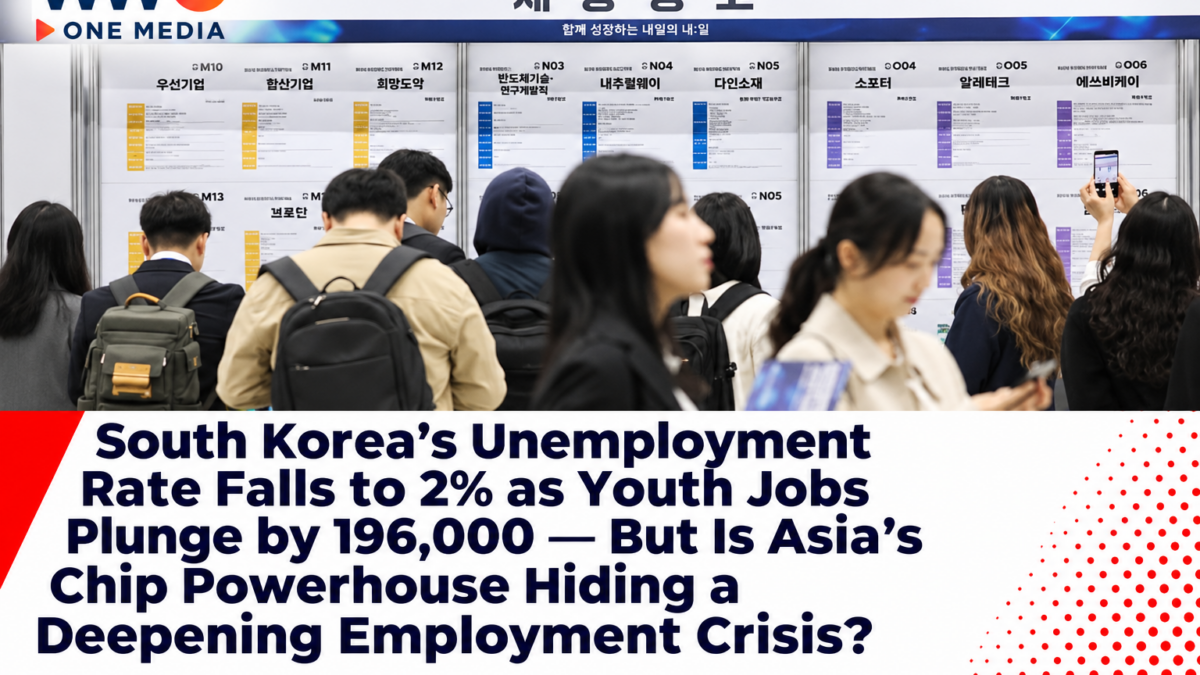
South Korea’s unemployment rate has fallen to an exceptionally low level, but beneath the encouraging headline numbers lies a troubling reality: young workers are losing jobs, major industries are cutting employment, and thousands of graduates are struggling to enter the workforce.
The country’s unadjusted unemployment rate dropped to 2.0% in October 2026, its lowest October reading since comparable records began in 1999, even as employment among young people declined by 196,000 from a year earlier.
According to figures released Wednesday by South Korea’s Ministry of Data and Statistics, the economy added 139,000 jobs compared with October 2025, bringing total employment to approximately 29.18 million.
The seasonally adjusted unemployment rate also improved, declining to 2.5% from 2.6% in September.
But the apparent strength of the labor market conceals a widening divide between generations and industries.
Employment among South Koreans aged 15 to 29 has declined for 48 consecutive months, while the youth employment rate has fallen for 30 straight months.
Meanwhile, the accommodation and restaurant industry lost 137,000 workers, construction shed 42,000 jobs, and manufacturing returned to contraction despite the country’s extraordinary semiconductor export boom.
The contrasting figures, highlighted in Bloomberg’s November 11 report and independently documented by Yonhap, KBS World and Korean financial publications, are raising questions about whether South Korea’s economic recovery is reaching ordinary workers.
South Korea may have one of the lowest unemployment rates in its recent history—but if young people cannot secure jobs and major industries continue shedding workers, how strong is the recovery?
South Korea’s Unemployment Rate Falls to 2% in October
The headline employment figures initially suggest a resilient economy.
The Ministry of Data and Statistics reported that South Korea had approximately 29.179 million employed people in October, an increase of 139,000 from the previous year.
The monthly employment gain exceeded 100,000 for a fourth consecutive month.
The number of unemployed people declined by 56,000 year over year to approximately 602,000.
The unadjusted unemployment rate fell by 0.2 percentage points to 2.0%.
That was the lowest October rate in the comparable series dating to 1999.
The employment rate for people aged 15 to 64 reached 70.4%, an increase of 0.3 percentage points from a year earlier and the highest recorded for an October.
However, the overall employment rate for people aged 15 and above slipped by 0.1 percentage point to 63.3%.
The contrast matters because employment indicators measure different aspects of the labor market.
A lower unemployment rate does not necessarily mean businesses are hiring aggressively.
It can also reflect changes in the number of people actively seeking employment.
For policymakers, understanding the underlying employment trends is essential before concluding that the labor market is improving across the entire economy.
The Biggest Warning: Youth Employment Falls for 48 Consecutive Months
The most troubling development concerns young workers.
Employment among South Koreans aged 15 to 29 fell by 196,000 compared with October 2025.
That marked the 48th consecutive month of year-over-year decline.
The youth employment rate dropped 1.7 percentage points to 42.9%.
It was the 30th consecutive month of decline and the weakest October reading since 2020.
According to Aju Press, employment among people in their 20s fell by approximately 203,000.
The decline was larger than the reported reduction in the population of that age group, suggesting that demographic changes alone do not explain the deterioration.
Among workers aged 20 to 24, the employment rate fell to approximately 40.0%.
The results highlight the difficulties many graduates and younger workers face when transitioning from education to stable employment.
In related reporting, WWC ONE MEDIA examined how South Korean university students are increasingly delaying graduation to avoid employment gaps and preserve access to campus career services.
That investigation found that applications for formal graduation-deferral programs across eight Seoul universities had risen 45.5% between 2022 and April 2026.
The trend illustrates a growing fear among students that obtaining a degree does not necessarily guarantee a timely transition into employment.
For South Korea’s younger generation, the challenge is no longer simply completing education.
It is finding a job that offers sufficient stability, compensation and career progression.
Why Low Unemployment Can Hide a Weak Job Market
South Korea’s latest figures illustrate an important distinction between unemployment and labor-force participation.
The official unemployment rate generally measures people without jobs who are actively seeking work and are available for employment under the relevant statistical definition.
People who are not looking for employment may fall outside that measure.
As a result, the unemployment rate can decline even when opportunities are becoming more difficult to find.
The latest figures show that the youth unemployment rate declined to approximately 5.2%.
But the youth labor-force participation rate also dropped by 1.9 percentage points to 45.2%.
That means fewer young people were participating in the labor market.
A broader youth labor-underutilization measure increased to 15.1%, according to Aju Press.
Meanwhile, the number of economically inactive people across the country rose by 179,000 year over year to approximately 16.29 million.
These figures do not mean every economically inactive individual is discouraged from seeking work.
The category includes students, retirees, caregivers and others outside the labor force for different reasons.
Nevertheless, reduced participation among young people can make a falling unemployment rate less reassuring.
The government therefore needs to examine actual employment, labor-force participation and job quality alongside the headline unemployment figure.
Manufacturing Jobs Decline Despite South Korea’s AI Chip Boom
Another major contradiction appears in manufacturing.
South Korea has enjoyed extraordinary export growth supported by demand for semiconductors and advanced memory technology.
Companies such as Samsung Electronics and SK Hynix are important suppliers to the global artificial intelligence industry.
Yet that strength has not translated into widespread manufacturing employment gains.
The sector lost approximately 7,000 jobs in October from a year earlier.
The decline reversed a modest increase of 16,000 jobs in September.
According to government statistics officials, weakness in textiles, automobiles and clothing contributed to the contraction.
The figures suggest that strong performance in certain high-technology industries is not enough to offset weakness elsewhere.
In related coverage, WWC ONE MEDIA examined South Korea’s record current-account surplus and surging semiconductor exports as global demand for AI computing accelerated.
The difference between export performance and employment growth is important.
Modern semiconductor production requires expensive equipment, specialized facilities and highly skilled workers.
Increasing manufacturing output does not necessarily require a proportional increase in employment.
Automation and productivity improvements can allow businesses to produce more with fewer additional employees.
At the same time, traditional manufacturing industries may face weaker demand, restructuring and competitive pressure.
South Korea’s chip boom can therefore strengthen national economic output without providing equally strong opportunities across the broader workforce.
Restaurants and Hotels Lose 137,000 Jobs in Their Worst Decline Since 2021
South Korea’s hospitality industry recorded one of the most severe employment declines in the latest report.
Accommodation and food services lost approximately 137,000 workers compared with October 2025.
According to Yonhap, it was the largest year-over-year decline since February 2021, when the sector shed 232,000 jobs during the pandemic.
The contraction matters because restaurants, cafes, hotels and other hospitality businesses often provide employment opportunities for younger workers.
Government officials said part of the decline reflected the comparison with employment supported by a consumption coupon program in the previous year.
But subdued activity in the sector also contributed.
When restaurants and accommodation providers face weaker demand or rising operating costs, they may reduce staffing, working hours or recruitment.
That can disproportionately affect people seeking entry-level or part-time positions.
For younger jobseekers, weakness in these industries can make it harder to obtain initial work experience.
The latest decline therefore reinforces concerns that employment opportunities are becoming increasingly concentrated in particular sectors.
Construction Loses 42,000 Jobs as Property Pressures Continue
South Korea’s construction industry also remained under pressure.
Employment in the sector declined by approximately 42,000 compared with the previous year.
Seoul Economic Daily reported that construction employment had contracted for 30 consecutive months.
Construction jobs are influenced by property development, financing conditions, government infrastructure investment and business confidence.
When developers delay projects or reduce construction activity, employment can weaken.
The prolonged decline suggests that pressures in the industry have not been fully resolved.
For workers, construction weakness can reduce opportunities in both skilled and less-specialized occupations.
For the broader economy, a sustained slowdown may affect suppliers of building materials, transportation services and other businesses linked to development.
However, the employment figures alone do not establish that South Korea is entering a nationwide property crash.
A more complete assessment requires construction investment, housing transactions, financing and project-approval data.
Healthcare Adds 249,000 Jobs as South Korea’s Population Ages
While several industries lost workers, healthcare and social welfare services recorded substantial gains.
Employment in the sector increased by approximately 249,000 compared with October 2025.
That was the largest reported positive contribution among major industries.
Transportation and storage added approximately 48,000 workers.
Business support services gained roughly 37,000.
The strength of healthcare and social services reflects, in part, South Korea’s demographic transformation.
The country has an aging population and faces growing demand for medical services, elder care and social support.
Older workers are also accounting for a substantial share of employment growth.
Aju Press reported that employment among people aged 65 and older increased by approximately 255,000.
By contrast, employment among people aged 15 to 64 declined by about 117,000.
These differences underline why total employment growth can conceal major changes in the composition of the workforce.
In another report, WWC ONE MEDIA examined South Korea’s population crisis as authorities expanded the list of officially designated population-declining areas to 92.
Declining birth rates, population aging and regional demographic imbalances create long-term challenges for the labor market.
They can increase demand for care workers while reducing the number of younger people entering employment.
For policymakers, the problem is not simply creating more jobs.
It is ensuring that employment opportunities match the needs and skills of the changing workforce.
More Older Workers Are Finding Jobs While Young People Struggle
The contrast between younger and older workers is becoming one of South Korea’s most significant labor-market challenges.
Employment among people aged 65 and older increased by roughly 255,000.
Among workers aged 30 to 39, employment rose by approximately 128,000.
But employment among those in their 40s declined by around 32,000.
The changing distribution reflects several trends.
Population aging is altering the number of people in different age groups.
Some older adults are remaining in employment longer.
At the same time, younger jobseekers face competition for entry-level roles and employers increasingly demanding relevant experience.
These patterns can produce a labor market in which total employment rises while certain generations experience persistent difficulty.
The issue also raises questions about job quality.
An increase in employment does not automatically mean all newly created positions offer similar wages, benefits or career prospects.
Long-term economic health depends partly on creating stable opportunities for workers across different ages and skill levels.
Why Korean Companies Are Becoming More Selective About Hiring
South Korean employers are increasingly emphasizing experienced workers rather than relying exclusively on traditional entry-level recruitment.
According to Aju Press, a senior statistics official identified growing corporate preferences for experienced hires and rolling recruitment as factors affecting younger jobseekers.
Under rolling recruitment systems, companies may hire for specific positions throughout the year rather than through large annual graduate recruitment programs.
That can create advantages for applicants with relevant experience.
But it may also make the transition from university to employment more difficult for recent graduates.
Some employers are seeking workers who can contribute immediately, particularly in technically specialized roles.
At the same time, broader adoption of automation and artificial intelligence is changing how businesses organize work.
The latest employment data do not prove that AI has directly caused the loss of 196,000 youth jobs.
However, changing technology requirements can influence recruitment decisions, skills demand and entry-level career pathways.
For South Korea, improving access to training and early-career work opportunities is likely to remain an important policy challenge.
South Korea’s Government Promises New Employment Measures
The government has acknowledged that strong exports have not produced equally strong employment gains across the economy.
First Vice Finance Minister Kwon Dae-young emphasized the importance of ensuring economic growth reaches households through jobs.
Authorities have identified vulnerable workers as a priority.
Government plans include employment-support programs, vocational training and initiatives intended to address gaps created by technological change.
A broader National Jobs Project is being developed to support younger workers, older employees and people facing difficulties returning to employment.
The government also plans to improve the implementation of employment-related projects before the end of 2026.
However, the effectiveness of these measures remains uncertain.
Public employment programs may provide temporary support.
Long-term improvements also depend on sustainable private-sector hiring, productivity, investment and demand.
The challenge will be creating opportunities that support stable income rather than simply increasing the number of people counted as employed.
South Korea’s Record AI Budget Could Create Future Opportunities
The administration of President Lee Jae Myung is also pursuing substantial investments in technology and industrial development.
The government has proposed a record 2027 budget of approximately ₩820.9 trillion.
The plan includes increased spending on artificial intelligence, semiconductor development and related infrastructure.
In related reporting, WWC ONE MEDIA examined South Korea’s proposed 2027 budget and its commitment to expanding AI and chip investment.
The government hopes that public investment can strengthen long-term economic competitiveness.
That could create opportunities for specialized engineers, technicians and other skilled workers.
However, spending on advanced technology does not guarantee broad employment growth.
The scale of job creation will depend on which projects are funded, the type of work required and how private businesses respond.
For young workers, the challenge will be acquiring skills that match the industries receiving investment.
Without effective training and recruitment pathways, technology-led growth could continue benefiting a relatively narrow segment of the workforce.
What South Korea’s Labor Market Means for Filipino Workers and Students
South Korea’s employment trends also matter to the Philippines.
Filipinos work and study in South Korea through different employment, educational and migration pathways.
Opportunities vary significantly depending on industry, qualifications, language requirements and visa rules.
A weakening Korean labor market could affect recruitment conditions in particular industries.
However, the October employment report does not establish that South Korea has suspended hiring foreign workers or canceled employment programs involving the Philippines.
Foreign-worker recruitment operates under separate rules and sector-specific requirements.
For Filipino students considering careers in Korea, competition for employment remains an important consideration.
The latest labor-market figures reinforce the importance of understanding local hiring practices, required qualifications and employment eligibility.
For investors, they also demonstrate that strong national export earnings do not necessarily translate into widespread consumer spending or employment growth.
Five Warning Signs South Korea Must Watch
1. Youth employment deterioration
The 48-month decline in youth employment suggests that younger workers face persistent structural challenges.
2. Weak manufacturing hiring
Strong semiconductor exports have not prevented employment losses in other manufacturing industries.
3. Hospitality and construction contractions
Job losses in labor-intensive sectors could continue affecting household income and opportunities for less-experienced workers.
4. Falling labor-force participation
A lower unemployment rate can conceal weaker employment opportunities when fewer people actively participate in the workforce.
5. Employment growth concentrated among older workers
Rising employment among older age groups may reflect demographic and economic changes that do not necessarily improve opportunities for younger generations.
These warning signs do not mean South Korea’s economy is collapsing.
They demonstrate why policymakers must look beyond the headline unemployment rate when evaluating labor-market conditions.
The Bottom Line: South Korea’s Jobless Rate Looks Strong, but Its Workers Tell a Different Story
South Korea’s October labor-market report presents two very different pictures.
The headline figures suggest economic resilience.
Unemployment fell to 2.0% on an unadjusted basis, employment increased by 139,000 from a year earlier, and the working-age employment rate reached a record high for October.
But several deeper indicators remain concerning.
Youth employment declined by 196,000, extending a four-year contraction.
The youth employment rate fell to 42.9%.
Hospitality, construction and manufacturing all lost jobs.
Meanwhile, much of the employment growth came from healthcare, social welfare and older workers.
The results show that South Korea’s export-led recovery has yet to generate broad improvements in employment opportunities.
For the government, the next challenge is translating strong industrial performance into sustainable jobs, especially for younger people entering the workforce.
For businesses, it means balancing investment in automation and advanced technology with the need to develop skilled employees.
And for Korean households, the most important measure of economic progress may not be the unemployment rate itself, but whether people can find secure and reasonably paid work.
South Korea has achieved one of its lowest recorded October unemployment rates while its semiconductor industry benefits from a global AI boom. But with young workers losing jobs for 48 consecutive months, is the country’s economic recovery truly creating opportunity—or concealing a generational employment crisis that could shape its future?