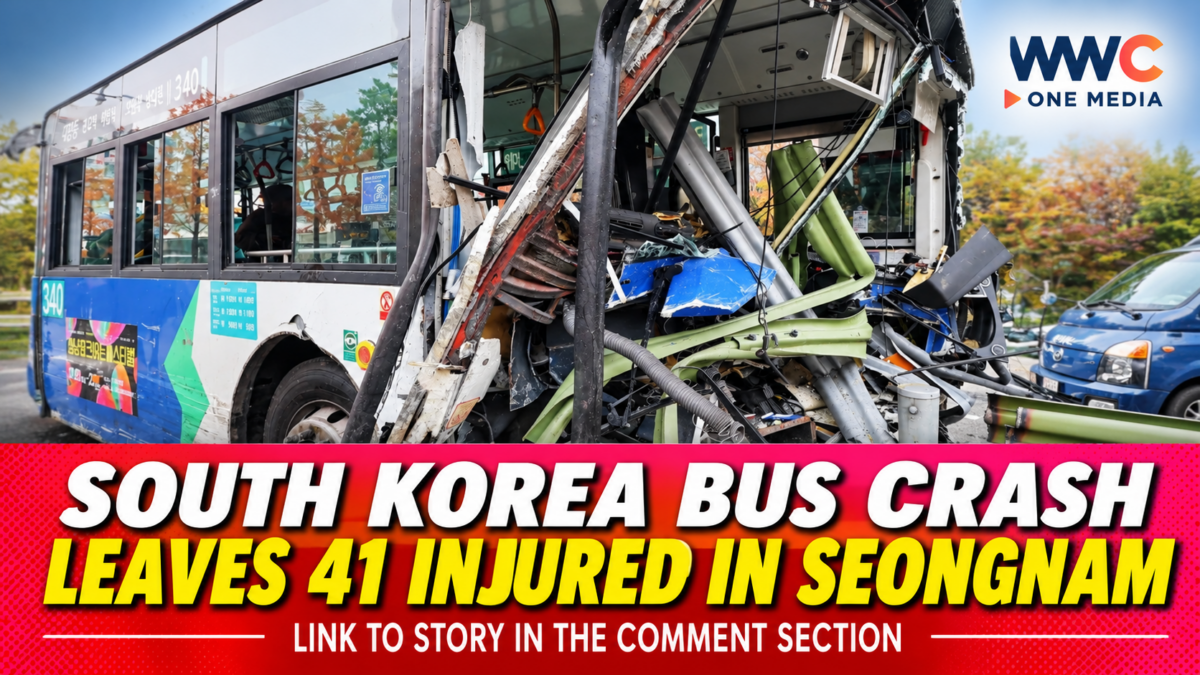
South Korea Bus Crash Leaves 57 Injured After 32 Vehicles Collide in Seongnam — Did Brake Failure Trigger the Morning-Rush Disaster?
SEONGNAM, South Korea — A morning commute turned into a major road emergency Wednesday after a city bus slammed into a line of vehicles waiting at a traffic light in Seongnam, south of Seoul, triggering a massive collision involving 32 vehicles and injuring at least 57 people.
The crash occurred at approximately 7:34 a.m. on November 11 in Yatap-dong, within Seongnam’s Bundang district.
According to South Korean emergency authorities, the bus struck multiple vehicles before crashing into a central median barrier, bringing its destructive path to an end.
The latest reports from the Associated Press and Reuters put the number of injured at 57, including nine people seriously hurt and 48 who sustained minor injuries. No life-threatening injuries had been reported in those accounts.
The bus driver was also injured and taken to hospital.
But one detail has become central to the investigation: the driver reportedly told police that the brakes had failed.
Authorities are now examining the vehicle, available recordings and surveillance footage to establish what caused the crash.
32 Vehicles Involved in Seongnam Morning-Rush Collision
The accident unfolded near a busy intersection in Yatap-dong as commuters were traveling through the area.
The bus struck vehicles stopped at a traffic signal, creating a chain-reaction collision that involved 32 vehicles in total.
According to Reuters, the vehicles included four buses, one cargo truck and 27 passenger cars. The bus involved in the initial impact was among the four buses.
The collision stretched approximately 100 to 150 meters along the road, according to local reporting.
Photographs from the scene showed the damaged commuter bus resting against the central barrier, with its front badly damaged and other vehicles left scattered along the roadway.
The scale of the collision required a substantial emergency response.
Firefighters, police officers and medical personnel were deployed to assist injured people, assess the wreckage and manage the resulting traffic disruption.
The accident temporarily disrupted traffic in both directions during the morning commute.
57 People Injured as Emergency Teams Respond
South Korean emergency authorities reported that 57 people were injured.
Nine sustained serious injuries, while 48 were classified as having minor injuries in the latest AP and Reuters accounts.
Although some early reports carried a lower total of 48 injured, subsequent reporting cited a higher figure of 57. The later count is used in this article to reflect the updated information available from AP and Reuters.
There were no reported deaths in the latest accounts reviewed.
The bus driver was among those injured and was hospitalized after being freed from the damaged vehicle.
Emergency responders established a medical station near the crash site to assess victims and coordinate treatment.
The number of people affected also reflects the fact that several buses were involved, potentially exposing multiple passengers to the impact.
Driver Says the Brakes Failed — But Police Have Not Confirmed the Cause
One of the most important questions surrounding the accident is whether a mechanical problem caused the bus to lose control.
According to the Associated Press, the driver told investigators that the brakes had failed.
A preliminary breathalyzer test reportedly detected no alcohol.
However, a driver’s statement alone cannot establish the cause of a collision.
Police are examining the circumstances surrounding the bus’s movement before impact, including the possibility of mechanical failure and other contributing factors.
Reuters reported that investigators plan to examine the vehicle’s black-box recordings and CCTV footage.
These sources could help establish the bus’s speed, movements, braking activity and the sequence of collisions.
Authorities have not announced a final determination of responsibility.
Investigators Examine Black-Box Recordings and CCTV Footage
The investigation is expected to focus on several important pieces of evidence.
Vehicle recording systems may provide information about the bus’s operation immediately before the collision.
Surveillance cameras could help reconstruct the accident and establish whether the bus attempted to slow down or change direction.
Investigators may also examine the braking system and other mechanical components.
Key questions include:
- Did the bus experience a sudden mechanical failure?
- Was there a problem with the braking system?
- How fast was the vehicle traveling before the first impact?
- Did the driver attempt to avoid the stationary vehicles?
- Were there warning signs before the collision?
- Could vehicle maintenance or another factor have contributed?
Until authorities complete their examination, brake failure should be treated as an allegation reported from the driver’s account rather than a confirmed explanation.
Morning Traffic Disrupted Across the Bundang District
The collision caused significant disruption in Seongnam’s Bundang district, an area south of Seoul with residential neighborhoods, commercial establishments and busy commuter roads.
Both directions of the affected road were temporarily blocked while emergency teams responded and damaged vehicles were removed.
The incident occurred during one of the busiest periods of the morning, increasing the impact on commuters traveling through the area.
Traffic restrictions were subsequently lifted after the wreckage was cleared, according to local reporting.
The accident also highlighted the potential consequences of a single major collision in a heavily used urban road network.
A crash involving multiple buses and passenger vehicles can quickly overwhelm emergency access routes and disrupt traffic well beyond the immediate accident location.
Why a Single Bus Accident Can Affect Dozens of Vehicles
Large public buses carry significant weight and can cause extensive damage when they collide with stationary vehicles.
When a bus strikes a line of vehicles waiting at a traffic signal, the initial impact can trigger a chain reaction.
Vehicles may be pushed forward into others, increasing the number of collisions and the risk of injuries.
The outcome depends on several factors, including vehicle speed, road conditions, the distance between vehicles and the effectiveness of safety systems.
The Seongnam accident demonstrates how quickly an ordinary commute can become a large-scale emergency.
However, investigators must still determine the precise sequence of events before conclusions can be drawn about what caused the collision.
South Korea’s Authorities Face Questions About Bus Safety
The crash is likely to renew attention on public transportation safety, vehicle inspections and mechanical reliability.
Buses are essential to daily transportation in South Korea, particularly in major metropolitan areas where large numbers of commuters depend on public transport.
A serious accident involving a city bus can affect passengers, other motorists and pedestrians.
If investigators establish that a mechanical defect contributed to the Seongnam crash, questions may arise about maintenance procedures, vehicle inspections and the responsibilities of the operator.
If another factor is identified, the investigation could instead highlight issues involving driver conduct, road conditions or other circumstances.
At this stage, none of these possibilities should be treated as an established finding.
The investigation must establish the facts before responsibility can be assigned.
Similar Bus Safety Concerns Have Also Emerged in Other Countries
The Seongnam collision comes amid wider attention to public transportation safety across Asia.
In the Philippines, a separate incident in Quezon province raised concerns after a passenger bus’s engine compartment cover reportedly opened while the vehicle was moving, striking and killing a 20-year-old college student.
The Philippine Land Transportation Office subsequently ordered the driver to surrender his license for a 90-day preventive suspension while investigating the circumstances.
That incident involved different facts and should not be confused with the South Korean collision.
However, both cases demonstrate why vehicle roadworthiness, mechanical inspections and proper maintenance are important to public safety.
In Singapore, another fatal accident involving a bus and a pedestrian also prompted a police investigation.
These separate incidents do not establish a common cause or a shared mechanical problem. They illustrate the importance of investigating each accident carefully and ensuring that public transport systems protect everyone using the road.
What Happens Next in the Seongnam Bus Crash Investigation?
Police will continue examining the driver’s account, the condition of the bus and available video and recording evidence.
The findings may help determine whether the accident resulted from a mechanical malfunction, driver-related factors or a combination of circumstances.
Investigators will also need to establish whether any safety or maintenance failures contributed to the collision.
For now, the most important confirmed details are:
- The accident happened at approximately 7:34 a.m. on November 11, 2026.
- It occurred in Yatap-dong, Bundang district, Seongnam.
- A total of 32 vehicles were involved.
- At least 57 people were injured in the latest AP and Reuters reporting.
- Nine people sustained serious injuries.
- The driver reportedly told police that the brakes had failed.
- A preliminary breathalyzer test detected no alcohol.
- Police are examining vehicle recordings and CCTV footage.
- No deaths were reported in the latest accounts reviewed.
The investigation remains ongoing, and the final cause has not been established.
The Bigger Question: Could This Disaster Have Been Prevented?
The Seongnam collision has left dozens of people injured and raised urgent questions about what happened during an ordinary Wednesday morning commute.
A bus reportedly struck 31 other vehicles before coming to a stop against a central median barrier.
The driver’s claim of brake failure has placed mechanical reliability at the center of the investigation, but authorities still need to establish whether the braking system actually malfunctioned.
The results of the investigation could have implications for vehicle maintenance, public transportation safety and the responsibilities of bus operators.
For the injured passengers and other road users, the immediate priority is recovery.
For investigators, the challenge is to reconstruct exactly what happened before the first impact.
If the bus really suffered a brake failure, what caused it — and could a mechanical inspection or earlier warning have prevented one of Seongnam’s most disruptive morning traffic accidents?