China and ASEAN Miss South China Sea Deal Deadline Despite 80% Progress — Could the Philippines Be Left Waiting as Maritime Tensions Grow?
MANILA, Philippines — A long-awaited agreement intended to prevent dangerous confrontations in the South China Sea has suffered another setback. China and Southeast Asian nations have made substantial progress in negotiations, but they will not meet their goal of completing a regional Code of Conduct by the end of 2026.
Three regional diplomats told The Associated Press that negotiators have provisionally agreed on approximately 80% of the proposed text. However, the remaining disagreements involve some of the most sensitive provisions, including the geographical area covered by the agreement, the meaning of key terms and whether the final document will be legally binding.
The delay is particularly significant for the Philippines, which has made completing the agreement a major diplomatic priority during its ASEAN chairmanship.
With confrontations involving Chinese and Philippine vessels continuing in disputed waters, the failure to meet the deadline raises a difficult question: Can regional governments agree on meaningful rules before another maritime incident escalates into a wider crisis?
80% Progress, but the Hardest South China Sea Issues Remain
The negotiations have been underway for years, with discussions formally beginning in 2005.
The proposed Code of Conduct, commonly called the COC, is intended to establish guidelines for how countries behave in the disputed South China Sea.
Its broader purpose is to reduce misunderstandings, encourage restraint and prevent encounters between military, coast guard and civilian vessels from escalating into dangerous confrontations.
The latest progress is substantial. However, agreement on approximately 80% of the text does not mean that the most difficult political and legal questions have been resolved.
According to diplomats cited by AP, disagreements remain over three major issues:
- Geographical scope: Which specific areas of the South China Sea should be covered by the agreement?
- Definitions: How should important and potentially sensitive terms be interpreted?
- Legal enforceability: Should the final code be legally binding, or will it remain a political commitment?
These questions matter because the agreement’s practical value will depend on what countries actually promise to do and whether those commitments can be enforced.
A document that encourages peaceful behavior but lacks clear obligations could have limited influence when tensions rise at sea.
Why the Philippines Wanted the Agreement Completed in 2026
The Philippines has been pushing to accelerate negotiations while serving as ASEAN chair in 2026.
Foreign Affairs Secretary Ma. Theresa Lazaro previously expressed confidence that China and ASEAN could complete the agreement by the end of the year.
During the July 2026 ASEAN Foreign Ministers’ Meeting in Manila, Lazaro highlighted the increased frequency of negotiations, with discussions taking place monthly since January.
She also identified self-restraint, geographical coverage, legal status and the relationship between the proposed code and existing international agreements as important negotiating issues.
The Philippine government has argued that a substantive agreement should be anchored in the 1982 United Nations Convention on the Law of the Sea, or UNCLOS.
Manila also wants the code to respect the rights of countries that are not directly involved in the negotiations.
The missed deadline therefore represents a diplomatic disappointment for the Philippines, although the progress reported by negotiators suggests that discussions have not collapsed.
The negotiations are expected to continue into 2027.
China and Malaysia Played Major Roles in the Negotiations
China and Malaysia jointly led at least 10 major negotiating rounds, according to the diplomats cited by AP.
Their involvement reflects the importance of cooperation between Beijing and ASEAN members in advancing the proposed agreement.
However, ASEAN is not a single claimant with identical interests.
The Philippines, Vietnam, Malaysia and Brunei have overlapping maritime claims or interests in the South China Sea. China also maintains extensive claims, while Taiwan has its own claims in the disputed region.
Indonesia is not generally considered a formal claimant to the Spratly Islands dispute, but it has maritime interests near the Natuna Islands that have brought it into friction with Chinese fishing and government vessels.
These differences make negotiations complicated.
Each government must consider its own territorial claims, economic interests, security concerns and relationship with China.
Reaching agreement on general principles is one thing. Agreeing on rules that could restrict a country’s future actions is considerably more difficult.
Why the South China Sea Dispute Matters Beyond Southeast Asia
The South China Sea is one of the world’s most strategically important maritime regions.
It carries substantial international shipping traffic and provides access to important fishing grounds, energy resources and commercial routes connecting major Asian economies with global markets.
A serious confrontation could affect more than the countries directly involved.
Disruptions to shipping, energy transportation and regional trade could have consequences for international businesses and consumers.
The dispute also involves several major powers, particularly the United States and China.
Washington has repeatedly emphasized its defense commitments to the Philippines under their mutual defense treaty, while Beijing has urged the United States to stay out of disputes between China and regional claimants.
That creates an additional diplomatic challenge: a maritime incident involving the Philippines and China could quickly attract international attention and increase pressure on regional governments.
The proposed COC is therefore important not simply because of territorial disagreements, but because of the risk that an incident at sea could become a much larger security crisis.
The 2016 Arbitration Ruling Remains Central to the Philippines’ Position
Another important part of the dispute is the landmark arbitration ruling issued on July 12, 2016.
The tribunal constituted under UNCLOS rejected China’s claimed historic rights to resources within the so-called nine-dash line insofar as those claims exceeded the maritime entitlements permitted under international law.
The ruling also clarified maritime entitlements and addressed the rights of the Philippines in its exclusive economic zone.
China rejected the ruling and continues to dispute its conclusions.
The proposed Code of Conduct is not intended to replace the 2016 ruling or settle every sovereignty dispute in the South China Sea.
Instead, its purpose is to establish practical rules for managing interactions and reducing the risk of confrontations.
This distinction is important.
Even if ASEAN and China eventually sign a COC, the agreement would not automatically determine who owns every disputed island, reef or maritime feature.
The legal disagreements would remain unless addressed through separate diplomatic or legal processes.
Why Analysts Question Whether the Code Will Be Strong Enough
The delay is not the only concern surrounding the negotiations.
Analysts have warned that even a completed agreement could be ineffective if its provisions are too vague or lack meaningful enforcement mechanisms.
A report by the South China Morning Post in October highlighted concerns that the proposed code could become a largely symbolic document if it fails to establish clear rules for preventing maritime confrontations.
The central issue is whether China and ASEAN can agree on provisions that go beyond general statements about cooperation and peaceful behavior.
For the Philippines, a weak agreement could create the appearance of diplomatic progress without adequately protecting its interests.
For China, accepting strict legal restrictions could limit its freedom of action in an area where it maintains extensive maritime claims.
The challenge is to produce an agreement that all participating governments can accept while still providing practical benefits.
Maritime Confrontations Continue While Negotiators Talk
The urgency of the negotiations is reinforced by continuing tensions between China and the Philippines.
The two countries have repeatedly exchanged accusations over encounters involving coast guard vessels, naval forces and Philippine resupply missions.
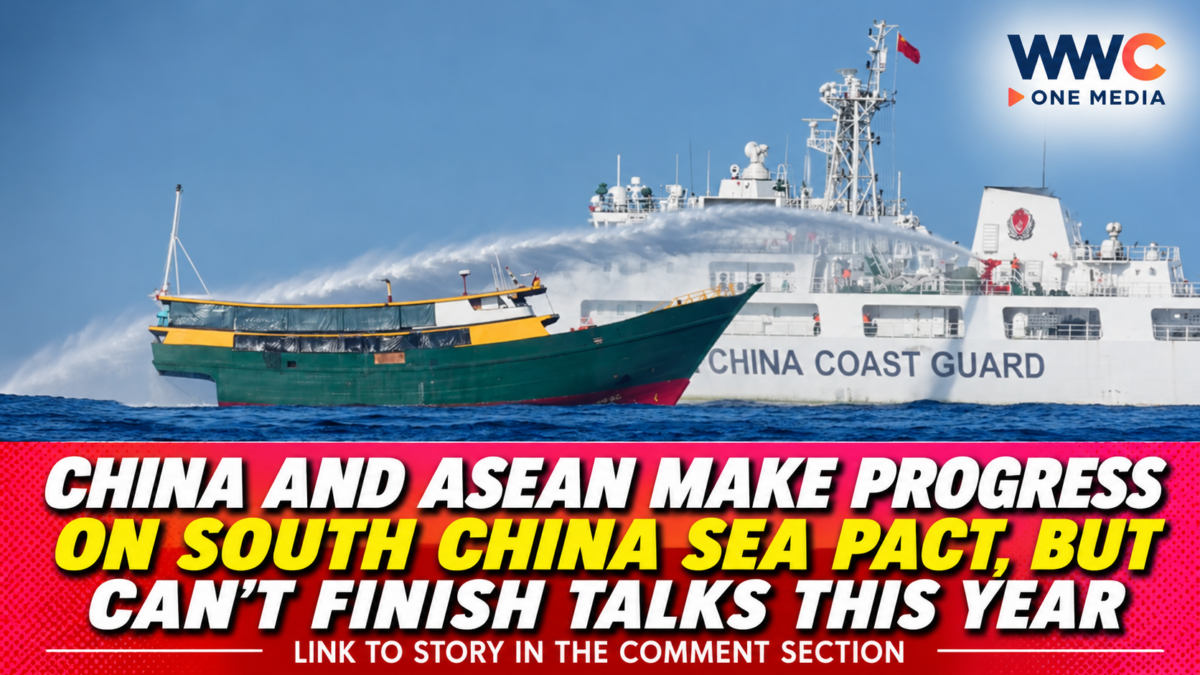
In September 2026, the Philippine Coast Guard accused Chinese vessels of obstructing a resupply operation to Filipino personnel stationed aboard the grounded BRP Sierra Madre at Second Thomas Shoal.
The Philippines described the reported maneuvers as dangerous, while China maintained that its vessels were carrying out monitoring and warning activities in waters it claims.
The confrontation illustrates why a clear regional framework could matter.
When vessels from countries with competing claims operate close to one another, unclear rules and conflicting interpretations can increase the possibility of accidents or escalation.
A meaningful COC could help establish expectations for communication, restraint and behavior during such encounters.
But until an agreement is completed and implemented, regional governments will continue relying on existing diplomatic channels, international law and their own maritime capabilities.
The Philippines Still Faces a Difficult Balance Between Diplomacy and Defense
The Philippines has two major priorities that must operate together.
First, it wants to preserve diplomatic engagement with China and other ASEAN members to prevent disputes from escalating.
Second, it must protect its maritime rights, fishing communities, economic interests and national security.
These objectives are not necessarily contradictory.
The Philippines can continue negotiating while strengthening maritime surveillance, improving defense capabilities and invoking international law when necessary.
In November, the Armed Forces of the Philippines reiterated that defending the country’s maritime rights does not mean seeking conflict with China.
That position reflects the difficult balance facing Manila: maintaining peaceful dialogue without giving up the rights it says are protected under international law.
For Filipino fisherfolk and communities dependent on the sea, the outcome has practical consequences.
The South China Sea is not merely a diplomatic issue discussed at international summits. It is connected to livelihoods, food security, maritime access and the country’s long-term economic interests.
What Happens Next at the ASEAN Summit in Manila?
The delayed agreement is expected to remain a major issue during the upcoming ASEAN summit in Manila.
Philippine President Ferdinand Marcos Jr. has repeatedly expressed support for completing the COC, while government officials continue emphasizing the importance of a substantive agreement.
The next phase of negotiations will need to address the remaining disagreements rather than simply increase the percentage of completed text.
The most important questions remain:
- Can China and ASEAN agree on the geographical scope of the code?
- Will the agreement include legally binding commitments?
- Can the document establish clear rules for preventing dangerous encounters?
- Will all participating governments accept provisions that protect the rights of other countries under international law?
The answers will determine whether the agreement becomes a practical tool for regional stability or another diplomatic document with limited influence over events at sea.
The Bigger Question: Can ASEAN and China Agree Before the Next Crisis?
The reported 80% progress demonstrates that negotiations have moved forward, but missing the 2026 deadline shows just how difficult the remaining issues are.
For the Philippines, the delay is a reminder that diplomatic progress does not automatically translate into stronger protection for its maritime interests.
For China and ASEAN, the challenge is to turn years of discussions into rules that can make a meaningful difference when ships encounter one another in contested waters.
The region cannot afford to treat the agreement as merely another diplomatic milestone.
The real test will not be how many paragraphs negotiators complete. It will be whether the final agreement can prevent the next confrontation from becoming a crisis.