BUDAPEST, HUNGARY / SEOUL, SOUTH KOREA / MANILA — November 11, 2026 | WWC ONE MEDIA | Global Business, Electric Vehicles, Battery Manufacturing and Environmental Regulation
South Korea’s biggest battery manufacturers are facing a growing regulatory challenge in Hungary as the European country’s new government intensifies inspections, raises environmental penalties and demands stronger workplace protections.
The crackdown is placing fresh pressure on companies including Samsung SDI and SK On, which have spent billions of dollars building production facilities to supply Europe’s electric-vehicle industry.
According to South Korea’s trade ministry, Korean battery companies have collectively invested more than $8 billion in Hungary.
But those investments are now facing tougher scrutiny following environmental violations, workplace-safety concerns and disputes over factory permits.
Hungary’s government has increased the maximum fine for serious permit breaches by large companies from 2 billion to 5 billion Hungarian forints.
SK On has already received two reported fines totaling 200 million forints, while regulatory controversies involving Samsung SDI and other battery-material suppliers have intensified.
The pressure has become serious enough for South Korea to intervene diplomatically.
On November 9, senior South Korean trade official Park Jeong-seong traveled to Hungary to discuss the treatment of Korean investors and implementation of environmental regulations.
Six Korean battery-sector companies subsequently signed a joint declaration promising stronger environmental protection, workplace safety and respect for employees.
The dispute reflects a fundamental question facing Europe’s green industrial transition.
Can Hungary continue attracting major electric-vehicle investments while enforcing tougher environmental standards—or could rising regulatory costs encourage battery companies to reconsider one of Europe’s most important manufacturing hubs?
Hungary Changes Course After Viktor Orbán’s Defeat
For years, Hungary actively courted foreign battery manufacturers.
Former Prime Minister Viktor Orbán promoted the country as a major European production center for electric vehicles and their components.
Government incentives, industrial infrastructure and Hungary’s position within the European Union helped attract manufacturers from South Korea and China.
According to Reuters, approximately €26 billion in foreign battery-sector investment had been attracted since 2021.
But the political landscape changed after Péter Magyar defeated Orbán in April 2026.
Magyar’s government promised stronger oversight of battery manufacturing, recycling and related industrial activities.
Environmental protection became a major political issue after residents raised concerns about pollution, industrial safety and the proximity of large factories to their communities.
The new government argues that economic development should not come at the expense of public health.
That shift is creating uncertainty for manufacturers that made long-term investments under the previous administration’s industrial strategy.
Samsung SDI Faces Renewed Attention Over Its Göd Factory
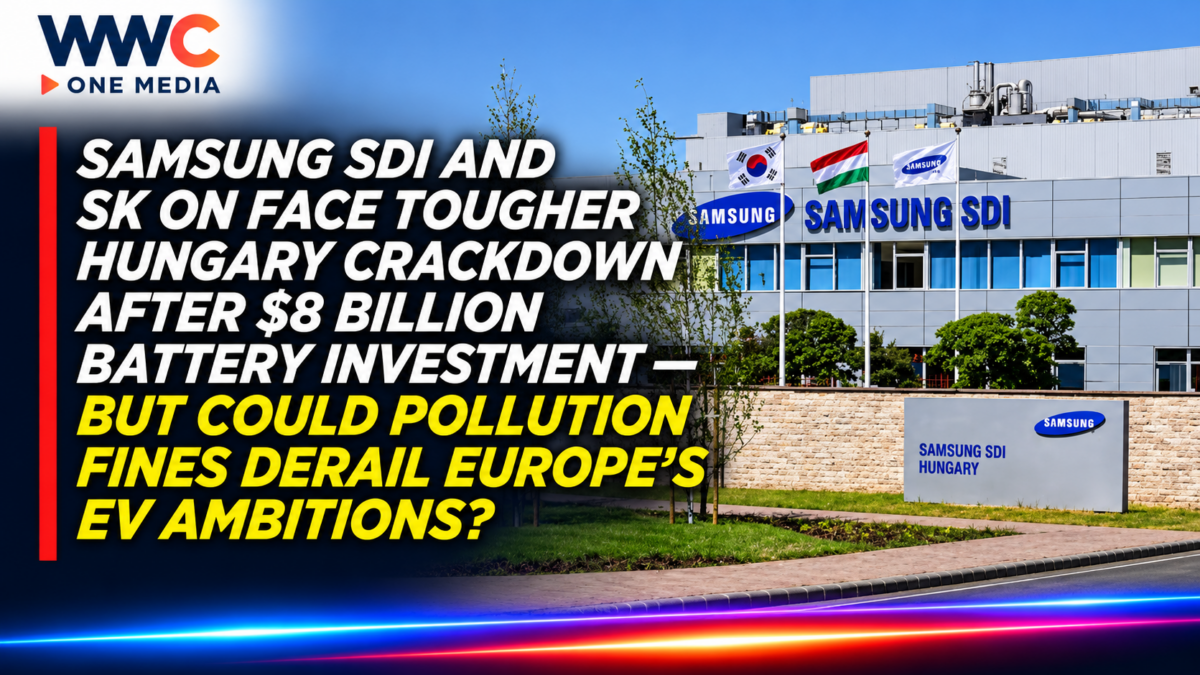
Samsung SDI operates a major electric-vehicle battery manufacturing facility in Göd, north of Budapest.
The plant has faced environmental controversies involving emissions, permitting and community concerns.
Reuters reported that the facility received repeated penalties between 2022 and 2023 for exceeding emissions limits.
In February 2026, Hungary’s highest court restored the validity of the plant’s environmental certification after an earlier ruling had canceled its permit.
That legal development is important.
It means the earlier cancellation should not be described as a permanent closure or a final prohibition on the plant’s operation.
Samsung SDI has disputed allegations concerning its compliance and maintained that the factory follows applicable environmental and safety requirements.
Nevertheless, Hungary’s tougher enforcement regime increases the financial consequences of future violations.
Prime Minister Magyar cited Samsung SDI’s Göd facility when explaining the government’s proposed penalty framework.
He said a minimum fine based on 0.5% of annual net revenue could result in a substantial penalty for a large manufacturer.
The government’s approach is intended to make environmental fines more meaningful for companies with multibillion-dollar operations.
SK On Receives Two Major Fines
SK On, another leading South Korean battery producer, has faced direct financial penalties.
According to Hungarian reporting and bne IntelliNews, its Iváncsa operation received a 100-million-forint workplace-safety fine in August.
Authorities identified deficiencies that reportedly placed 65 workers at direct risk.
A further 100-million-forint environmental fine followed in September, involving alleged violations of permit conditions and pollution affecting water-related infrastructure.
The combined fines amounted to approximately 200 million forints.
SK On was subsequently placed on a register of serious environmental offenders.
The designation makes the affected operation ineligible for certain Hungarian state support for two years.
These developments represent more than reputational pressure.
The loss of subsidy eligibility could affect the financial assumptions behind future investment decisions.
However, the fines and designation should not be interpreted as evidence that every SK On facility in Hungary has been permanently closed.
The precise operational restrictions depend on the individual regulatory orders.
Hungary Raises Pollution Penalties to 5 Billion Forints
The government has significantly increased the potential cost of noncompliance.
Under a decree reported in November, the maximum fine for qualifying large companies breaching environmental permit conditions was raised from 2 billion to 5 billion forints.
The government has also developed a stricter system for repeat offenders.
In September, Prime Minister Magyar outlined a three-strikes principle under which large companies committing three qualifying violations within five years could face a minimum penalty equivalent to 0.5% of annual net revenue.
The administration is also establishing a new national environmental supervisory authority, with operations planned to begin in January 2027.
The authority is expected to focus particularly on battery manufacturing, recycling and decommissioning.
For investors, the significance is clear.
Environmental compliance will become an increasingly important part of the cost of operating in Hungary.
But tougher penalties do not necessarily mean the government wants battery manufacturers to leave.
Hungarian officials continue emphasizing the importance of industrial investment while insisting that companies comply with environmental standards.
Dongwha Electrolyte Faces a Permit Setback
The regulatory campaign extends beyond the two biggest battery producers.
In October, Hungary’s environmental authority annulled an environmental permit for a facility operated by South Korean battery-material company Dongwha Electrolyte in Sóskút.
The decision followed challenges by local authorities and a civil association.
According to Hungary Today, the regulatory review raised concerns about the assessment of a proposed facility capable of producing approximately 23,500 metric tons of battery electrolyte annually.
The permit decision created additional uncertainty for the project.
However, the action did not automatically establish that the plant had been permanently shut down.
The company would need to satisfy applicable requirements through the relevant permitting process.
The case illustrates how environmental concerns can affect not only completed battery factories but also facilities supplying chemicals and other materials needed for battery production.
South Korea Sends Senior Trade Official to Budapest
The growing regulatory pressure prompted direct diplomatic engagement from Seoul.
On November 9, South Korean trade official Park Jeong-seong visited Hungary and met senior government representatives.
The discussions included Hungarian Deputy Prime Minister and Foreign Minister Anita Orbán and Economy and Energy Minister István Kapitány.
Park emphasized the economic importance of Korean investment and asked Hungary to provide a stable and predictable regulatory environment.
He also requested adequate preparation time for companies implementing European Union battery regulations.
According to The Korea Herald, Park said Korean companies such as Samsung SDI and SK On had invested more than $8 billion in Hungary.
The South Korean government stressed that its companies were committed to continuing investment while fulfilling their environmental and social obligations.
The message reflects Seoul’s attempt to balance two interests.
It wants to protect Korean companies from unpredictable business disruption.
But it must also recognize Hungary’s authority to enforce environmental and workplace laws.
Six South Korean Companies Sign Environmental Pledge
During the November 9 visit, six Korean battery-sector companies signed a joint environmental, social and governance declaration.
The participating companies were:
- Samsung SDI
- SK On
- EcoPro BM
- Dongwha Electrolyte
- W-SCOPE
- SungEel HiTech
The declaration commits the signatories to protecting air, water and soil, strengthening workplace safety and respecting the rights of employees.
It also includes commitments involving foreign workers and subcontractor personnel.
The initiative was coordinated with South Korean government and trade organizations, including KOTRA.
The agreement may help improve communication with Hungarian authorities and local communities.
But it is voluntary.
Signing an ESG declaration does not automatically erase previous regulatory violations, restore suspended permits or exempt companies from future inspections.
Its credibility will depend on measurable changes in factory operations and compliance.
Europe’s Battery Supply Chain Faces a Difficult Test
Hungary has become a significant production base for batteries used by European automakers.
Manufacturers established facilities there to supply electric vehicles assembled across the European Union.
Producing batteries closer to customers can reduce some transportation costs and help companies respond to regional demand.
But the economics of European battery manufacturing are changing.
Companies must consider energy costs, environmental regulations, labor expenses and competition from other battery-producing regions.
At the same time, the European electric-vehicle market remains sensitive to consumer demand and government incentives.
For Korean manufacturers, Hungary’s regulatory changes add another factor to investment planning.
However, higher environmental standards do not necessarily make the country uncompetitive.
Predictable rules, reliable enforcement and well-planned compliance investments may support the industry’s long-term stability.
Korean Battery Companies Are Still Investing in Global Supply Chains
South Korean companies remain important players in the global battery industry.
Their operations extend beyond Europe into lithium extraction, battery materials, cell manufacturing and related technologies.
In related reporting, WWC ONE MEDIA examined POSCO’s expansion of lithium processing in Argentina, including a second plant designed to strengthen the Korean group’s supply of battery materials.
POSCO’s Argentine project is separate from the Hungarian regulatory controversy.
Nevertheless, it demonstrates the international scale of Korea’s battery-sector investments.
Manufacturers are seeking reliable access to raw materials while establishing factories close to major automotive markets.
The challenge is maintaining competitive costs across these interconnected operations.
Environmental regulation is becoming an increasingly important part of that calculation.
Lithium Market Volatility Creates Additional Pressure
The battery industry is also confronting volatile raw-material prices.
Lithium carbonate prices in China have experienced sharp movements during 2026 amid changes in supply expectations and electric-vehicle demand.
In related coverage, WWC ONE MEDIA reported that Chinese lithium prices had lost more than half their value from a May peak, highlighting the uncertainty confronting miners and battery manufacturers.
Lower lithium prices can reduce material costs for some battery manufacturers.
But they can also disrupt investment decisions and financial planning.
For Korean companies operating in Hungary, raw-material volatility and environmental compliance represent separate challenges.
Both can influence profitability, but one does not automatically cause the other.
A manufacturer benefiting from cheaper lithium may still face substantial costs from factory upgrades or environmental penalties.
European EV Expansion Is Raising New Regulatory Questions
Battery manufacturers are not the only companies facing increased scrutiny in Europe’s electric-vehicle industry.
Automakers also face regulatory debates involving connected-vehicle cybersecurity, data protection and the treatment of overseas suppliers.
In related reporting, WWC ONE MEDIA examined European lawmakers’ request for an investigation into security concerns involving Chinese automaker BYD.
That investigation request is unrelated to the Hungarian pollution cases.
But it illustrates the expanding range of regulatory considerations affecting European EV supply chains.
The industry’s growth increasingly depends on more than manufacturing capacity.
Companies must also satisfy environmental, labor, safety and technology-related requirements.
Those obligations can create additional costs but may help maintain public confidence.
Worker Safety Has Become a Central Concern
The scrutiny of Hungarian battery factories has also highlighted workplace safety.
Battery production involves industrial machinery, chemical processing and materials that require careful handling.
Regulators must ensure that workers receive appropriate training, protective equipment and safe working conditions.
Failures can create risks for employees and subcontractors.
In a separate South Korean case, WWC ONE MEDIA examined a government audit into a major data-center battery fire that uncovered serious subcontracting and safety-procedure failures.
That incident involved battery replacement work at a government data center, not battery manufacturing in Hungary.
The cases should not be conflated.
Nevertheless, both demonstrate why proper oversight of battery-related operations is essential.
Safety systems are only effective when workers, contractors and management follow the required procedures.
Environmental Rules Could Reshape Investment Decisions
Major battery factories are expensive to build.
Companies typically make investment decisions based on expected demand, operating costs, government incentives and long-term policy conditions.
A sudden increase in compliance costs may require firms to revise their financial projections.
Permit suspensions can also delay production and affect customer delivery schedules.
But regulatory uncertainty does not necessarily lead to investment withdrawal.
Existing facilities represent substantial capital commitments.
Relocating production would require new permits, construction, equipment and supplier arrangements.
For many manufacturers, adapting to stricter rules may be more practical than abandoning established operations.
South Korea’s latest diplomatic engagement suggests that companies and officials are seeking ways to continue operating while addressing Hungary’s concerns.
The outcome will depend on how the rules are implemented and whether firms can demonstrate consistent compliance.
Why the Philippines Should Pay Attention
The controversy offers lessons for Southeast Asian countries seeking foreign investment in advanced manufacturing.
Battery factories and other large industrial facilities can create jobs, support exports and strengthen technological capabilities.
But they also require effective environmental monitoring and workplace-safety enforcement.
A government focused exclusively on investment announcements may overlook risks that emerge after factories begin operating.
At the same time, unpredictable regulations can discourage businesses from committing capital.
The ideal framework combines transparent rules, independent inspections and proportionate enforcement.
Battery technology is also expanding into Philippine energy-storage applications.
In related coverage, WWC ONE MEDIA examined TCL’s entry into the Philippine residential solar-plus-storage market and the importance of proper battery installation and protection systems.
Residential energy storage differs from industrial battery-cell production.
Still, both involve technologies that require credible quality and safety standards.
The broader principle is that clean-energy investment must be supported by effective oversight throughout its life cycle.
Five Questions That Could Determine the Future of Hungary’s Battery Industry
1. Can Samsung SDI and SK On meet stricter environmental requirements?
Continued operations will depend partly on compliance with applicable permits and safety rules.
2. Will the new environmental authority enforce the rules consistently?
The planned January 2027 launch will be an important test of Hungary’s regulatory reforms.
3. Can South Korean diplomatic engagement reduce uncertainty?
Seoul is seeking predictable implementation while acknowledging the importance of environmental protection.
4. Will tougher rules delay future investment?
Companies may reassess expansion costs and timelines, although widespread investment cancellations have not been established.
5. Can local communities regain confidence?
Transparent monitoring, reliable data and meaningful enforcement will be essential.
The Bottom Line: Hungary’s Battery Boom Is Entering a New Era
Hungary’s growing scrutiny of South Korean battery manufacturers represents a significant change in European industrial policy.
Under Viktor Orbán, the country aggressively promoted battery production as a source of foreign investment and economic development.
Under Prime Minister Péter Magyar, environmental compliance and worker safety have become more prominent priorities.
Samsung SDI, SK On and other Korean manufacturers now face stronger oversight.
Some companies have received fines or encountered permit disputes.
South Korea has responded by dispatching a senior trade official to Budapest and coordinating a voluntary ESG declaration involving six battery-sector businesses.
The outcome could influence future investment decisions across Europe’s electric-vehicle supply chain.
But the central issue is not whether Hungary should choose investment or environmental protection.
It is whether the government and industry can establish conditions that allow both to coexist.
South Korean battery companies have invested more than $8 billion in Hungary, helping transform the country into a major European EV manufacturing hub. But after fines, permit disputes and a tougher environmental crackdown, can Samsung SDI, SK On and their suppliers prove that industrial expansion can coexist with public safety—or could the next wave of European battery investment move elsewhere?