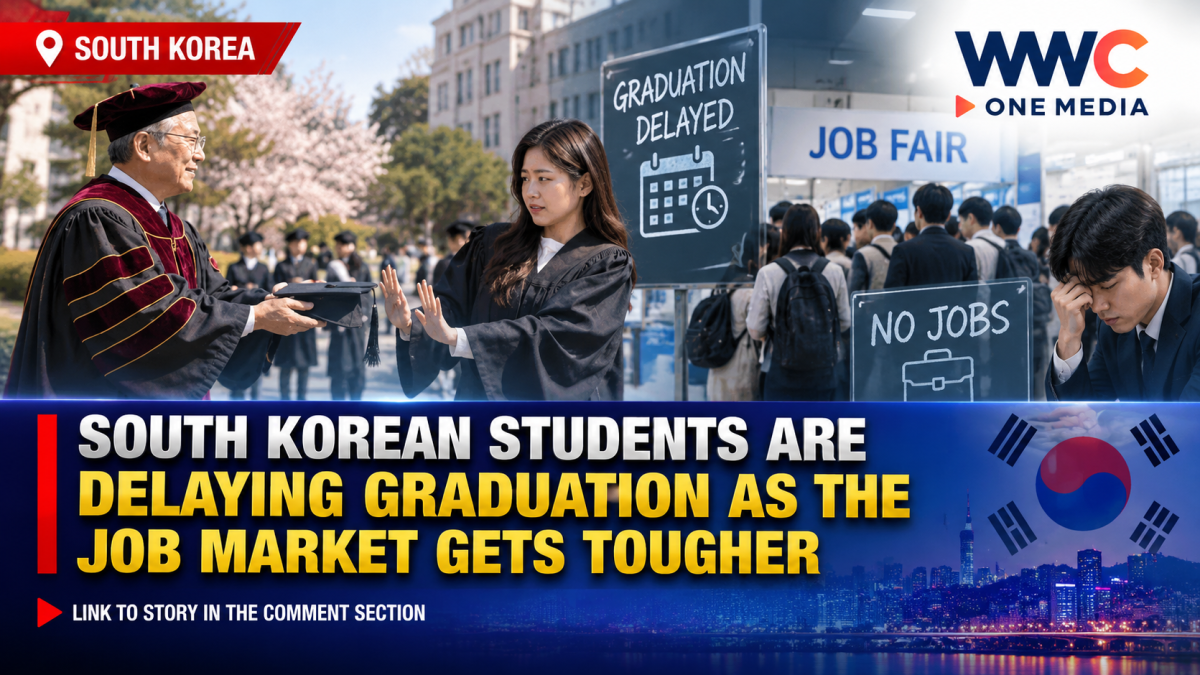
For a growing number of South Korean university students, getting a diploma is no longer the final step toward a career—it can feel like a deadline they are trying to avoid.
More students are postponing graduation while they search for jobs, hoping to avoid employment gaps on their résumés and preserve access to university facilities, career programs and other student benefits.
According to data reviewed by Hankook Ilbo, applications for formal graduation-deferral programs at eight four-year universities in Seoul jumped 45.5%, from 4,825 in 2022 to 7,020 by April 2026. The universities include Konkuk, Dongguk, Sogang, Yonsei, Chung-Ang, Hanyang, Hongik and Ewha Womans universities.
Why Are Students Staying in University Longer?
One major factor is concern over how employers may view the period between graduation and a first job.
Some students fear that spending months or years searching for work after receiving their degrees could create a résumé gap, making an already difficult transition into the labor market even harder.
Remaining officially enrolled can also provide practical advantages. Students may retain access to libraries, study spaces, career information, internships, employment programs and other university resources while continuing their job search.
The trend reflects the pressure surrounding the first job in South Korea, where students often see their initial employment as an important factor in their longer-term career and earnings prospects.
Universities Are Adapting to the Trend
The growing demand has also prompted universities to establish or expand formal graduation-deferral systems.
Kyung Hee University introduced such a program this year, while Korea University and Soongsil University introduced similar programs in 2025. Soongsil University said its one-year deferral period was designed to provide students with support comparable to that available to enrolled students while limiting the financial burden on the university.
Seoul National University does not operate a formal graduation-deferral program. However, 624 undergraduate students remained beyond their regular period of study to take only one to three credits during the spring semester, equivalent to about 15.8% of the university’s incoming freshman class and the highest level in five years.
A Sign of a Changing Student-to-Work Transition
The increase in delayed graduation highlights how the traditional path from university to employment is changing.
For some students, graduating quickly represents progress. For others, maintaining student status can provide additional time and resources to find a job they consider suitable while avoiding a potentially difficult period on their résumé.
The trend also places universities in a new position: they are increasingly being used not only as places of education, but also as employment-support networks during a challenging transition into the workforce.
As more Korean students postpone the moment they officially leave university, the question is no longer simply when students graduate—but what is happening in the job market that makes them reluctant to do so.
WWC ONE MEDIA G,A