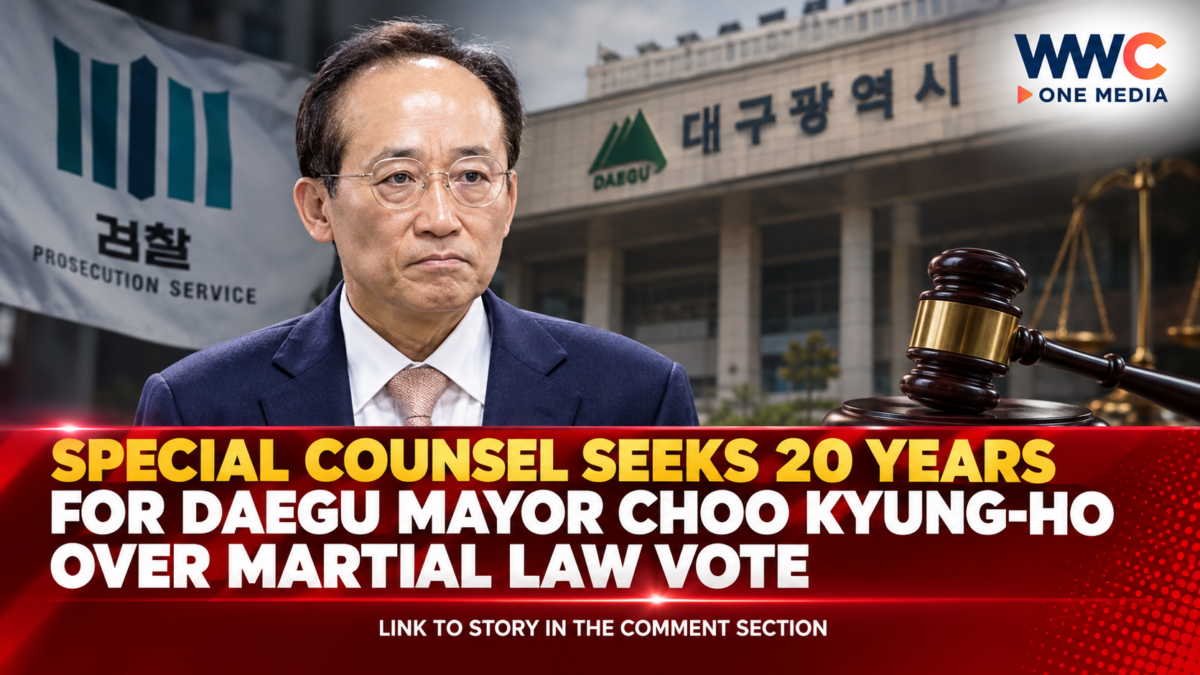
SEOUL, South Korea — A special counsel team has asked a Seoul court to sentence Daegu Mayor Choo Kyung-ho to 20 years in prison over allegations that he helped obstruct the National Assembly’s vote to lift martial law during the December 2024 emergency.
The request was made Wednesday, Sept. 30, during the final hearing of Choo’s trial at the Seoul Central District Court. The sentence is a prosecution recommendation; the court has not yet issued its verdict.
Special counsel alleges lawmakers were kept from the vote
Choo is accused of helping prevent ruling-party lawmakers from participating in the National Assembly’s vote to end the martial law decree declared by then-President Yoon Suk Yeol on Dec. 3, 2024.
At the time, Choo was serving as floor leader of the then-ruling People Power Party.
According to the special counsel, Choo changed the location of an emergency party meeting multiple times after martial law was declared. Prosecutors argue the moves kept lawmakers away from the National Assembly during the critical vote.
The special counsel said the case involved Choo’s alleged role in preventing the number of lawmakers needed for the Assembly to pass the motion to lift martial law.
What happened on the night of Dec. 3?
The prosecution says the emergency party meeting was moved three times, with the locations shifting between the National Assembly and the party headquarters.
According to Yonhap, 90 of the 108 People Power Party lawmakers did not participate in the vote to lift martial law. The special counsel argues that the repeated venue changes contributed to lawmakers being unable to take part.
The prosecution has charged Choo with playing an important role in an alleged insurrection.
Its argument is that he failed to carry out his constitutional responsibility as a lawmaker to monitor and check the use of martial-law powers and instead assisted efforts to prevent the Assembly from acting.
Choo’s defense disputes the prosecution’s account
Choo’s side has presented a different explanation for what happened that night.
According to Seoul Economic Daily, his defense maintains that lawmakers at the party headquarters were unable to reach the National Assembly because police controls had restricted access to the building.
His side also disputes the prosecution’s characterization of his phone call with former President Yoon. The defense says the call concerned an apology for not having shared the contents of Yoon’s address in advance, rather than a request for cooperation with martial law.
These competing accounts will be considered by the court as it reaches its decision.
Verdict could come as early as October
The Sept. 30 hearing marked the conclusion of the first trial’s arguments, with the special counsel presenting its sentencing request and the defense making its final arguments.
A first-instance ruling could come as early as October, according to Seoul Economic Daily, although the exact timing is up to the court.
If Choo is ultimately convicted and a prison sentence or heavier punishment becomes final after appeals, he could lose his position as Daegu mayor, according to the report.
The 20-year request is not the final sentence
The most significant development on Sept. 30 is the 20-year prison term requested by the special counsel.
That figure should not be confused with a court-imposed sentence. Choo remains subject to the court’s determination, and the defense disputes key elements of the prosecution’s case.
The upcoming verdict will therefore determine the next major stage of a case rooted in one of South Korea’s most consequential political and constitutional crises in recent years.
The special counsel has made its sentencing request. Now, attention turns to the court — and the ruling that could determine Choo Kyung-ho’s legal and political future.
WWC ONE MEDIA G,A