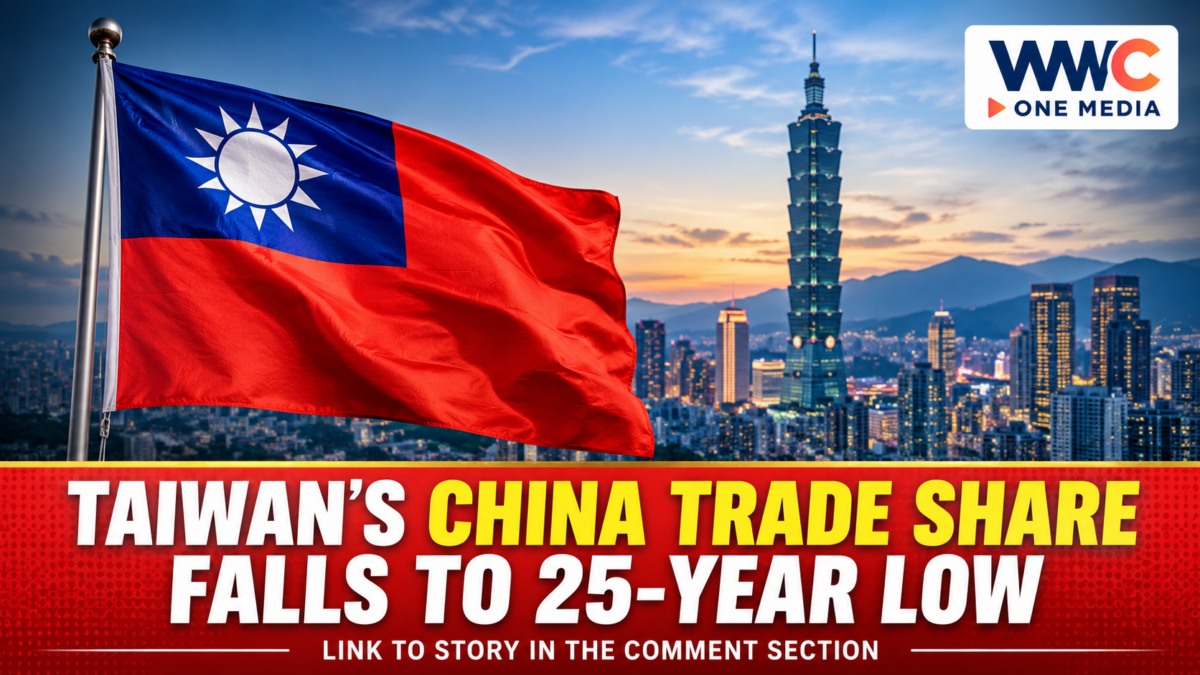
TAIPEI — Taiwan’s exports to mainland China and Hong Kong accounted for 26.6% of its total exports in 2025, the lowest share in 25 years, even as the value of those shipments increased, the island’s central bank reported. The figures give fresh context to a warning from Taiwan’s Ministry of Foreign Affairs about the risks of deepening trade relationships with China, raised during Deputy Foreign Minister Chen Ming-chi’s visit to Canada from November 20 to 22.
The numbers reveal a more complicated picture than a simple retreat from the Chinese market. Taiwan is expanding its trade with other destinations, but China and Hong Kong remain a major market for its exporters and a significant source of imported goods.
That distinction matters as governments try to balance commercial opportunities against the possibility that concentrated supply chains can become a source of political or economic pressure.
Taiwan China trade: A smaller share, but still a large market
Taiwan’s 2025 trade figures show a clear shift in the distribution of its export markets.
Exports to mainland China, including Hong Kong, reached US$170.477 billion in 2025, an increase of 13.2% from the previous year. Yet the market’s share of Taiwan’s total exports declined from 31.7% in 2024 to 26.6% in 2025.
The Central Bank of the Republic of China (Taiwan) described that share as the lowest in 25 years. The United States, meanwhile, became Taiwan’s largest export destination, receiving US$198.274 billion in goods, equivalent to 30.9% of total exports.
The Association of Southeast Asian Nations (ASEAN) accounted for 18.6% of Taiwan’s exports, with shipments worth US$119.027 billion.
These figures show that Taiwan’s export base is becoming more geographically distributed. But they also show why describing the shift as an economic separation from China would be inaccurate: exports to the mainland and Hong Kong still represented more than one-quarter of the total.
Imports tell a similar story. Taiwan brought in US$93.124 billion in goods from mainland China and Hong Kong in 2025, representing 19.3% of total imports. The value increased 15.5% year on year, even though the market’s share declined from 20.5%.
Diversification is not the same as disengagement
A falling percentage can sometimes obscure an increase in the underlying amount. That is what happened in Taiwan’s 2025 export relationship with China and Hong Kong: the share declined while the value of exports rose.
The difference is important for businesses. A company can reduce the proportion of its sales going to one market while continuing to depend on that market for substantial revenue. The same applies to manufacturers buying components, materials or equipment from suppliers concentrated in one country.
Taiwan’s trade statistics also show that diversification is not limited to shifting sales to the United States. Exports to ASEAN increased 35.6% in 2025, while imports from the region rose 27%. The central bank linked the growth partly to artificial-intelligence demand and supply-chain relocation, with information and communications technology products and electronic components contributing to the increase.
WWC has previously examined how regional manufacturing networks are changing in its report on Taiwan’s technology export orders and the scale of AI-related demand. That expansion illustrates why alternative markets and production locations matter: companies need customers, suppliers and manufacturing partners across more than one geography.
Taiwan’s warning in Canada has an official policy backdrop
Chen attended the Halifax International Security Forum in Canada from November 20 to 22. Taiwan’s Foreign Ministry confirmed that he took part in panel discussions, gave a speech and held interviews with Canadian media.
The ministry’s November 23 statement said Chen discussed international developments and the instability associated with deeper trade relations with China. It also said he used Taiwan’s experience to describe the island’s efforts to develop its trade, technology and defence capabilities, and expressed interest in cooperation with like-minded partners.
The official statement did not publish a full transcript of his interviews or provide detailed evidence for each concern raised in them. The broader policy message, however, is consistent with Taiwan’s stated effort to expand international economic partnerships.
The issue is not simply whether trade with China should increase or decrease. It is whether businesses and governments can avoid placing too much reliance on a single market, supplier or transport route.
Canada is pursuing trade opportunities while managing risk
Canada’s current approach illustrates the choices facing countries that want to diversify their economic relationships without giving up access to a major market.
In a November 9 backgrounder, Canada’s Department of Finance described the second Canada-China Economic and Financial Strategic Dialogue, co-chaired by Chinese Vice Premier He Lifeng and Canadian ministers François-Philippe Champagne and Maninder Sidhu.
The two governments agreed to continue economic and financial cooperation, including work on financial policy dialogue, investment, cross-border payments and a bilateral currency-swap arrangement.
Earlier, Canada’s international trade minister said the country was seeking to increase exports to China by 50% by 2030. The government also reported that two-way merchandise trade with China totalled C$125.7 billion in 2025, making China Canada’s second-largest single-country merchandise trading partner.
These are concrete commercial interests, not evidence that Canada has ignored security concerns. The Canadian government’s own dialogue document also refers to global economic uncertainty and the importance of a transparent and predictable environment for trade and investment.
The policy challenge is therefore a balancing act: pursuing market access and investment while ensuring that businesses have options if trade conditions change.
Supply-chain risk reaches beyond finished products
Trade dependence is not measured only by the value of finished goods crossing a border. It can also arise through intermediate inputs, specialised materials, technology components and production processes that are difficult to replace quickly.
A manufacturer may sell most of its products to customers in several countries but still rely on one source for a critical material. If that input is delayed or becomes subject to new licensing conditions, production can be affected even when the company’s customer base is diversified.
WWC’s earlier examination of China’s controls on critical-metal shipments and their potential impact on Taiwan’s technology sector explored this vulnerability. The wider lesson is that resilience requires businesses to understand the origin of key inputs, not just the destination of their exports.
That is also why Taiwan’s growing trade with ASEAN matters. Regional production links can provide alternatives, but relocating a supplier or qualifying a new component is not immediate. It can require investment, testing, regulatory approvals and changes to logistics.
The same issue appears in Taiwan’s efforts to build industrial partnerships with other advanced economies. WWC’s report on the Taiwan-Japan drone partnership and the gap between agreements and actual trade showed why signing cooperation documents does not automatically create substantial commercial flows.
What happens next
The next test for Taiwan is whether its trade relationships continue to broaden without creating new concentrations elsewhere. The 2025 figures show a lower export share for China and Hong Kong, but also rising trade values and continued reliance on imported goods from the same market.
For Canada, the question is whether its expanding economic engagement with China can deliver the promised commercial gains while preserving room to respond if trade becomes unpredictable.
For businesses in both markets, the practical work is less political than operational: identify critical suppliers, measure exposure by product and market, assess alternative routes, and understand how quickly production could shift if access is disrupted.
Diversification does not require ending trade with a major partner. It requires having credible alternatives when a relationship becomes difficult.
Frequently asked questions
What share of Taiwan’s exports went to China and Hong Kong in 2025?
The combined share was 26.6% of Taiwan’s total exports in 2025, the lowest level in 25 years, according to the Central Bank of the Republic of China (Taiwan).
Did Taiwan’s exports to China fall in value?
No. Exports to mainland China and Hong Kong rose 13.2% to US$170.477 billion in 2025, even as their share of Taiwan’s total exports declined.
Which market became Taiwan’s largest export destination in 2025?
The United States was Taiwan’s largest export destination, receiving US$198.274 billion in goods, or 30.9% of total exports.
Why does Taiwan want to diversify its trade?
Diversification can reduce the risk of relying too heavily on one market, supplier or route. It does not necessarily mean ending trade with China; it means building alternatives if access or commercial conditions change.
Is Canada ending trade with China?
No. Canadian government documents show that Canada is pursuing expanded economic and financial cooperation with China while also emphasizing trade diversification and a predictable trading environment.