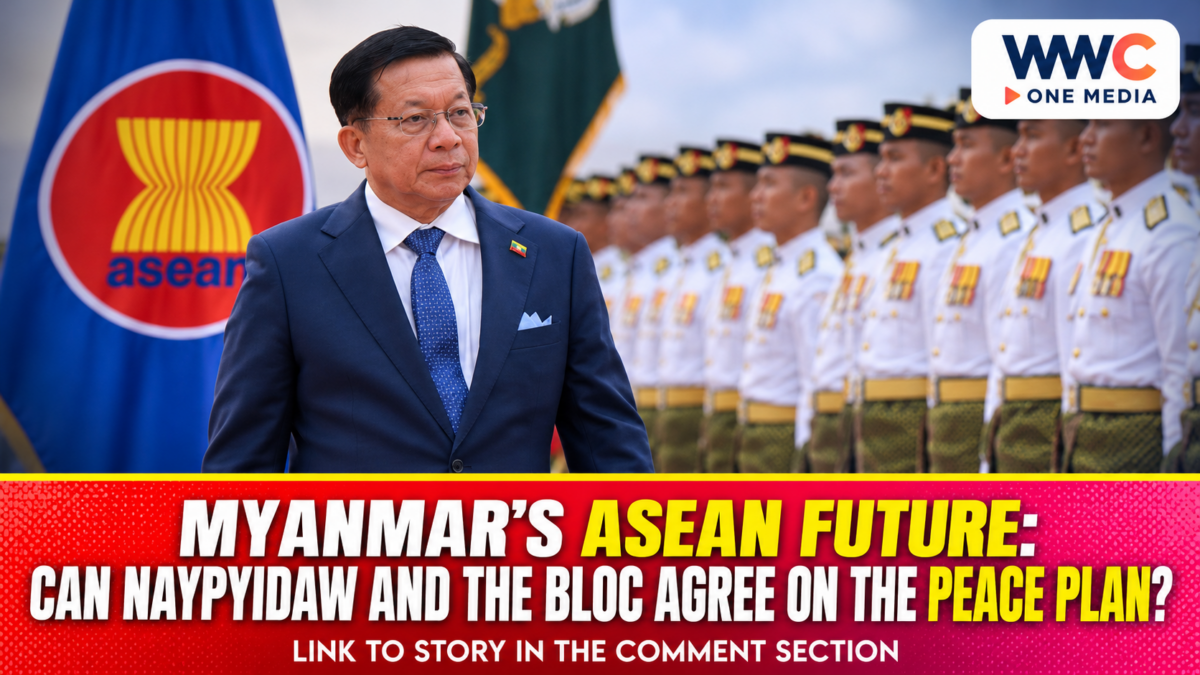
Myanmar’s relationship with the Association of Southeast Asian Nations remains strained as the regional bloc maintains restrictions on the country’s political representation while leaving a conditional route towards fuller participation.
The disagreement is rooted in competing positions over how the bloc should address Myanmar’s political crisis. Myanmar’s official government position has questioned the Five-Point Consensus, while ASEAN’s November 15 decision in Manila reaffirmed the framework as its main reference for pursuing a peaceful resolution.
The issue matters beyond diplomatic protocol. The way ASEAN handles Myanmar affects regional cooperation, humanitarian access and the bloc’s ability to maintain a common response to a prolonged crisis within one of its member states.
Myanmar’s ASEAN future faces a continuing policy disagreement
Myanmar’s Ministry of Information published a Foreign Ministry statement on July 24 outlining the government’s objections to the way the Five-Point Consensus was adopted and implemented.
The statement argued that the 2021 framework had been released without prior notification and circulation of a draft to member states, including Myanmar. It also maintained that the framework was released without consensus among all members.
Myanmar’s position was that the government’s own Five-Point Roadmap was complementary to ASEAN’s framework and that cooperation should take account of the country’s national interests and sovereignty.
The statement also referred to a July 9 parliamentary motion urging the government to review and take necessary action regarding the ASEAN Five-Point Statement. It said the government would take appropriate measures in response to the legislature’s decision while continuing to cooperate with ASEAN.
These are the Myanmar government’s stated positions, not findings accepted by ASEAN. They show that the disagreement concerns both the substance of the peace framework and the role the regional organisation should play in addressing the crisis. Ministry Of Information
Parliament’s review motion put the dispute on the official record
The July parliamentary debate provides further context for the government’s position.
A Ministry of Information report dated July 10 said the Pyidaungsu Hluttaw approved a motion calling on the government to review the Five-Point Statement through diplomatic channels. The motion was submitted by Dr Nanda Hla Myint, a representative for Kalaw Constituency.
The report recorded that 553 of 560 eligible lawmakers attended the session. It also summarised arguments from lawmakers who said the framework did not reflect Myanmar’s current political circumstances and raised concerns about sovereignty and equal representation within ASEAN.
The report included a statement from Foreign Minister U Tin Maung Swe, who said Myanmar would continue seeking normal engagement with the regional organisation while strengthening bilateral relations with individual member states.
The parliamentary report is evidence of an official institutional position. It does not establish that ASEAN accepted the motion’s arguments or agreed to revise the Five-Point Consensus. Ministry Of Information
The debate also illustrates why the disagreement is difficult to resolve. Myanmar’s official position places emphasis on sovereignty and its own political roadmap, while ASEAN’s approach links fuller political participation to progress under a regional agreement.
ASEAN’s Manila decision keeps political representation conditional
ASEAN leaders addressed the issue directly in their November 15 decision adopted in Manila.
The document reaffirmed the Five-Point Consensus as the main reference for addressing Myanmar’s political crisis. It also expressed deep concern over continuing conflict and the humanitarian situation, and called for substantive progress in implementing the framework.
The leaders maintained the existing policy of non-political representation from Myanmar at ASEAN summits and ASEAN Foreign Ministers’ Meetings until meaningful progress is achieved.
However, the decision did not exclude Myanmar from every ASEAN activity. It explicitly states that Myanmar’s participation in other ASEAN sectoral ministerial bodies and mechanisms should remain unrestricted at all levels.
The distinction is important. ASEAN is maintaining a channel for technical and sectoral cooperation while withholding full political representation at its highest-level meetings. ASEAN
The decision also leaves room for a gradual change. ASEAN said it may consider restoring Myanmar’s full political representation through a phased and progress-based approach, subject to sustained and concrete progress in implementing the Five-Point Consensus.
No fixed timetable was announced. The document does not promise that Myanmar’s senior political leadership will return to the next summit or that a particular diplomatic meeting will automatically change the policy. ASEAN
Humanitarian assistance remains a measurable part of ASEAN’s approach
The Manila decision also recorded humanitarian developments, showing that ASEAN’s engagement is not limited to the question of political representation.
Leaders welcomed an ASEAN Monitoring Team mission to Myanmar on October 28, led by the ASEAN Chair’s Special Envoy. The mission marked the start of a month-long distribution of humanitarian support to more than 11,000 households, including in four priority townships that had not previously been reached by the ASEAN Coordinating Centre for Humanitarian Assistance on disaster management.
The document also noted Myanmar’s openness to further expanding humanitarian access.
But the overall assessment remained cautious. ASEAN said progress in implementing the Five-Point Consensus was insufficient, while acknowledging limited progress in humanitarian assistance through the AHA Centre. ASEAN
That distinction prevents a misleading conclusion. Humanitarian assistance reaching additional households is a meaningful development, but it does not prove that violence has ended, that all communities can receive aid or that the political crisis has been resolved.
For background on the regional diplomatic effort, WWC has examined Thailand’s attempts to support peace talks with Myanmar. The wider institutional challenge is also explored in WWC’s explanation of ASEAN’s role and regional responsibilities.
Bilateral engagement does not automatically change ASEAN policy
Myanmar’s official statements have emphasised cooperation with individual ASEAN members as part of its effort to normalise relations with the bloc.
A July 23 Foreign Ministry statement said Myanmar would continue bilateral engagement and work towards restoring normal relations with ASEAN while safeguarding its national interests and sovereignty.
A separate Ministry of Information report on an August 1 seminar at the Ministry of Foreign Affairs described discussions on strengthening Myanmar’s role within ASEAN, maintaining constructive relations with member states and developing longer-term policy recommendations.
These records show that Myanmar’s engagement with ASEAN has been an ongoing policy issue, rather than a question that emerged only during the November summit. Ministry Of Information+1
For ASEAN, however, bilateral visits and diplomatic contact are not the same as implementation of the Five-Point Consensus. The November decision specifically ties possible restoration of full political representation to sustained and concrete progress under that framework.
That is the central test facing both sides: whether diplomatic engagement can produce verifiable progress on violence, humanitarian access and inclusive political dialogue.
What happens next
ASEAN Foreign Ministers have been tasked with continuing to monitor implementation of the November decision and reporting to the next ASEAN Summit. The leaders also called for coordination among previous, current and incoming ASEAN chairs to maintain continuity in the bloc’s approach.
The document further encourages cooperation with neighbouring countries, external partners and the United Nations. It recognises that the crisis has implications beyond Myanmar, including displacement, human trafficking, drug trafficking and online scams. ASEAN
For Myanmar, the challenge is to demonstrate progress that can be assessed against the regional framework. For ASEAN, it is to keep diplomatic channels open without treating engagement as a substitute for measurable results.
The available primary records establish a continuing policy disagreement and ASEAN’s conditional approach to political reintegration. They do not verify the specific November 18 parliamentary remarks described in the news tip. That claim should be added only if an official transcript, parliamentary record or government statement becomes available.
Frequently asked questions
1. Has Myanmar been removed from ASEAN?
No. ASEAN’s November 15 decision maintains restrictions on Myanmar’s political representation at summits and foreign ministers’ meetings, while allowing unrestricted participation in other ASEAN sectoral ministerial bodies and mechanisms. ASEAN
2. What is the Five-Point Consensus?
It is ASEAN’s main framework for addressing Myanmar’s political crisis. The November 15 decision reaffirmed it as the regional bloc’s principal reference for pursuing a peaceful and durable resolution. ASEAN
3. Why does Myanmar want the framework reviewed?
Myanmar’s official July statements and parliamentary report argue that the framework does not adequately reflect the country’s current political circumstances and raises questions about sovereignty and the principle of non-interference. These are the government’s stated arguments, not an agreed ASEAN assessment. Ministry Of Information+1
4. Can Myanmar regain full political representation?
Yes, potentially. ASEAN said it may consider gradual restoration through a phased and progress-based approach if Myanmar demonstrates sustained and concrete progress in implementing the Five-Point Consensus. ASEAN
5. Did ASEAN set a deadline for restoring Myanmar’s full representation?
No deadline appears in the November 15 decision. ASEAN tasked its Foreign Ministers with monitoring progress and reporting to the next summit.