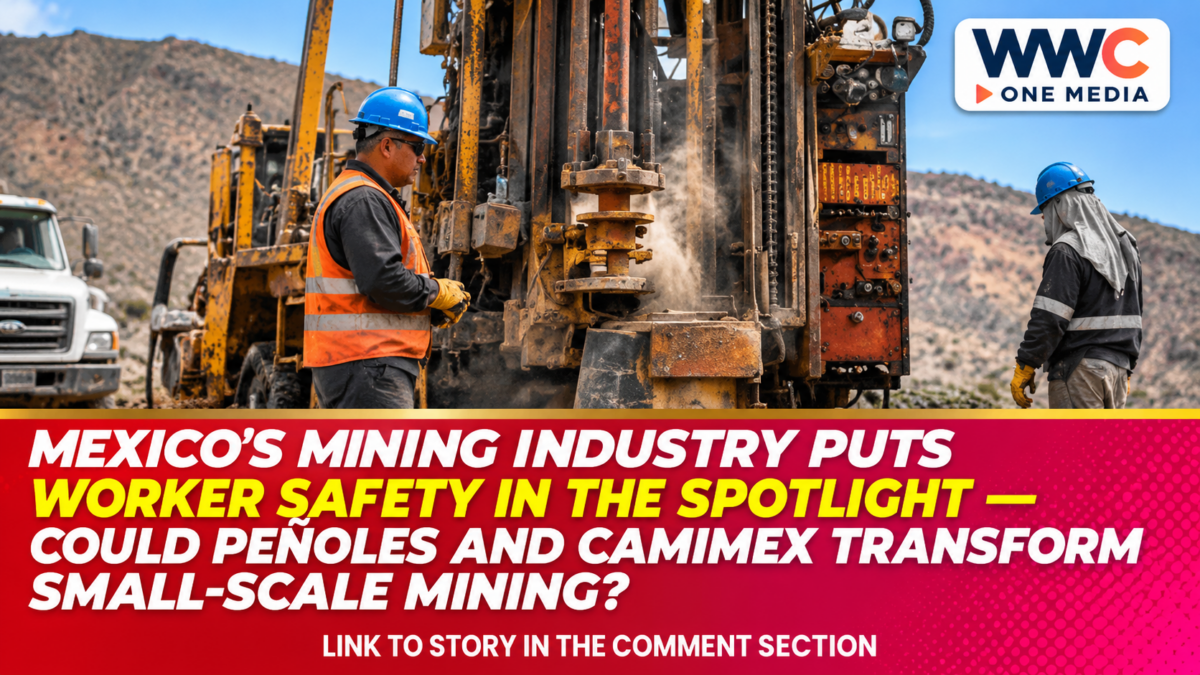
TORREÓN, MEXICO — Mexico’s mining industry faces an increasingly important challenge as companies seek to strengthen workforce capabilities while meeting demanding occupational safety and environmental responsibilities.
Industrias Peñoles has established a competency certification system that works alongside the Mexican Mining Chamber, known as CAMIMEX, to develop professional standards across the country’s mining sector.
Meanwhile, Mexico’s Secretariat of Labour and Social Welfare has introduced a proposed update to occupational safety requirements for underground coal mines, reinforcing the importance of risk prevention and effective safety management.
Together, these developments highlight a fundamental issue facing the extractive industry: expanding mineral production requires more than equipment and financial investment. It also requires qualified workers, effective management systems and consistent regulatory compliance.
Mexico mining safety: Peñoles expands professional competency development
Industrias Peñoles operates a competency assessment and certification entity authorised by Mexico’s National Council for Standardisation and Certification of Labour Competencies, commonly known as CONOCER.
Its 2025 sustainability report documents a network of 36 active assessors conducting competency evaluations across the company’s business units.
Among personnel targeted for certification, 78% had successfully obtained certification, while the remaining 22% were developing the skills necessary to qualify.
The company is accredited to provide certification across 16 competency standards.
Peñoles also participates in CAMIMEX’s competency development committee, creating an institutional connection between its workforce development activities and broader industry standards.
These arrangements illustrate how mining companies can contribute to professional development beyond conventional classroom instruction.
Formal competency assessment can help distinguish workers who have attended training from those who have demonstrated the capabilities required under a recognised assessment framework.
Nevertheless, individual certification alone cannot establish that an entire mining operation complies with every applicable safety requirement.
Mexico proposes stronger underground coal mining requirements
In 2026, Mexican labour authorities introduced a public consultation notice concerning PROY-NOM-032-STPS-2026, a proposed occupational safety standard for underground coal mines.
The draft seeks to strengthen protections against workplace accidents and occupational illnesses.
Its proposed provisions address several operational areas, including ventilation, underground working conditions, risk assessment and the implementation of occupational health and safety management systems.
The framework also envisages assigning engineering personnel responsibility for implementing and monitoring workplace safety requirements.
These proposals build upon Mexico’s existing regulatory history.
The original NOM-032-STPS-2008 standard establishes safety requirements for underground coal mining operations, covering matters such as electrical installations, ventilation, machinery, fire prevention, flooding and underground transportation.
The distinction between the existing standard and the proposed revision is particularly important.
A public consultation notice does not automatically establish that every proposed provision has entered into force.
Mining operators must therefore distinguish between currently applicable obligations and potential future requirements when assessing their compliance programmes.
Why smaller mining producers need access to technical expertise
The economic challenges facing smaller mineral producers can differ considerably from those experienced by major industrial groups.
A large mining company may have dedicated engineering, legal, environmental and occupational health departments.
Smaller businesses may need to obtain equivalent expertise through external specialists, industry associations and shared training initiatives.
This makes cooperation between mining companies and industry organisations potentially valuable.
Technical support could help smaller producers identify gaps in their operating procedures, improve workforce capabilities and better understand regulatory obligations.
The relationship between small-scale mining, formalisation and responsible operations is also examined in WWC ONE MEDIA’s coverage of the Patiacan small-scale mining community.
Although mining regulations differ between jurisdictions, access to appropriate technical expertise remains an important consideration for companies seeking to operate responsibly.
Training should therefore be evaluated by whether it produces measurable improvements in workplace practices, rather than simply by the number of participants attending an event.
Peñoles builds a long-term pipeline of mining professionals
The company’s workforce development strategy extends beyond competency certification.
In 2003, Peñoles introduced a structured engineering training programme designed to recruit and develop professionals from Mexican universities specialising in engineering and earth sciences.
Its 2025 sustainability report records more than 103 cohorts and 2,618 graduates since the programme began.
Participants receive general organisational instruction alongside specialised training connected to their assigned business divisions.
The company has also identified graduates who subsequently progressed into senior operational management positions.
Another initiative, launched in 2024, focuses on preparing experienced operational personnel to serve as instructors for their colleagues.
This approach creates opportunities for practical knowledge to be transferred within the organisation.
The commercial importance of developing skilled mining professionals becomes particularly apparent when companies pursue technically demanding expansion opportunities.
For example, recent silver exploration developments at Mexico’s La Colorada mine illustrate the continuing importance of geological interpretation, engineering expertise and operational planning.
Discovering mineral resources is only one stage of mining development. Companies must also establish whether those resources can be extracted safely, responsibly and economically.
Environmental responsibilities extend beyond active mining
Responsible mineral production requires companies to consider the full operational life of their mining assets.
From an investment perspective, environmental management should not be treated solely as an expense arising after production begins.
Planning for operational risks, eventual rehabilitation and mine closure can influence the overall financial requirements of a project.
The importance of these responsibilities is illustrated in Panama’s negotiations concerning the future of the Cobre Panamá copper mine and its eventual closure.
While Panama and Mexico operate under different legal frameworks, the commercial distinction remains relevant: mineral production, regulatory permission and environmental responsibilities must be assessed separately.
For smaller mining businesses, understanding these responsibilities before committing substantial capital could help reduce exposure to unexpected costs.
However, participation in a training programme does not itself constitute an environmental permit, regulatory approval or guarantee of continued operations.
Can workforce development improve Mexico’s mining competitiveness?
Professional competency development could help mining companies improve the consistency of their operations and strengthen their ability to implement appropriate industrial standards.
The potential commercial benefits include better workforce preparation, improved operational planning and more effective management of industrial risks.
Nevertheless, these outcomes depend on how training is implemented.
A credible safety programme requires management accountability, suitable equipment, appropriate supervision and ongoing assessment of workplace conditions.
Companies should also distinguish between educational participation, formal competency certification and independent regulatory compliance assessments.
Each serves a different purpose.
The next important milestones for Mexico’s mining industry will include the implementation of occupational safety initiatives, further clarification of regulatory requirements and evidence that workforce development produces measurable operational improvements.
The industry’s long-term competitiveness may ultimately depend on its ability to develop skilled professionals while protecting the people responsible for extracting its mineral resources.
Frequently asked questions
What is CAMIMEX?
CAMIMEX is the Mexican Mining Chamber, an industry organisation that participates in initiatives involving mining-sector development and professional competency standards.
How does Industrias Peñoles train mining professionals?
Peñoles operates competency assessment, certification, engineering development and instructor training programmes designed to strengthen workforce capabilities.
How many competency standards can Peñoles certify?
Its 2025 sustainability report identifies accreditation across 16 competency standards, supported by 36 active assessors.
What is PROY-NOM-032-STPS-2026?
It is a proposed Mexican occupational safety standard intended to strengthen safety and health requirements for underground coal mines.
Does mining safety training automatically establish regulatory compliance?
No. Training and professional certification can support compliance, but mining operators must independently satisfy the applicable legal, technical and operational requirements.