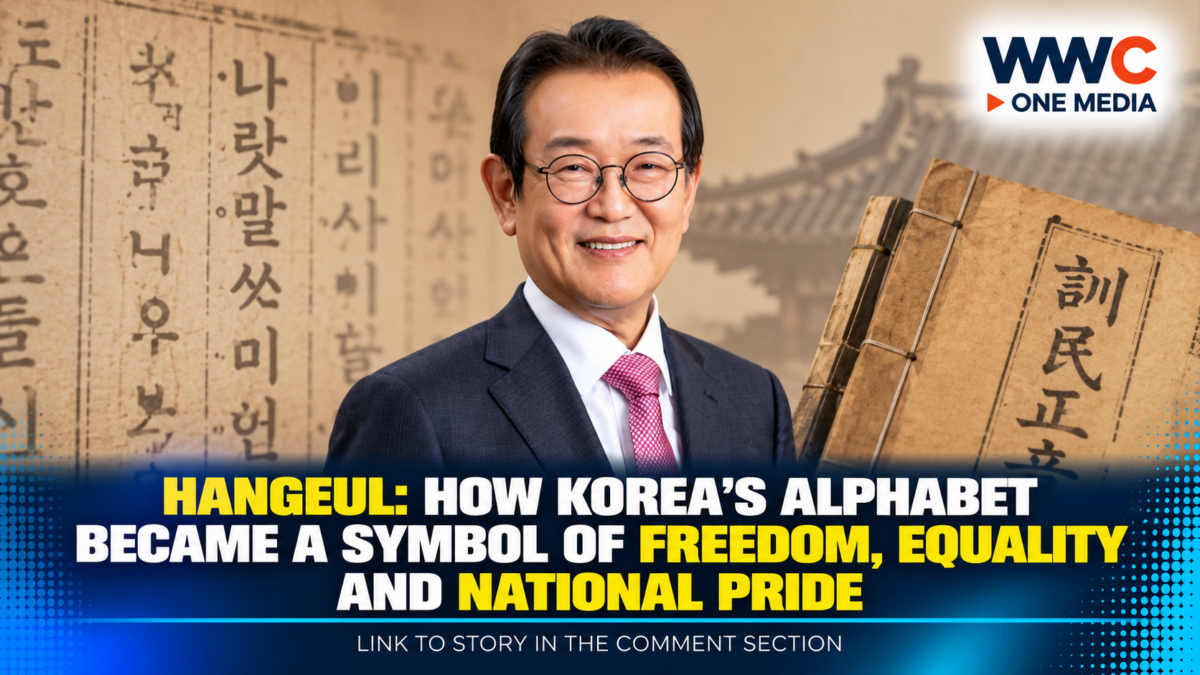
SEOUL, October 9, 2026 — South Korea is marking the 100th anniversary of Hangeul Day with renewed attention to the history of its writing system and the generations who fought to preserve the Korean language during colonial rule.
More than an alphabet, Hangeul represents a vision of a society in which language and literacy should not be reserved for the privileged. Its history is closely connected to Korea’s struggle for cultural independence, social equality and national identity.
In an opinion article published by The Korea Times on October 9, Chun Woo-yong, president of the King Sejong Institute Foundation, reflected on how Hangeul became a symbol of resistance and hope — and why its legacy continues to matter a century after the origins of the national holiday.
How Hangeul Became a Symbol of Equality
Hangeul traces its origins to King Sejong of the Joseon Dynasty, who oversaw the creation of the writing system in 1443. It was formally promulgated in 1446 under the name Hunminjeongeum, commonly translated as “the correct sounds to instruct the people.”
At the time, Classical Chinese dominated formal writing and was closely associated with the educated elite. Hangeul offered a more accessible writing system that could help ordinary people, women and children express themselves in writing.
Yet the alphabet did not immediately receive universal acceptance. Some traditional labels for it carried dismissive connotations, suggesting that it was an inferior form of writing compared with Chinese characters.
The struggle for recognition continued for centuries. Although Hangeul gained official status as Korea’s national writing system during the Gabo Reforms of 1894, its position was undermined after Japan annexed Korea in 1910.
Under Japanese colonial rule, efforts to preserve Korean language and culture took on a deeper political significance. Protecting Hangeul became part of the broader effort to maintain Korean identity and resist cultural assimilation.
The 1926 Gathering That Helped Shape Hangeul Day
A defining moment came in 1926, when members of the Korean Language Society and pro-independence groups gathered in Seoul to commemorate the 480th anniversary of the promulgation of Hunminjeongeum.
The gathering took place on November 4, several months after the funeral of Korea’s last emperor, Yi Cheok, which had coincided with another independence demonstration.
Participants resolved to commemorate the writing system annually. In 1927, the Korean Language Society formally adopted the name “Hangeul” for the Korean script and launched its influential journal, helping establish the foundation for the holiday now celebrated nationwide.
The name itself had an important history. Linguist Ju Si-gyeong had coined the term around 1913, offering an alternative to older labels that treated the writing system as inferior. The word conveyed the idea of a great or distinctly Korean script.
Adopting the name was therefore more than a linguistic decision. It was also a declaration that Korea’s language and cultural heritage deserved recognition and respect.
From Colonial Suppression to Global Recognition
Today, Hangeul has reached audiences far beyond the Korean Peninsula.
International interest in Korean language education has grown alongside the worldwide popularity of K-pop, Korean dramas, films and literature. Learners across different countries are studying the alphabet to better understand Korean culture, communicate with Korean speakers and access original-language content.
The global reach of Hangeul represents a remarkable contrast with the period when its use and status faced discrimination under colonial rule.
However, the historical lesson extends beyond international popularity. Hangeul’s survival depended on people who continued to teach, study and preserve the language despite political and social pressures.
Their work helped ensure that the writing system remained a living part of Korean society rather than simply a historical artifact.
Why Hangeul’s Legacy Still Matters
The centennial of Hangeul Day offers South Korea an opportunity to reflect on the relationship between language, identity and equal access to education.
The writing system was designed to make literacy more accessible, and its later history became intertwined with the struggle to preserve Korean culture. Those principles remain relevant as languages adapt to digital communication, artificial intelligence and an increasingly interconnected world.
For Chun Woo-yong, the enduring significance of Hangeul lies in the hopes earlier generations attached to it: a more inclusive society, cultural independence and a future in which people can connect across national boundaries.
The anniversary is therefore not simply a celebration of an alphabet. It is a reminder that language can preserve collective memory, challenge social barriers and help a nation maintain its identity through periods of profound change.
As South Korea celebrates 100 years of Hangeul Day, the question is how the hopes of those early language advocates will continue to shape the next century of Korean culture and global communication.
WWC ONE MEDIA G,A