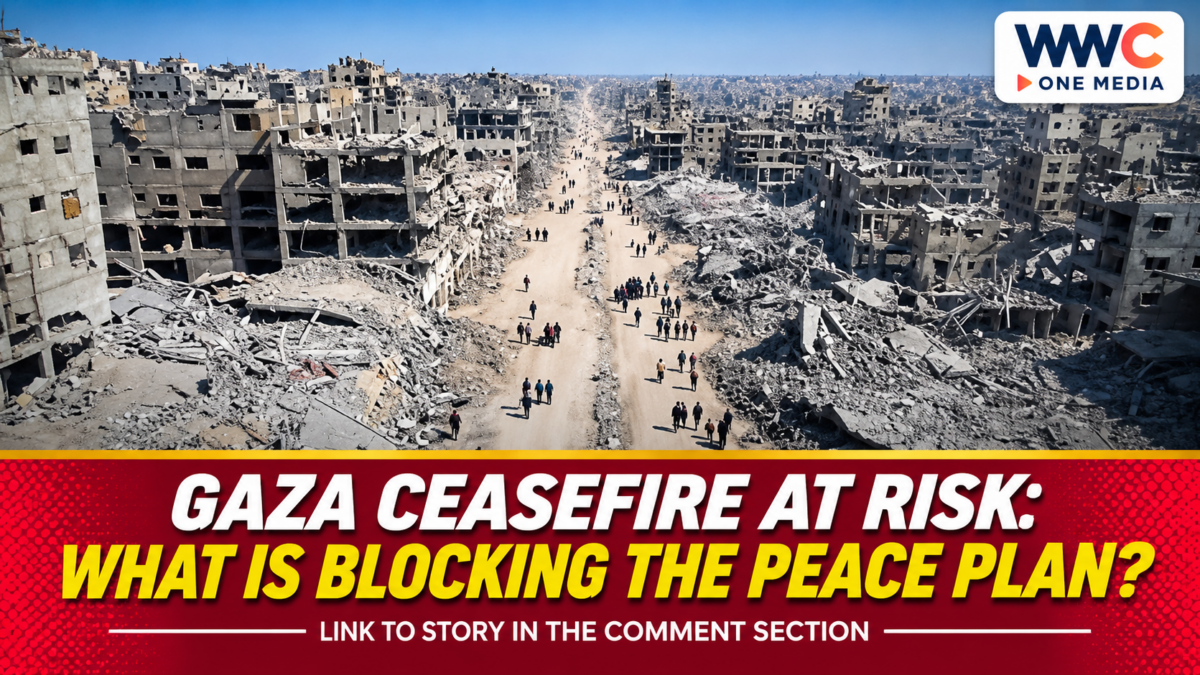
GAZA / NEW YORK — The Board of Peace warned the United Nations Security Council on Nov. 17, 2026, that the Gaza ceasefire remains vulnerable because key security, governance and humanitarian commitments have not been fully implemented. Its second six-month report, covering May 15 to Nov. 16, said the ceasefire remained in force, even as military activity and delays threatened further progress.
The Gaza ceasefire debate now turns on more than whether a written agreement exists. The central test is whether the parties can deliver civilian administration, verifiable disarmament, military withdrawal and access to essential supplies in a workable sequence.
Gaza Ceasefire: What the Board’s Report Actually Establishes
The November report was transmitted to the Security Council under document symbol S/2026/913. It follows Resolution 2803, adopted on Nov. 17, 2025, which endorsed a comprehensive plan to end the conflict and provided for international oversight and a stabilisation force.
The Board says the ceasefire has prevented a return to the previous scale of hostilities. However, it also records continued Israeli strikes and civilian casualties, alongside Hamas military activity that, in the Board’s assessment, has not met the commitment to cease operations fully.
These findings must be reported as the Board’s account of implementation. The document is not a court ruling and does not independently adjudicate every incident, military justification or alleged violation. WWC’s earlier report on military operations during the Gaza ceasefire examined related incidents without treating claims made by a party to the conflict as proven legal findings.
A July Roadmap Has Yet to Become Operational
The report describes a July 30 acceptance by Hamas and other Palestinian factions of a 15-point roadmap addressing the transfer of authority and disarmament. The proposed sequence links civilian governance, policing, verification, the deployment of an international stabilisation force and phased Israeli withdrawal.
Acceptance of that framework is different from completing it. As of Nov. 16, the Board said the implementation timetable and execution mechanisms remained unfinished. The National Committee for the Administration of Gaza, or NCAG, had not entered the territory, and the International Stabilization Force, or ISF, had not deployed.
The Board identifies three requirements: enabling the force’s deployment, implementing Israel’s undertakings and securing Hamas compliance with the roadmap. Each matters because the plan makes progress in one area dependent on verifiable steps elsewhere.
A delayed institution therefore has consequences beyond paperwork. Without an operating authority, routine policing, the handover of public services and the supervision of weapons decommissioning remain difficult to implement as envisaged.
Civilian Police and Transitional Government Face Obstacles
The report says the NCAG has prepared staffing, financial procedures and operating plans. It describes vetted police candidates who could begin training with Egypt’s support, but says decisions by the Israeli government concerning their training, return and deployment remain outstanding.
The Board presents this as an obstacle to building a civilian security service capable of assuming responsibility during the transition. That is its formal assessment, not evidence that all implementation barriers arise from one party alone.
There is also a public-finance challenge. The report describes planned government financial systems and an independent audit of staff, finances and public assets. Those preparations cannot be equated with effective administration inside Gaza until the committee is able to operate there.
WWC analysis: An agreement that relies on multiple institutions must be evaluated by whether those institutions actually function. Organisational readiness outside the territory does not necessarily deliver services or accountability within it.
Winter Aid Shortages Raise the Human Cost of Delay
The Board’s report describes extensive shelter and sanitation needs, worsened by heavy rain starting Nov. 6. It says humanitarian partners had received requests for assistance from more than 26,000 households by Nov. 8, and preliminary assessments recorded more than 6,000 family shelters destroyed and another 17,400 damaged.
It also reports that more than 150,000 procured tents were waiting outside Gaza for dispatch. These figures are the report’s time-specific humanitarian assessments, not a current verified count of all affected households as of Nov. 22.
The Board attributes impediments to Israeli restrictions on supplies and equipment, funding gaps and concerns about diversion of dual-use goods by Hamas. It calls for more shelter materials, fuel, pumps, generators, spare parts and heavy equipment.
The urgency is consistent with WWC’s earlier coverage of November floods and displaced families in Gaza. That story addressed the flooding itself; the new report instead documents how delays in the peace framework complicate assistance and recovery.
The $2.45 Billion Recovery Plan Is Still a Plan
The Board describes an indicative six-month recovery programme consisting of 66 costed projects worth approximately US$2.45 billion, plus about US$200 million in identified in-kind contributions. Its sectors include infrastructure, security, health, education, economic development and digital systems.
These are programme values, not proof that the same amount has already been disbursed or that all projects are underway. The document identifies financial controls and coordination measures intended to govern future implementation.
WWC previously examined the Board of Peace’s proposed Gaza reconstruction programme when it was presented in September. The November report adds a crucial operational update: preparations may advance while the necessary civilian and security arrangements remain unfinished.
WWC analysis: The decisive measures are safe access for supplies, functioning public services, transparent expenditure and independently verified milestones. A budget announcement alone cannot show that displaced households have received shelter or infrastructure has been restored.
What Happens Next
The next test is whether the parties finalise implementation mechanisms and allow the NCAG and ISF to carry out their intended roles. Further official reports should make clear which commitments have been completed, which remain disputed and what civilians have received in practice.
As of Nov. 22, the reviewed primary document does not establish that the ceasefire has ended, that the stabilisation force has deployed, or that the full recovery programme has been funded and completed. The Board’s warning is serious precisely because the agreement remains in place while critical elements of it are still incomplete.
Frequently Asked Questions
Has the Gaza ceasefire collapsed?
No collapse is established in the Nov. 17 Board of Peace report. The Board says the ceasefire remains in force but warns that incomplete implementation makes it vulnerable.
What is the Board of Peace asking Israel and Hamas to do?
Its report calls for implementation of agreed undertakings, including Israeli commitments under the governing framework and Hamas commitments concerning military activity and the handover of authority.
Has the international stabilisation force entered Gaza?
The report says it had not deployed as of Nov. 16, 2026. A later deployment would require separate official confirmation.
Is the US$2.45 billion reconstruction budget already spent?
No. The report describes an indicative six-month programme of planned projects; it does not document complete expenditure or delivery of all projects.
Why does the report emphasise winter supplies?
It records damaged shelters, flooding, sanitation problems and barriers to obtaining materials and equipment needed to protect displaced households.