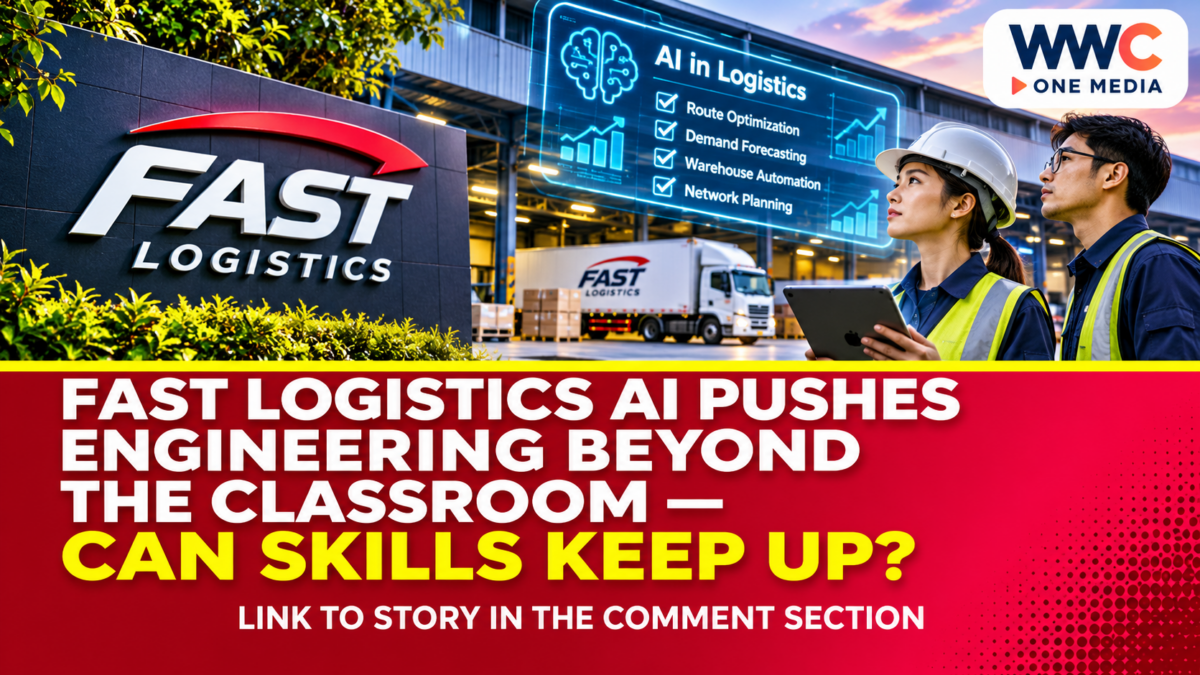
MANILA, Philippines — Nov. 14, 2026. FAST Logistics Group is placing artificial intelligence, warehouse systems and engineering-led cargo handling at the centre of its published strategy for modernising Philippine supply chains. Its own records describe software-assisted transport operations, a modular loading system and training programmes, raising a practical question for future engineers: can technical skills keep pace with increasingly connected logistics operations?
An account of a recent student engineering expo prompted fresh attention to the company’s work. The particular event’s date, participating schools and remarks were not independently established from an accessible organiser or company announcement in this review, so those details are not presented as verified. The more substantial story is what FAST has actually documented about its technology and workforce plans.
FAST Logistics AI: Systems Behind the Promises
FAST’s October 2026 account of the Philippine Institute of Industrial Engineers’ 21st National Congress identifies Chief Information Officer Leo Sacamos Jr. as a participant in discussions about artificial intelligence, automation and operational excellence. The company’s earlier workforce publication describes the need for employees who can operate digital platforms, interpret data and recognise what automated tools cannot reliably do.
That is a more specific proposition than simply putting AI into a warehouse. Information from a truck, storage location or shipment must move between operational systems without creating incorrect dispatch instructions.
FAST identifies warehouse and transport management platforms as part of its operations. These tools can organise inventory, coordinate the movement of goods and help supervisors make decisions.
The company’s own October congress account also frames automation as support for workers performing higher-value tasks. That is a stated corporate position, not independent evidence that every affected job will be preserved or that every warehouse employee has already received new training.
FleXChange Tackles a Very Physical Bottleneck
A particularly concrete innovation is FleXChange, which FAST introduced at a September 2024 supply-chain conference. Its company-authored product description says detachable, stackable truck boxes allow workers to prepare cargo before the vehicle arrives. Forklifts can then place the prepared containers onto a truck rather than leaving the truck parked throughout the loading process.
FAST advertises loading-time reductions of up to 97%, describing an example that moves a process lasting several hours toward roughly 20 minutes. Those figures are company-reported performance claims. They should not be mistaken for an independent, nationwide study of all warehouses or for a guarantee across every cargo type.
This distinction is important because engineers must ask what has actually been measured. Is the figure dock occupancy, total labour time, order preparation or complete truck turnaround?
AI Dashcams and Digital Dispatch Need Human Oversight
FAST’s own descriptions of its fleet technology include AI-assisted dashcams intended to identify risky driving behaviour and support monitoring of transport operations. Its transport systems are designed to improve route visibility and dispatch coordination.
Such tools can help bring potential problems to a supervisor’s attention, but they also create responsibilities. An alert is not automatically proof of a traffic violation or employee misconduct. Systems need rules for checking false positives, protecting personal information and allowing workers to challenge incorrect findings.
The wider business context is evident in WWC’s earlier coverage of logistics expansion in Cebu, which examined the difficulty of moving goods across Philippine islands. Software can assist scheduling and visibility, but it cannot itself create additional road space, reliable shipping capacity or a new port facility.
Engineering students should therefore learn the limits of an algorithm as well as its benefits. Data quality, mechanical equipment, network availability and safe manual fallback procedures are all part of whether an innovation works outside a demonstration.
Why Training Matters as Much as the Machines
In a company-authored discussion of industry-academe cooperation, FAST executives identified forklift operation, reach-truck skills, professional driving and communication as essential logistics capabilities. The company also described a management-trainee programme and technical training at its Learning and Innovation Hub in Cabuyao, Laguna.
FAST’s published workforce outlook describes digital literacy and analytical problem-solving as increasingly important. It identifies a training and innovation centre and learning-management systems among its initiatives.
The difference between studying optimisation and deploying it inside a live warehouse can be substantial. A mathematical route may look efficient until delivery windows, vehicle restrictions and loading times are included. Likewise, a robotic workflow needs maintenance, safety procedures and staff who understand when to stop the system.
A useful parallel appears in WWC’s coverage of AI tools for frontline workers. The platforms serve different sectors and companies, but both raise the question of whether staff have accurate information, reliable access and training to act on automated recommendations.
What This Could Mean for Philippine Engineering Careers
Analysis: The opportunity is not limited to building new AI models. Logistics firms also need people who can connect existing tools, audit processes, maintain machinery, improve workflows and measure whether technology actually lowers the cost of moving products.
Industrial engineering provides one path because it joins process design with time, safety and resource constraints. Software, electronics and mechanical engineering also matter where digital platforms connect to vehicles, forklifts, sensors and warehouse equipment.
In WWC’s report on proposed AI-enabled industrial robots, the key unanswered issue was performance in real working conditions. The same standard should apply to warehouse innovation: measure outcomes rather than treat a launch or presentation as proof of broad commercial success.
What Happens Next
FAST can substantiate its modernisation claims more fully through comparable operating data: time saved before and after deployments, safety outcomes, staff certifications, fleet utilisation and total costs. Clear methodology would help customers and students understand which gains can be repeated.
A separately published organiser or company account would also be needed to authenticate the recent student expo, its participants and any event-specific remarks. Until then, the verified news is FAST’s documented investment in logistics systems and talent development—not an independently confirmed account of everything said at that gathering.
Frequently Asked Questions
What is FAST Logistics using AI for?
FAST’s official publications describe AI-assisted vehicle monitoring and digitally supported warehouse and transport operations. The intended benefits include better visibility, planning and risk detection, subject to implementation quality.
What is FleXChange by FAST?
It is a cargo-handling system using detachable and stackable boxes prepared before a truck arrives. FAST advertises loading-time reductions of up to 97%, a company-reported claim.
Which engineering skills are useful in logistics?
Process analysis, data interpretation, equipment safety, software integration, maintenance and communication can help engineers improve warehouse and transport systems.
Did FAST confirm the November engineering expo?
The specific recent expo details were not corroborated in an accessible first-party announcement during this review. They are excluded pending original documentation.