
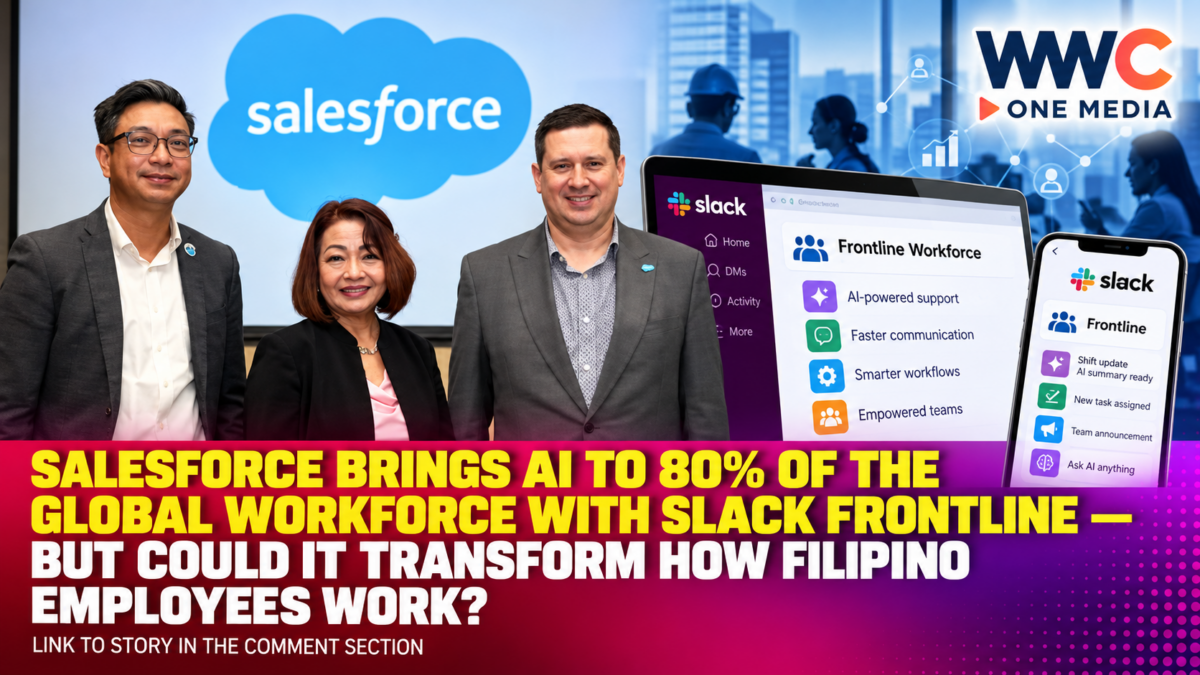
MANILA, PHILIPPINES — Salesforce is targeting one of the biggest remaining gaps in workplace digital transformation: millions of employees who keep businesses running but rarely sit behind an office desk.
The global enterprise software company has introduced Slack Frontline, a mobile-first workplace platform designed to connect retail associates, healthcare professionals, factory workers, hospitality personnel and field technicians with artificial intelligence, company information and real-time communication tools.
Announced locally on October 22 and highlighted by InsiderPH on October 26, the service is part of Salesforce’s broader push to bring AI-powered workplace technology into everyday business operations.
The company estimates that frontline employees account for approximately 80% of the global workforce.
Yet many of these workers still depend on printed schedules, paper checklists, personal messaging applications and manual coordination with supervisors.
Salesforce believes the combination of mobile communication, automated workflows and AI assistants could reduce those inefficiencies.
But while the platform promises faster operations and better customer service, its real impact will depend on how businesses implement it, protect sensitive information and support workers who may have limited experience with enterprise software.
SALESFORCE TARGETS THE WORKERS LEFT BEHIND BY DIGITAL TRANSFORMATION
Most workplace technology has traditionally focused on office employees.
Corporate teams commonly use customer relationship management systems, project management software, digital calendars and collaboration platforms.
Frontline employees often work differently.
Retail workers spend their shifts helping customers and checking inventory.
Manufacturing personnel monitor equipment and production processes.
Healthcare teams move between patient visits.
Hotel employees coordinate room preparation, guest requests and maintenance.
Field technicians may spend entire days away from headquarters.
These employees need quick access to information, but may not have dedicated computers or corporate email addresses.
Salesforce designed Slack Frontline to address that problem through a simplified mobile interface.
The goal is to make company information and operational tools available at the point where work happens.
SLACK FRONTLINE OFFERS 10 ROLE-SPECIFIC CHANNELS
One of the platform’s main features is a streamlined workspace containing up to 10 communication channels relevant to a worker’s role.
Instead of navigating numerous corporate conversations, employees can focus on information related to their particular responsibilities.
A retail associate might see store announcements, product availability and daily promotions.
A factory operator could access safety procedures, maintenance updates and shift handover notes.
A healthcare professional might receive relevant care-team information within an authorized workspace.
The platform also provides Slack Huddles, allowing employees to communicate directly with supervisors and headquarters personnel.
Workers can access schedules, assigned tasks, training materials, policy updates and operational announcements through mobile devices.
Salesforce says these features are intended to reduce time spent searching for information or waiting for instructions.
However, limiting the number of channels does not automatically eliminate workplace distractions.
Organizations must still design communication structures that prioritize useful information.
AI AGENTS CAN ANSWER QUESTIONS DURING A SHIFT
Slack Frontline is designed to integrate with Salesforce’s Agentforce artificial intelligence platform.
AI agents can retrieve information from connected business systems and respond to authorized employee requests.
For example, a retail worker could ask whether a specific product is available.
A maintenance employee might request instructions for handling an equipment alert.
A new staff member could ask an AI assistant to locate an approved workplace procedure.
The technology is intended to reduce the need to search through documents or contact multiple supervisors.
Some workflows can also automate routine administrative tasks, such as recording requests and routing them to the appropriate department.
However, AI responses depend on the quality and currency of the underlying information.
An assistant connected to outdated inventory records may provide an incorrect answer.
Businesses must therefore maintain reliable data and establish processes for reviewing information used by AI agents.
RETAIL STORES COULD RESPOND FASTER TO CUSTOMERS
Salesforce identifies retail as one of the industries that could benefit from the platform.
Store employees frequently need information about promotions, stock availability, returns policies and customer preferences.
When that information is stored in separate systems, responding to customer questions can take additional time.
Slack Frontline is intended to connect employees with authorized Salesforce data and automated assistance.
For example, a worker could check product availability or receive an updated promotion without leaving the sales floor.
Managers could also communicate operational priorities across multiple branches.
The potential benefit is a more consistent shopping experience.
However, connecting customer records to frontline systems requires careful access controls.
Employees should only be able to view customer information necessary for their legitimate duties.
HEALTHCARE WORKERS GET CONNECTED CARE-TEAM TOOLS
Healthcare is another sector highlighted by Salesforce.
Home healthcare professionals and community-based caregivers frequently operate outside traditional clinical facilities.
They may need access to patient histories, care plans and specialist guidance.
The platform is designed to support secure communication between authorized care-team members.
Salesforce describes scenarios in which a caregiver can retrieve a permitted patient summary, consult a specialist through a Huddle and document a visit for the next healthcare professional.
The potential benefit is better continuity between shifts and care providers.
However, healthcare information is particularly sensitive.
AI-generated summaries must be reviewed carefully, and access must comply with applicable privacy and healthcare requirements.
For Philippine healthcare providers, the Data Privacy Act and relevant professional obligations remain important considerations.
The technology should support trained medical personnel rather than replace their professional judgment.
MANUFACTURING TEAMS CAN REPORT EQUIPMENT PROBLEMS IN REAL TIME
For factories and warehouses, delays in communicating equipment problems can disrupt operations.
Salesforce says Slack Frontline can allow workers to report issues directly through dedicated channels.
A machine operator could send an alert, access safety procedures and initiate a maintenance request.
Supervisors, engineers and technicians could then coordinate their response within the same workspace.
The system can also preserve a record of the issue and the steps taken to resolve it.
That information may help managers identify recurring equipment problems.
Shift handovers could also become more structured when outgoing employees record important updates in a shared system.
However, the platform itself does not repair machinery or replace safety-critical industrial controls.
Equipment problems still require qualified personnel and appropriate technical procedures.
VILLAGE HOTELS REPORTS FASTER CUSTOMER SERVICE
One of the most notable examples in Salesforce’s announcement comes from Village Hotels.
The hospitality operator reported that approximately 90% of its workforce operates in frontline roles.
According to the company’s chief technology officer, Jon Davis, its use of Slack has helped reduce customer issue resolution times from approximately 48 hours to under 20 minutes.
The improvement is striking because hotel operations require coordination across multiple departments.
A guest reporting a maintenance problem may need assistance from reception, housekeeping and engineering personnel.
When communication is fragmented, requests can be delayed or overlooked.
A shared workflow can help staff identify who is responsible for an issue and track whether it has been resolved.
However, the Village Hotels figures are customer-reported.
Salesforce’s announcement does not provide an independently audited methodology demonstrating that every organization adopting Slack Frontline will achieve similar results.
The example illustrates potential operational benefits, not a guaranteed outcome.
SALESFORCE EMPHASIZES SECURITY AND ACCESS CONTROLS
Businesses considering AI-enabled workplace platforms must evaluate how employee and customer information is protected.
Salesforce says Slack Frontline supports employee access through methods such as corporate email, employee identification and QR codes.
The platform also integrates administrative controls and multifactor authentication.
Salesforce describes access restrictions that allow workers to retrieve only information they are authorized to view.
Enterprise configurations may also support requirements involving regulated industries and data residency.
However, access to security features depends on the purchased services, configuration and relevant licensing arrangements.
Compliance with a particular law is not achieved automatically simply by purchasing software.
Organizations remain responsible for their own data processing practices, employee training and operational safeguards.
SLACK FRONTLINE BUILDS ON SALESFORCE’S BROADER AI STRATEGY
The launch follows a series of product announcements expanding Salesforce’s Agentforce platform.
In September, the company introduced additional AI agents designed for sales, customer service, commerce and internal business operations.
The expansion reflects Salesforce’s effort to move beyond AI systems that merely answer questions.
Its newer tools are intended to help employees complete multi-step tasks across connected business applications.
Salesforce has also expanded collaboration with Amazon Web Services to make business data and AI agents available through different workplace interfaces.
Slack Frontline extends that strategy to employees who may not use conventional office computers.
The broader commercial opportunity is significant.
Businesses may already use Salesforce for customer records or service operations, but many frontline workers have limited direct access to those systems.
Giving authorized employees mobile access could increase the practical usefulness of existing investments.
SALESFORCE RESEARCH SHOWS GROWING ENTERPRISE AI ADOPTION
Additional context comes from Salesforce’s 2026 Agentic Enterprise Index.
The company analyzed usage among organizations consistently using its Agentforce platform between February 2025 and April 2026.
Its report found that participating organizations nearly tripled their number of activated AI agents over the period.
It also reported a 53% reduction in average agent creation time.
These findings suggest that businesses already using Salesforce’s AI tools have been expanding their deployments.
However, the study is based on Salesforce platform activity among selected existing users.
It should not be treated as independent proof that AI adoption has tripled across every business worldwide.
The data also do not establish that Slack Frontline itself caused those improvements, because the report predates the product’s October announcement.
WHAT THE PLATFORM MEANS FOR PHILIPPINE BUSINESSES
The introduction is potentially relevant to industries employing large numbers of frontline workers in the Philippines.
Retail chains operate branches across major cities and provincial communities.
Manufacturing companies depend on factory operators, warehouse personnel and logistics teams.
Hotels and tourism establishments coordinate employees across multiple shifts.
Healthcare providers require timely communication between medical staff, administrators and caregivers.
Field service businesses must manage technicians working across different customer locations.
A mobile-first collaboration system could help these organizations share instructions, document service requests and coordinate operational tasks.
However, the economic case will differ by industry and company size.
A nationwide business with many branches may see different benefits from a small enterprise operating only one location.
WILL SMALL BUSINESSES BE ABLE TO AFFORD IT?
Pricing remains an important consideration.
InsiderPH reports that Slack Frontline is offered as an add-on for organizations subscribing to Slack Enterprise+.
Salesforce has cautioned that availability, packaging and pricing may differ by region.
A publicly verified Philippine peso price for the add-on was not established in the reviewed reporting.
This matters because the total cost of adoption may include software subscriptions, integration, deployment, training and ongoing administration.
For businesses with hundreds or thousands of employees, even a modest per-user charge can become a significant recurring expense.
Companies considering the platform should calculate whether the expected improvements in productivity and customer service justify the investment.
They should also assess internet connectivity, device availability and the technical skills of the workforce.
AI COULD CHANGE JOBS WITHOUT ELIMINATING THE NEED FOR PEOPLE
The launch also raises questions about the future of work.
Artificial intelligence may help automate repetitive tasks, retrieve information and coordinate business processes.
But frontline occupations often require physical activities, interpersonal communication and professional judgment.
Retail workers must assist customers.
Healthcare providers must deliver care.
Manufacturing personnel must operate and maintain equipment.
Hotel employees must respond to guest needs.
Slack Chief Product Officer Jaime DeLanghe has emphasized the continued importance of workers whose responsibilities cannot simply be replaced by software.
The most immediate opportunity for many businesses may be using AI to reduce administrative work rather than eliminating frontline roles entirely.
However, changes in workflows could still affect job responsibilities and staffing requirements.
Employers should provide training and involve employees in implementation decisions.
PRIVACY AND AI ACCURACY REMAIN MAJOR RISKS
Introducing AI into frontline operations brings several risks.
An AI agent may produce incorrect instructions if its source information is incomplete.
A poorly configured system could expose customer details to unauthorized users.
Employees may also become dependent on automated responses without checking whether those responses are appropriate.
These concerns are particularly significant in healthcare, financial services and safety-sensitive industrial environments.
Organizations should establish safeguards for sensitive actions.
They should also maintain clear escalation processes so workers can consult human supervisors when necessary.
Access permissions, audit records and employee education are essential components of responsible deployment.
The broader objective should be to use AI where it can provide measurable benefits without weakening accountability.
WHAT INDEPENDENT VERIFICATION SHOWS
InsiderPH’s October 26 article accurately reflects the main elements of Salesforce’s October 22 Philippine announcement.
The company’s official product material confirms the mobile-first design, up to 10 role-specific channels, integration with AI agents and support for automated workflows.
Salesforce’s separate Australia and New Zealand announcement, published October 27, also describes the product and its intended applications.
Its earlier September Slack product update confirms that frontline functionality was previewed before the October launch.
These sources establish the announcement and product positioning.
However, much of the available coverage relies on Salesforce’s own information.
Independent, comparative studies confirming how much Slack Frontline improves productivity across multiple Philippine businesses were not identified in the reporting reviewed.
The claimed benefits should therefore be understood as intended capabilities and customer-specific examples rather than proven universal results.
THE BIGGER QUESTION: CAN AI REALLY TRANSFORM FRONTLINE PRODUCTIVITY?
Salesforce’s latest product represents an effort to extend artificial intelligence to employees traditionally underserved by corporate technology.
The concept is straightforward.
Instead of requiring frontline workers to depend on paper documents, disconnected messages and repeated calls to supervisors, businesses can give them a unified mobile workspace.
AI agents can help locate information, while automated workflows can route routine requests.
For employers, the potential benefits include faster decisions, improved coordination and more consistent customer service.
For workers, the system could reduce the time spent searching for instructions or resolving administrative problems.
But technology alone will not guarantee success.
Its impact will depend on affordability, implementation quality, reliable company data and employee training.
Businesses must also protect sensitive information and ensure that AI-generated recommendations remain subject to appropriate human oversight.
Slack Frontline could help bring AI-powered business systems to millions of employees who work outside traditional offices, but meaningful productivity gains must ultimately be demonstrated in daily operations.
And as Salesforce pushes artificial intelligence deeper into workplaces around the world, one question remains:
Will AI-powered frontline tools finally close the technology gap between corporate offices and everyday workers — or will cost, privacy concerns and implementation challenges prevent the promised productivity revolution?










