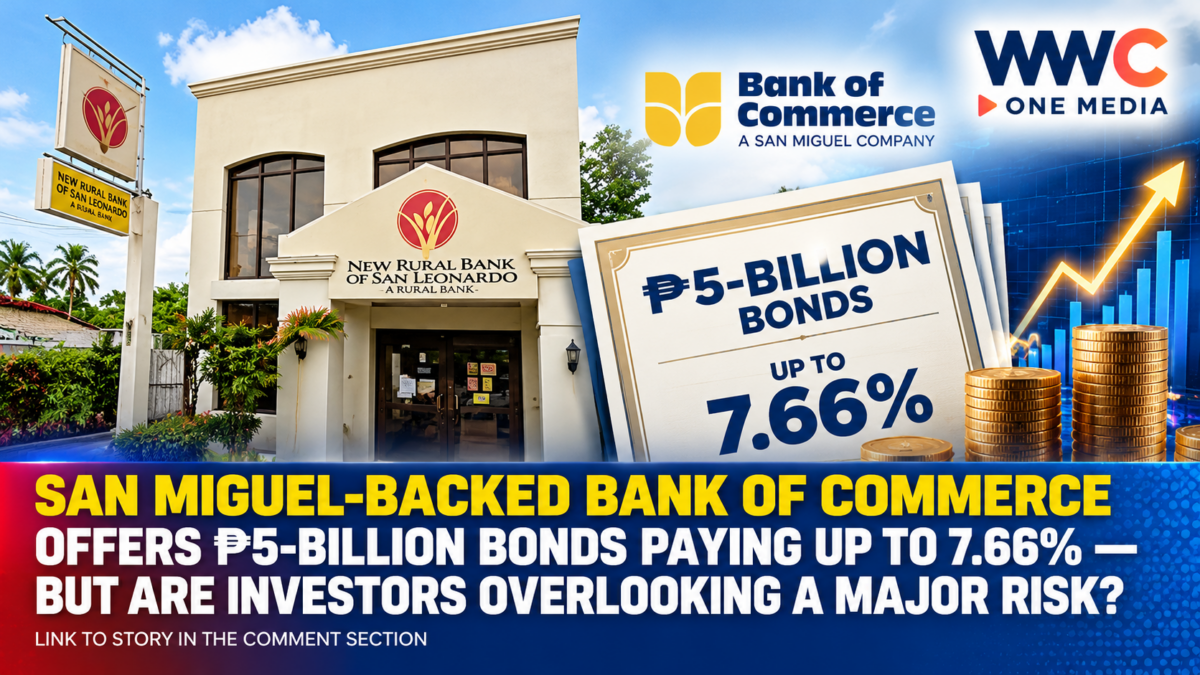
MANILA, PHILIPPINES — San Miguel Corporation-affiliated Bank of Commerce is returning to the Philippine debt capital market with a new bond offering worth at least ₱5 billion, giving investors an opportunity to earn fixed annual interest rates of up to 7.6563%.
The bank opened subscriptions on October 26 for two peso-denominated bond series maturing in 2028 and 2029.
The shorter Series E bonds offer a 6.9882% annual coupon over one and a half years, while the three-year Series F bonds carry a higher annual rate of 7.6563%.
Both series provide quarterly interest payments.
With a minimum investment of ₱100,000, the offering targets eligible individual and institutional investors seeking fixed-income investments.
However, there is an important distinction that potential buyers must understand.
These are bonds issued by a bank, not ordinary bank deposits. They are not insured by the Philippine Deposit Insurance Corporation, and investors face the possibility of losses.
The offering arrives as Bank of Commerce reports improving profitability and seeks to diversify its funding sources.
But as investors evaluate the attractive headline rates, questions remain about credit risk, taxes, liquidity and the cost of selling the securities before maturity.
BANK OF COMMERCE LAUNCHES AT LEAST ₱5 BILLION IN NEW BONDS
According to an October 26 report published by InsiderPH, Bank of Commerce has commenced a dual-tranche fixed-rate bond offering with a minimum combined issue size of ₱5 billion.
The bank has the option to increase the total amount raised if investor demand exceeds the base offering.
This arrangement is known as an oversubscription option.
The bonds are being issued under Bank of Commerce’s updated ₱80-billion peso bond program.
The transaction represents the fourth tranche under that program.
It is important to distinguish the two figures.
The ₱80-billion amount represents the authorized program framework, not the value of bonds being offered in this particular transaction.
The October 2026 offering starts at ₱5 billion, with the final issuance size depending on subscriptions and the bank’s decisions.
TWO BOND OPTIONS OFFER DIFFERENT INTEREST RATES
Investors can choose between two series.
Series E: 6.9882% per annum
The Series E bonds mature in 2028 and have a tenor of approximately 18 months.
They offer a fixed annual coupon of 6.9882%, with interest paid quarterly.
This may appeal to investors seeking a shorter maturity period.
Series F: 7.6563% per annum
The Series F bonds mature in 2029 and have a three-year tenor.
They provide a fixed annual coupon of 7.6563%, also payable quarterly.
The longer maturity comes with a higher stated interest rate.
However, a higher coupon does not automatically make the longer bond the better investment.
Investors must consider how long they can commit their funds, whether they might need to sell early and how comfortable they are with the bank’s credit risk.
The principal is scheduled to be repaid at maturity according to the bond terms, subject to the issuer meeting its obligations.
₱100,000 MINIMUM INVESTMENT — HERE’S HOW THE INTEREST WORKS
Bank of Commerce has set a minimum subscription of ₱100,000.
Additional investments must be made in increments of ₱50,000.
The quarterly payment structure can provide investors with regular interest income.
For illustration, a ₱100,000 investment in Series E at the published annual coupon of 6.9882% would generate approximately ₱6,988.20 in gross interest annually.
That is equivalent to approximately ₱1,747.05 per quarter before applicable taxes, assuming equal quarterly accrual periods.
For Series F, the annual gross coupon on the same ₱100,000 principal would be approximately ₱7,656.30.
That is equivalent to roughly ₱1,914.08 per quarter before tax, again using a simple four-quarter illustration.
Actual coupon payments may vary slightly according to the precise day-count convention and payment dates in the final bond documents.
The calculations also assume the bonds are held at their original principal amount and the issuer makes the scheduled payments.
The quoted rates are annual coupon rates, not quarterly returns.
TAXES WILL REDUCE WHAT INVESTORS TAKE HOME
Another important consideration is taxation.
Under the Philippines’ Capital Markets Efficiency Promotion Act, interest income is generally subject to a standardized 20% final withholding tax, subject to applicable exceptions and investor-specific treatment.
For a resident individual whose bond interest is subject to this rate, a ₱100,000 Series E investment would produce approximately ₱5,590.56 in annual interest after tax, based on the stated coupon.
A ₱100,000 Series F investment would provide approximately ₱6,125.04 in annual interest after the same tax assumption.
This means the annual after-tax coupon income would be lower than the advertised gross interest rates.
The tax treatment may vary for certain investors.
Potential buyers should confirm the applicable withholding arrangements and fees with their selling agent.
The calculations do not represent a guarantee of payment or a forecast of the bonds’ resale value.
OFFER PERIOD RUNS UNTIL NOVEMBER 4
The public offer began on October 26, 2026.
It is scheduled to run until November 4 at 5 p.m., Philippine time.
However, Bank of Commerce reserves the right to shorten or extend the subscription period.
The bonds are expected to be issued and listed on the Philippine Dealing & Exchange Corporation on November 11.
The PDEx listing is intended to provide a market through which eligible investors may trade the securities after issuance.
However, listing does not guarantee that buyers will always be available or that holders can sell immediately at their preferred price.
Secondary-market liquidity depends on actual trading activity and market conditions.
Investors who may need access to their funds before maturity should carefully consider this risk.
WHY BANK OF COMMERCE IS RAISING MORE FUNDS
Bank of Commerce said proceeds from the issuance will support balance-sheet management, funding diversification and general corporate purposes.
Banks raise money through several channels, including deposits, capital markets and other financing arrangements.
Issuing bonds can help establish longer-term peso funding and diversify the institution’s liability structure.
A fixed-rate bond also provides greater certainty about the interest cost associated with the issuance.
However, the offering creates contractual payment obligations.
The bank must make scheduled coupon payments and repay principal at maturity, subject to the applicable bond terms.
The ultimate benefit of the transaction will depend on how efficiently the proceeds are deployed and how the additional financing fits into the bank’s overall financial strategy.
BANK’S FIRST-HALF PROFIT RISES 13% TO ₱2.11 BILLION
The fundraising follows an improvement in Bank of Commerce’s financial performance.
For the six months ended June 30, 2026, the bank reported net income of ₱2.11 billion.
That represented 13% growth from approximately ₱1.86 billion during the same period in 2025.
The bank attributed the improvement to its core banking operations and gains associated with client-related foreign exchange activity.
It also reported an 11.56% return on equity and a 1.47% return on assets.
Bank of Commerce described these profitability ratios as record highs since its stock market debut.
The results provide useful context for evaluating the financial position of the issuer.
However, past profitability does not guarantee that a bank will meet all future bond obligations.
Investors should also examine asset quality, capital adequacy, liquidity, funding costs and credit ratings where available.
SAN MIGUEL AFFILIATION ADDS BUSINESS CONTEXT
Bank of Commerce has been affiliated with San Miguel Corporation since 2008.
The bank is publicly listed on the Philippine Stock Exchange under the ticker BNCOM.
Its affiliation with one of the country’s major conglomerates is an important part of its corporate identity and business relationships.
The bank also offers financing and other banking services to individuals, companies and institutional customers.
However, being associated with a major conglomerate does not automatically mean that every financial obligation of the bank is guaranteed by the parent group.
Bondholders must evaluate the actual issuer and any guarantees expressly established in the offering documents.
The presence of a recognizable corporate shareholder is not a substitute for reviewing credit risk.
MAJOR FINANCIAL INSTITUTIONS SUPPORT THE OFFERING
Bank of Commerce appointed four institutions as joint lead arrangers and joint bookrunners.
They are ING Bank N.V., Manila Branch; Philippine Commercial Capital Inc.; Security Bank Capital Investment Corporation; and Standard Chartered Bank.
The same institutions are acting as selling agents alongside Bank of Commerce.
These organizations help structure, distribute and market the securities to eligible investors.
Their participation provides access to established financial distribution networks.
However, involvement by arrangers or bookrunners is not a guarantee against investment losses.
The bank remains responsible for fulfilling its obligations as bond issuer.
BANKCOM RAISED ₱18 BILLION IN ITS EARLIER BOND SALE
The latest offering follows another successful domestic bond transaction.
In February 2025, Bank of Commerce raised approximately ₱18 billion through a previous dual-tranche issuance.
That offering substantially exceeded its initial ₱5-billion target.
The earlier transaction included Series C bonds with a two-year tenor and a 6.1942% coupon, alongside Series D bonds with a longer maturity and a 6.3494% coupon.
The October 2026 offering features higher published coupon rates.
However, comparing interest rates across separate issuance dates requires care.
Market yields reflect prevailing interest rates, bond maturities, issuer credit risk and investor demand.
The higher rates do not necessarily mean the bank has become riskier by an equivalent amount.
They reflect the terms at which the issuer is seeking funding under current market conditions.
THESE BONDS ARE NOT COVERED BY PDIC INSURANCE
The most important warning in the offering concerns deposit protection.
Bank of Commerce explicitly states that the securities are not deposit instruments and are not insured by the Philippine Deposit Insurance Corporation.
The PDIC protects eligible bank deposits within the applicable statutory coverage limit.
Bonds are different.
When an investor purchases a bond, that person or institution becomes a creditor of the issuer.
If the issuer fails to make required payments, bondholders may face losses or delays in recovery.
The treatment of bondholders in a financial distress or resolution process depends on the legal terms and ranking of the securities.
For this reason, the published coupon rate should never be treated as a risk-free or government-guaranteed return.
SELLING BEFORE MATURITY COULD MEAN LOSING MONEY
Another risk involves market pricing.
Fixed-rate bonds may rise or fall in value as prevailing interest rates change.
When market rates increase, existing fixed-rate bonds can become less attractive, potentially causing their prices to decline.
When market rates fall, the market value of an existing bond with a higher coupon may increase.
However, prices are also influenced by the issuer’s credit condition and trading liquidity.
An investor who sells before maturity might receive less than the original investment.
Transaction costs and the difference between buying and selling quotations can also affect the final outcome.
Even a bond with an attractive coupon may produce a negative overall return if it is sold at a sufficiently large discount.
Investors who plan to hold until maturity still face the issuer’s credit risk.
HOW THIS OFFER COMPARES WITH OTHER PHILIPPINE BONDS
The Philippine debt market has seen significant fundraising activity from banks and corporations in recent years.
Several major banks have issued peso bonds to diversify funding and support their businesses.
Bank of Commerce’s 2026 offering adds another option to this market.
However, investors should avoid comparing bonds solely through their advertised rates.
A bond offering 7.6563% may carry different risks from one offering a lower coupon.
Important differences include maturity, credit quality, security structure, ranking of claims, secondary-market liquidity and taxation.
For individual investors, the appropriate comparison should be based on after-tax yield, risk and the ability to hold the investment for the required period.
INDEPENDENT REPORTING CONFIRMS THE KEY TERMS
Context.ph reported on October 26 that Bank of Commerce had opened its ₱5-billion dual-tranche offering with the published coupon rates and minimum subscription amount.
Bankero separately covered the fundraising plan, confirming the maturities, subscription window and intended use of proceeds.
Bilyonaryo also reported the transaction and noted the bank’s stronger first-half financial performance.
The Philippine Dealing System’s disclosure records confirm that Bank of Commerce filed relevant bond-offering announcements on October 26.
These sources align with the bank’s official statement on the principal offer terms.
However, the final amount raised remains unknown until the issuer announces the completed transaction.
The ₱5-billion base offering should not be presented as an already completed ₱5-billion fundraising result.
WHAT FILIPINO INVESTORS SHOULD CONSIDER
The offering may attract investors seeking predictable peso-denominated coupon income.
Quarterly payments could be useful to those planning recurring cash flows.
However, the relatively high minimum investment may limit accessibility for some households.
A ₱100,000 investment can also represent a substantial concentration of savings.
Before subscribing, investors should assess whether they have adequate emergency funds and whether they can hold the securities until maturity.
They should also review the offering circular and final pricing supplement.
Particular attention should be paid to credit risk, early redemption provisions, tax treatment, fees, liquidity and the legal status of the securities.
Investors should not assume that a bond issued by a bank provides the same protections as a savings or time deposit.
THE BIGGER QUESTION: IS A HIGH COUPON WORTH THE RISK?
Bank of Commerce’s new bond offering highlights growing opportunities for Philippine investors seeking alternatives to traditional savings products.
The bank is offering two fixed rates, with the three-year Series F bonds paying 7.6563% annually.
The fundraising comes alongside improved earnings and an effort to diversify its financing base.
But the attractive coupon figures tell only part of the story.
These securities are not PDIC-insured deposits.
They are subject to issuer credit risk and may fluctuate in market value.
Taxes also reduce the amount of interest investors actually receive.
For Bank of Commerce, the transaction represents an opportunity to secure additional funding. For investors, it is a decision that requires balancing income potential against risk and liquidity.
And as the subscription deadline approaches, one important question remains:
Will Bank of Commerce’s nearly 7.66% annual coupon draw another wave of strong investor demand — or will concerns about credit risk, taxes and access to funds make buyers think twice before committing their money?