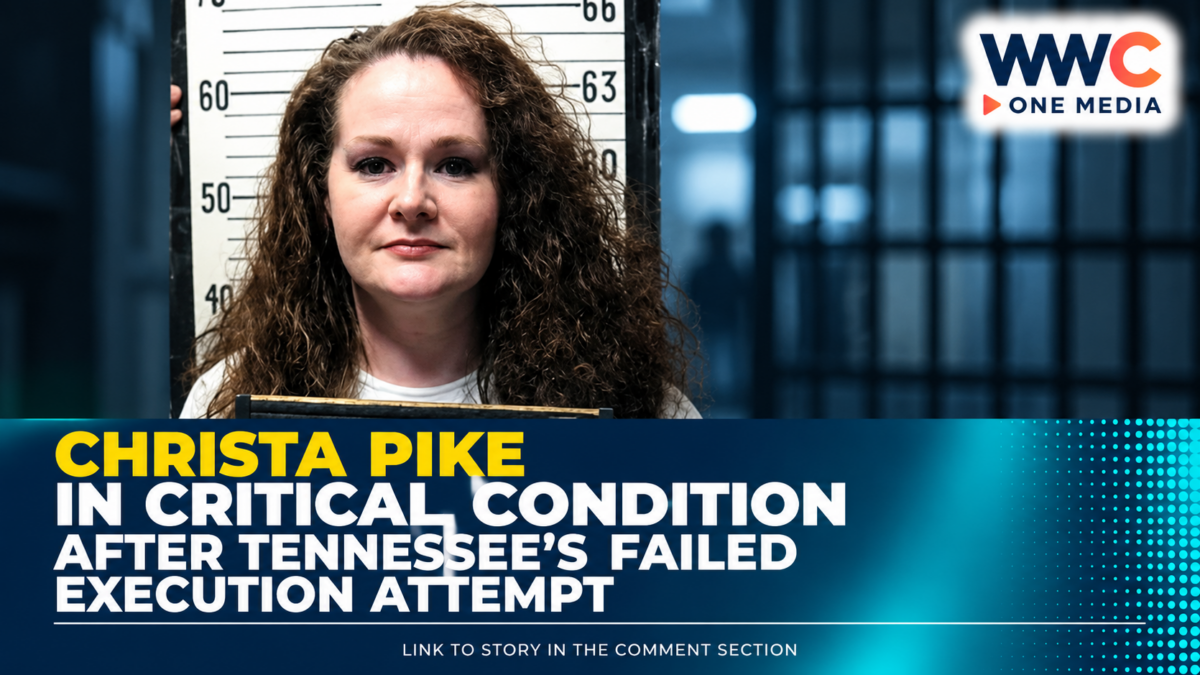
Christa Gail Pike remains in critical condition after Tennessee’s attempt to execute her by lethal injection failed, with her lawyers saying the 50-year-old death row inmate is receiving lifesaving medical treatment at a hospital.
Pike was taken to the hospital late Wednesday, September 30, after prison officials administered two doses of pentobarbital during an execution that did not result in her death. Her attorneys said Thursday that they had limited information about her condition and did not know her prognosis.
Attorney Randy Spivey said Pike was still alive and receiving lifesaving care. He said her legal team remained concerned about possible complications following the failed procedure, including the possibility of serious neurological injury, although no determination about such injuries has been publicly confirmed.
The execution began after a day of legal uncertainty. An appeals court had temporarily halted the procedure roughly an hour before it was scheduled to begin, but the US Supreme Court later allowed Tennessee to proceed. Pike was ultimately taken to the execution chamber at Riverbend Maximum Security Institution in Nashville.
During the procedure, officials encountered difficulties establishing intravenous access. Pike’s lawyers said she had warned them beforehand that a lifelong blood disorder had previously made it difficult to access her veins. Spivey said he counted at least seven needles being used in her left arm as officials attempted to establish the necessary IV lines.
According to media witnesses, Pike remained conscious after the first dose was administered. She was heard speaking and later making snoring sounds, indicating that she remained alive as the execution continued.
A second dose of pentobarbital was eventually administered, but Pike still did not die. Witnesses continued to hear her breathing and snoring after the second dose, and the execution chamber microphone was eventually switched off. She was later transported by ambulance to a hospital.
The Tennessee Department of Correction said the execution team followed the state’s established execution protocol. Officials have not publicly explained why the lethal injection failed or why the two doses did not produce the intended result.
The incident has prompted Tennessee Governor Bill Lee to suspend the state’s remaining scheduled execution for 2026 and order a comprehensive independent review of what happened. Lee described the failed execution as deeply disturbing and said the review would examine the circumstances surrounding the procedure.
Pike’s lawyers have called for her death sentence to be commuted following the failed execution. They have characterized the procedure as cruel and said the difficulties experienced during the attempt were foreseeable because of Pike’s medical history. Those statements represent the position of her legal team, while the state’s investigation into the procedure is still pending.
Pike was sentenced to death for the 1995 killing of 19-year-old Colleen Slemmer, a classmate at a job-training facility in Knoxville. Pike was 18 at the time of the crime. She was convicted alongside her then-boyfriend, Tadaryl Shipp, who received a life sentence.
Pike would have been the first woman executed in Tennessee in more than 200 years. Her case had already attracted renewed attention before the execution because her lawyers argued that allegations of severe childhood abuse and other circumstances surrounding her background warranted further consideration.
The failed procedure was also the second time this year that Tennessee has been unable to complete an execution. In May, officials halted the lethal injection of Tony Barruthers after execution personnel spent more than an hour attempting to establish an IV.
For now, Pike remains hospitalized in critical condition while authorities review the failed execution. Her lawyers have said they are awaiting further information about her medical condition, while Tennessee’s independent review is expected to examine how the procedure unfolded and why the state’s execution protocol did not result in her death.