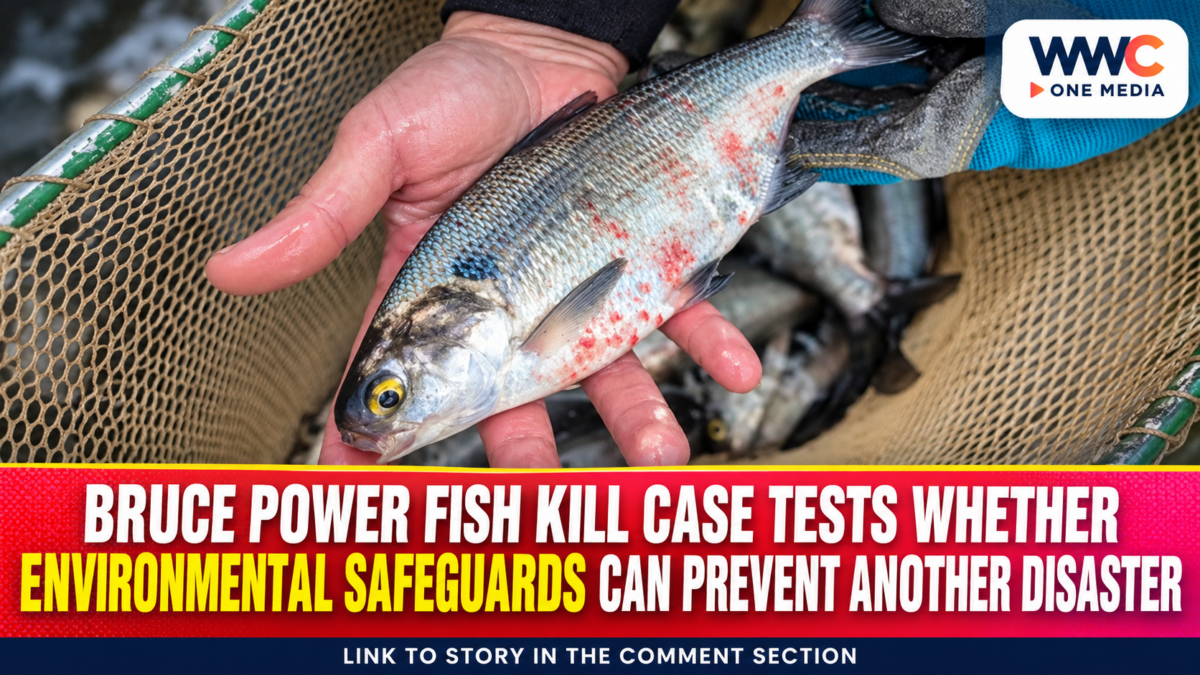
Bruce Power confirmed on October 22, 2026, that it faces two charges under Canada’s federal Fisheries Act following the deaths of large numbers of gizzard shad at its Bruce A nuclear generating station in 2025. The case places renewed attention on how industrial facilities manage fish mortality, comply with environmental authorizations and demonstrate that corrective measures are effective.
The allegations are not findings of guilt. But the incident raises a broader question for energy operators: when infrastructure designed to support essential electricity production creates risks for the surrounding ecosystem, are existing safeguards strong enough to prevent a repeat?
What the Bruce Power fish kill revealed
The Canadian Nuclear Safety Commission’s public event record identifies February 13, 2025, as the date it was informed of a substantial increase in gizzard shad entering the condenser cooling-water system at Bruce A. The accumulation reduced water flow and affected condenser operation.
Bruce Power responded by taking Unit 2 offline and reducing the reactor power of Unit 1. The company also removed fish from the intake channel, cooling-water systems and forebay, while implementing measures intended to prevent further fish from entering the system. The regulator said the situation stabilised after those actions. <Cite refs={[“turn826799view0″,”turn437300view3”]} />
The incident was not limited to equipment operations. Dead gizzard shad were later observed along the Lake Huron shoreline. In a March 21, 2025 update, Bruce Power acknowledged that fish had become trapped and died in the intake channel. It also noted that the species is sensitive to prolonged cold and changes in water temperature.
The Saugeen Ojibway Nation (SON), whose territory includes the area around the facility, subsequently conducted its own investigation. Its November 2026 update said the event involved nearly five million gizzard shad and identified heated-water discharge, cooling-water channels, fish entrapment and thermal shock as important contributing factors. Those are the Nation’s findings, not a judicial determination of legal responsibility. <Cite refs={[“turn437300view1″,”turn437300view2″,”turn437300view3”]} />
Two Fisheries Act charges put compliance under scrutiny
Bruce Power’s October 22 statement confirmed that it had been formally notified of two charges under the federal Fisheries Act. The company said it would respond through the appropriate process and did not announce how it intended to plead. <Cite refs={[“turn437300view0”]} />
SON’s November 20 community update identified the charges as causing the death of fish by means other than fishing, contrary to subsection 34.4(1), and failing to comply with conditions of a federal fisheries authorization. The Nation said the second allegation relates to an annual fish mortality limit of 6,600 kilograms. <Cite refs={[“turn437300view1″,”turn437300view2”]} />
The legal distinction matters. Canada’s Fisheries Act generally prohibits activities that result in the death of fish unless the activity has been authorised by Fisheries and Oceans Canada under specified conditions. An authorization is therefore not an unrestricted permission: it allows specified activities subject to requirements designed to protect fish and habitat. <Cite refs={[“turn826799view1″,”turn437300search5”]} />
The charges do not establish that Bruce Power committed either offence. That determination belongs to the court process. The central question is whether the evidence establishes a breach of the law or authorization conditions.
Why the authorization matters beyond the courtroom
The nuclear facility’s relationship with the lake is governed by more than its electricity-generation requirements. The Canadian Nuclear Safety Commission’s 2019 regulatory oversight report records that Fisheries and Oceans Canada issued Bruce A and B a Fisheries Act authorization in December 2019. It covers fish deaths through impingement and entrainment associated with water intakes used by the cooling systems.
The report describes conditions involving monitoring, inspections and maintenance of structures intended to reduce fish impingement. It also records an offsetting plan that included removal of the Truax Dam on the Saugeen River and funding for a Lake Huron lake-trout rehabilitation programme. <Cite refs={[“turn826799view2”]} />
In plain terms, impingement occurs when fish are trapped against intake screens or structures, while entrainment involves fish being drawn into a water system. Both can be environmental consequences of infrastructure that moves large volumes of water.
This context makes the alleged breach more specific than a general debate about whether nuclear power and nature can coexist. The issue is whether the facility met the conditions attached to its authorization and whether those conditions were adequate to manage the circumstances that occurred.
Mitigation spending is not the same as proven prevention
Bruce Power says it invested millions of dollars in additional protective measures after the event. Its October statement lists physical barriers, acoustic and strobe-light deterrents, sonar and camera-based monitoring, as well as expanded lake monitoring and research. The company said these measures were implemented for the winter of 2026. <Cite refs={[“turn437300view0”]} />
Those steps are relevant, but announcing equipment and spending does not by itself demonstrate that fish mortality has been reduced to an acceptable level. That requires evidence collected over time: monitoring results, comparisons with previous seasons, records of fish entering the cooling-water system and transparent reporting of any further incidents.
SON has also emphasised the need to assess whether mitigation measures are working. Its November update said the Nation was monitoring the legal proceedings and continuing to advocate for meaningful involvement in decisions affecting its waters. <Cite refs={[“turn437300view1″,”turn437300view2”]} />
This question of proof is familiar in environmental accountability. WWC has examined how companies respond to scrutiny over reported fire hotspots and corporate environmental responsibility. The circumstances are different, but the principle is similar: an explanation or mitigation announcement should be assessed against evidence, not treated as the final answer.
What the case means for energy and environmental governance
Bruce Power is an important electricity operator in Ontario, and the event affected the operation of two units. That makes the incident relevant to both environmental oversight and infrastructure resilience.
The regulatory challenge is not necessarily to choose between electricity generation and environmental protection. It is to ensure that industrial systems are designed, monitored and adjusted to account for the ecosystems around them.
For regulators, that means checking whether authorization conditions remain suitable as environmental conditions change. For operators, it means demonstrating that protective measures work under difficult conditions, rather than relying only on the fact that a response was implemented after an incident.
For Indigenous communities, the issue also concerns participation in decisions affecting fisheries and waters with cultural, economic and ecological significance. SON has made clear that it expects more than a legal process; it wants lasting prevention and meaningful involvement. <Cite refs={[“turn437300view1″,”turn437300view2”]} />
WWC’s reporting on industrial pollution risks exposed by flooding in Thailand and cross-border environmental accountability in Southeast Asia has highlighted a recurring problem: environmental safeguards matter most when monitoring, enforcement and corrective action can be independently assessed.
What happens next
The Fisheries Act case will proceed through the Canadian legal system. The publicly reviewed primary records confirm the charges, but do not establish the outcome of the court proceedings or independently confirm the reported procedural developments surrounding the initial court filing.
The next important evidence will include the court’s handling of the charges, any publicly released findings from Fisheries and Oceans Canada, and monitoring data showing whether the measures installed for the 2026 winter period have reduced fish mortality.
Until those records are available, the charges remain allegations and the effectiveness of the mitigation programme remains a question to be answered through evidence.
Frequently asked questions
1. What happened at Bruce Power in 2025?
A large accumulation of gizzard shad entered the Bruce A cooling-water system in February 2025, affecting condenser operation. Bruce Power took Unit 2 offline and reduced the reactor power of Unit 1.
2. What charges does Bruce Power face?
Bruce Power confirmed two federal Fisheries Act charges. SON identified them as causing the death of fish by means other than fishing and failing to comply with conditions of a federal fisheries authorization.
3. Has Bruce Power been found guilty?
No finding of guilt is established by the records reviewed. The charges are allegations that must be dealt with through the court process.
4. What measures has Bruce Power introduced?
The company says it implemented physical barriers, acoustic and strobe-light deterrents, sonar and camera-based monitoring, and expanded lake monitoring and research.
5. Why does the case matter for Lake Huron?
Gizzard shad form part of the lake’s aquatic food web. The scale of the reported mortality raises questions about the protection of fish populations, the effectiveness of industrial safeguards and the involvement of affected Indigenous communities.