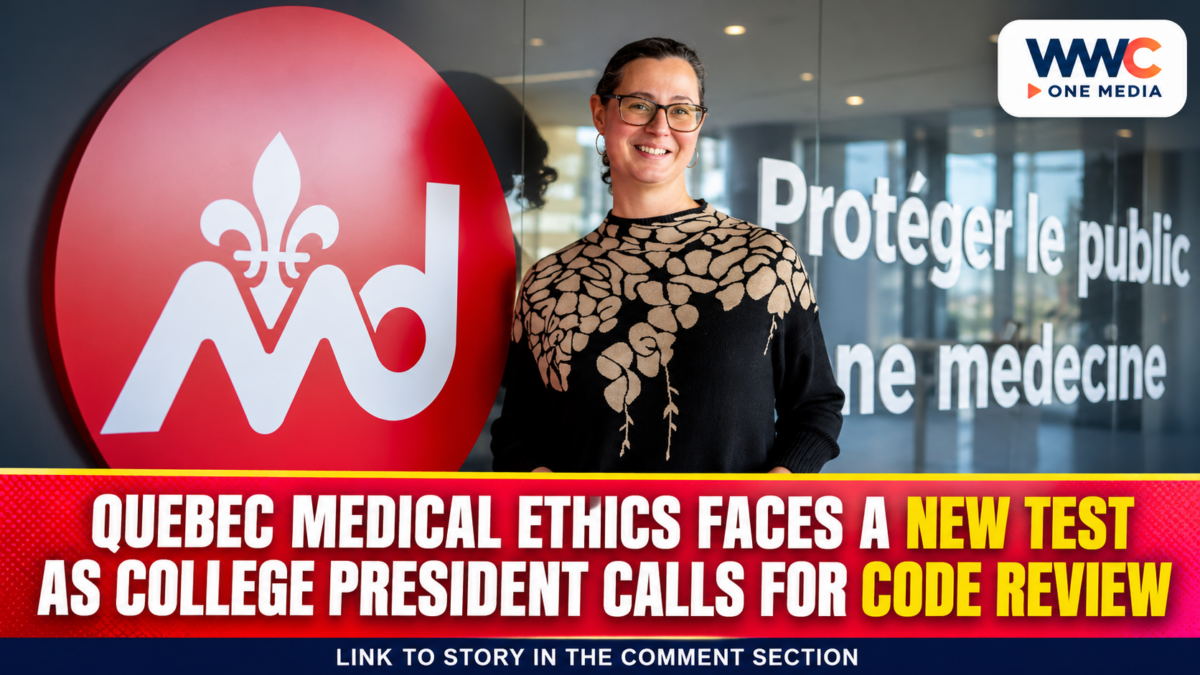
Quebec’s medical regulator has a new president, and one of her stated priorities is to reconsider the professional rules governing doctors as artificial intelligence, telehealth and team-based healthcare become increasingly important. Dr. Nathalie Saad took office as president of the Collège des médecins du Québec on October 29, 2026, beginning a four-year term.
Her call to review the Code of Ethics raises a larger question for patients and healthcare professionals: can rules written around traditional medical practice adequately address decisions increasingly influenced by digital tools, remote consultations and collaboration among different health professionals?
The issue is not simply whether doctors should use new technology. It is how responsibility, patient confidentiality, professional independence and quality of care should be protected when medical practice changes.
Quebec medical ethics enters a new leadership period
Saad succeeds Dr. Mauril Gaudreault and becomes the College’s 35th president. The organisation described her as the first woman to hold the presidency. Before her election, she had served as vice-president of its board of directors for eight years. <Cite refs={[“turn111420view0″,”turn115403search1”]} />
A pulmonologist, Saad has professional roles at the Jewish General Hospital and McGill University Health Centre. The College also identifies her as vice-dean for student affairs at McGill University’s Faculty of Medicine, director of the pulmonary telerehabilitation programme at Mount Sinai Hospital, and a medical consultant and expert in chronic obstructive pulmonary disease for Santé Québec and the provincial health ministry. <Cite refs={[“turn111420view0”]} />
For her four-year presidency, she identified population ageing, primary care, management of results and access to healthcare as major priorities. She also argued that the Code of Ethics should be reviewed to better reflect modern practice, specifically naming artificial intelligence, telehealth and interprofessionalism. <Cite refs={[“turn111420view0”]} />
That is a call for review, not confirmation that a replacement code has been drafted, approved or given an implementation date.
Why artificial intelligence is becoming an ethics issue
The College had already begun examining the implications of artificial intelligence before Saad became president.
In its June 2026 board update, the organisation said its AI working group was studying the growing integration of artificial intelligence into medical practice, including applications with increasing levels of autonomy. It was also examining the use of health-related AI tools by patients.
The College identified risks involving the quality of care and professional ethics, particularly responsibility and confidentiality. It said it was evaluating how best to fulfil its regulatory role and support the public as AI becomes more common in healthcare. <Cite refs={[“turn949838view0″,”turn775795view3”]} />
The distinction is important. An AI system may help a physician organise information, review medical literature or prepare documentation. But the presence of an automated recommendation does not settle who is accountable for checking its accuracy or deciding whether it is appropriate for an individual patient.
WWC previously examined this challenge in its report on clinical AI and the need for professional oversight in public hospitals. The broader issue is how healthcare institutions can use digital assistance without confusing technical support with independent medical judgment.
A revised ethical framework could clarify expectations around physician supervision, verification of AI-generated information, disclosure and the handling of patient data. These are possible areas for consideration, not confirmed provisions of a proposed Quebec amendment.
The existing code already sets important boundaries
Quebec’s current Code of Ethics of Physicians is not an empty framework waiting for technology rules. The regulation establishes duties for every member of the Collège des médecins du Québec.
It requires physicians to protect and promote the health and well-being of the people they treat, practise with competence and integrity, follow scientific principles and maintain professional independence. <Cite refs={[“turn111420view1″,”turn775795view2”]} />
Articles 8 and 9 are particularly relevant as healthcare becomes more organisational and technology-dependent. Article 8 states that a physician’s professional obligations are not reduced because the physician works within a partnership or joint-stock company. Article 9 prohibits a physician from allowing another person to perform, in the physician’s name, an act that would breach the applicable professional rules if performed by the physician. <Cite refs={[“turn775795view2”]} />
These provisions offer a foundation for considering technology-assisted care. If an automated system contributes to a clinical decision or prepares part of a medical record, the important question remains how the responsible physician reviews and takes responsibility for professional work.
The College has also previously emphasised that doctors remain bound by their professional obligations when practising within organisations. In a January 2026 statement, it raised concerns about the limits of its ability to compel organisations not owned by physicians to comply with professional standards, while reiterating the duties that continue to apply to its members. <Cite refs={[“turn111420view3”]} />
Telehealth and team-based care create different responsibilities
Remote consultations can make medical services more accessible, but they also change how physicians communicate with patients, assess information and maintain records.
The College’s current ethical framework already includes duties concerning professional relationships, consent, medical follow-up, confidentiality and access to patient records. The challenge for a future review would be to consider whether these principles need more specific guidance for remote and digitally supported practice.
Interprofessionalism presents another question. Healthcare increasingly involves physicians working alongside nurses, pharmacists, therapists and other professionals. Collaboration can support coordinated care, but professional responsibilities must remain clear when decisions and information move between different members of a care team.
For patients, the practical concern is straightforward: they should know who is responsible for their care, how their information is being handled and how to raise concerns if something goes wrong.
The growth of consumer-facing AI adds another dimension. WWC’s coverage of patients turning to AI for medical advice explored the risks when people rely on automated answers without appropriate professional assessment. A professional code review could help clarify the responsibilities of doctors when patients bring AI-generated information into consultations.
Why the review matters to patients and healthcare organisations
A professional code is more than a list of restrictions. It helps establish what patients can expect from licensed practitioners and what standards professionals must maintain, including when working in complex institutional settings.
For healthcare organisations, clearer rules could help guide procurement and use of AI systems, staff training, clinical documentation and privacy safeguards. They could also help distinguish administrative automation from activities requiring professional judgment.
Digital healthcare platforms are expanding beyond online consultations. WWC’s reporting on mWell’s AI-assisted doctor tools and connected healthcare services examined how technology may support documentation and coordination while leaving physicians responsible for reviewing clinical records.
Quebec’s review could become a useful test of how professional regulators respond to similar changes. But clearer rules will matter only if they are practical, understandable and enforceable.
The College’s own public ethics page also sets out proposed preamble principles recognising the historical and cultural factors affecting First Peoples, respect for culture and identity, and the need to recognise systemic discrimination. This indicates that the regulator’s wider ethics discussion also concerns trust, equity and the relationship between patients and the healthcare system. <Cite refs={[“turn111420view2”]} />
What happens next
The next step is to establish whether the College will translate Saad’s call into a formal review process, consultation or proposed regulatory amendments.
The records reviewed confirm her stated intention and the College’s existing AI work. They do not establish a published draft of a revised Code of Ethics, a consultation timetable or approval by the provincial government.
The College has separately reported changes to mandatory continuing medical education, including a new ethics, deontology and professional-practice requirement. Its June update said the amended regulation would be submitted to the Office des professions du Québec for approval, with January 2027 anticipated as its effective date. That is a separate regulatory measure and should not be confused with a revision of the Code itself. <Cite refs={[“turn949838view0″,”turn115403search2”]} />
For patients, the key measure of any future reform will be whether it strengthens accountability while allowing responsible innovation. For doctors, it will be whether the rules offer practical guidance in situations that existing professional standards may not address in sufficient detail.
Frequently asked questions
1. Who is the new president of Quebec’s College of Physicians?
Dr. Nathalie Saad became president of the Collège des médecins du Québec on October 29, 2026. She is the organisation’s 35th president and its first woman to hold the position.
2. Does Quebec plan to replace its physicians’ Code of Ethics?
The new president has called for the Code to be reviewed. The public records reviewed do not confirm that a replacement code has been formally drafted or approved.
3. Why does artificial intelligence matter to medical ethics?
AI can influence medical information, documentation and decision-making. Ethical questions include who verifies its output, who remains responsible for clinical decisions and how patient information is protected.
4. Does the current Code already cover physician responsibility?
Yes. It establishes duties involving patient well-being, competence, integrity, scientific principles and professional independence. Articles 8 and 9 also address professional obligations when physicians work within organisations.
5. What could change for patients?
A future review could clarify expectations for AI-assisted care, telehealth, confidentiality and collaboration among healthcare professionals. The exact changes will depend on any formal proposals the College eventually publishes.