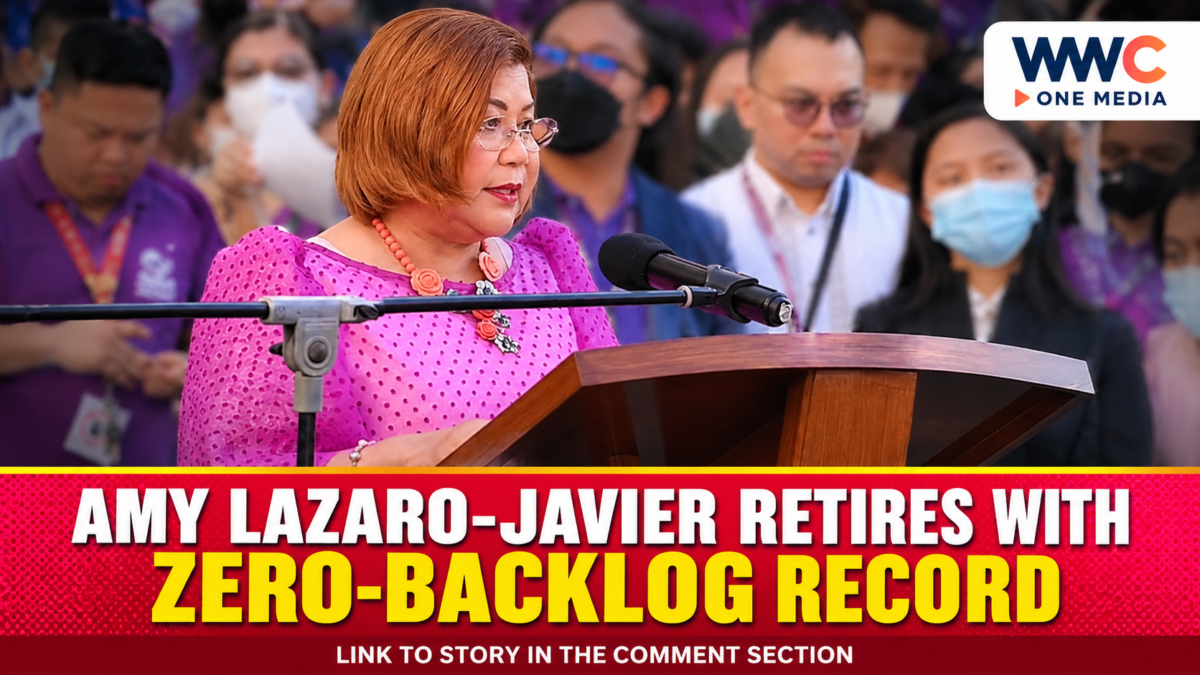
Supreme Court Associate Justice Amy C. Lazaro-Javier officially retired on Monday after reaching the mandatory retirement age of 70, closing a government career that spanned 49 years and included service as a teacher, government lawyer, appellate magistrate and member of the country’s highest court.
Her departure is notable not only because of her years in public service but also because the Supreme Court recognised her for maintaining a zero-backlog docket throughout her judicial career. She received the Judicial Medal of Distinction, an honour associated with retiring justices who meet the constitutional standard for deciding cases within the prescribed period.
The retirement comes during a period of change at the Supreme Court, which has recently welcomed a new Chief Justice and is filling another associate justice position. Lazaro-Javier’s departure therefore marks both the end of an individual judicial career and another transition in the membership of the High Court.
Lazaro-Javier retirement marks the end of a 49-year public career
The Supreme Court’s public information office confirmed that Lazaro-Javier’s retirement took effect on Nov. 16, 2026, upon reaching the mandatory retirement age of 70.
The Court’s record identifies her as the 182nd Associate Justice of the Supreme Court. President Rodrigo Duterte appointed her to the position on March 7, 2019.
Before joining the High Court, she served as an Associate Justice of the Court of Appeals from September 13, 2007, to March 6, 2019. Her judicial work followed a lengthy career in government service that began before her appointment to the appellate courts.
The Supreme Court’s official profile also records her experience as a law professor, Bar examiner and lecturer on legal and judicial subjects.
Her retirement closes a career that crossed several parts of the justice system: legal education, government litigation, appellate adjudication and the final court of appeal.
What the zero-backlog record means
One of the most significant details in the Court’s retirement recognition was Lazaro-Javier’s reported zero-backlog docket.
The Supreme Court Public Information Office said she maintained that record first at the Court of Appeals and later at the Supreme Court. The Court’s published profile independently identifies her zero-backlog record during her Court of Appeals service.
The distinction matters because judges and justices must manage cases within constitutional time limits while ensuring that decisions receive proper legal study and deliberation.
Article VIII, Section 15 of the 1987 Constitution sets periods for deciding cases submitted for decision. The provision generally gives the Supreme Court 24 months, lower collegiate courts 12 months and other lower courts three months, subject to the constitutional text and applicable rules.
A zero-backlog record should not be confused with a claim that every case was resolved immediately. It refers to the absence of cases left undecided beyond the applicable period, rather than the absence of pending cases at any point.
For litigants, timely decisions matter because unresolved cases can prolong uncertainty over property, family matters, employment, public accountability and other legal rights.
Why she received the Judicial Medal of Distinction
The Supreme Court included the Judicial Medal of Distinction among the honours presented to Lazaro-Javier during her retirement recognition.
The Court describes the medal as one of its highest recognitions of judicial excellence. Its explanation links the award to retiring justices who leave no cases undecided beyond the Constitution’s prescribed 24-month period.
The recognition places attention on an important part of judicial responsibility that is less visible than high-profile rulings: the steady handling of cases assigned to a magistrate.
Supreme Court justices decide cases collectively in the Court’s divisions and en banc sessions, but each justice also has responsibilities involving the study of records, preparation of opinions and participation in deliberations.
A record of resolving assigned cases within the required periods is therefore an institutional achievement as well as an individual professional distinction.
The award does not mean that every decision made during a justice’s career was unanimous or free from disagreement. Judicial independence includes the ability of justices to express separate opinions when they interpret the law differently.
From the Court of Appeals to the 2025 Bar Examinations
Lazaro-Javier’s work extended beyond deciding cases.
The Supreme Court appointed her chairperson of the 2025 Bar Examinations, placing her at the centre of the process through which aspiring lawyers seek admission to the Philippine legal profession.
The Court announced in January 2026 that 5,594 of 11,420 qualified examinees passed the 2025 examinations, producing a passing rate of 48.98%.
Her role as Bar chairperson involved overseeing one of the Judiciary’s major responsibilities: administering the examination that determines whether candidates have met the required standards for entry into the legal profession.
The Bar examination process is significant beyond the number of successful candidates. It is one of the mechanisms through which the Supreme Court supervises admission to the practice of law and maintains professional standards.
WWC previously covered the appointment of Gamaliel Asis Cordoba as the Supreme Court’s 196th Associate Justice, the appointment that filled the position following Lazaro-Javier’s scheduled retirement.
A Supreme Court undergoing leadership and membership changes
Lazaro-Javier’s retirement comes shortly after another major change in the Court’s leadership.
Rodil V. Zalameda took his oath as the 28th Chief Justice on Nov. 6, 2026, succeeding Alexander G. Gesmundo, who retired upon reaching the mandatory retirement age.
The Judicial and Bar Council had also submitted a shortlist of nominees for the associate justice position expected to become vacant upon Lazaro-Javier’s retirement. The appointment process is separate from the selection of the Chief Justice.
The JBC’s role is to screen candidates and recommend nominees for judicial appointments. The President makes the appointment from the council’s shortlist, following the constitutional process.
These developments place the Court in a period of institutional transition. WWC has also examined the Judicial and Bar Council’s process for filling another Supreme Court vacancy.
The changes matter because the Supreme Court’s membership influences how the institution deliberates on constitutional questions, government powers, individual rights and disputes with national consequences.
Why judicial case management matters to ordinary Filipinos
Analysis: The most practical lesson from Lazaro-Javier’s reported record is that the justice system depends not only on landmark rulings but also on the consistent handling of ordinary cases.
For people waiting for a court decision, delay can have serious consequences. A dispute that remains unresolved may affect a person’s livelihood, access to property, family arrangements or ability to move forward with important decisions.
A justice’s individual record cannot, by itself, solve the wider problem of court congestion. Case delays can involve staffing, procedural requirements, the number of cases filed, available resources and the actions of parties in litigation.
Nevertheless, the recognition of a zero-backlog docket highlights a standard of judicial performance that the institution can encourage and monitor.
The Supreme Court has also pursued broader initiatives to improve court efficiency and access to justice. WWC has previously examined the High Court’s reform agenda to reduce court delays and expand access to justice.
The larger challenge is to make timely decisions a consistent feature of the justice system, rather than an achievement associated with only a limited number of magistrates.
What happens next
With Lazaro-Javier’s retirement effective Nov. 16, the next step is the continuation of the appointment process for the vacant associate justice position.
The Judicial and Bar Council had already submitted its shortlist to the President. The appointment will determine who succeeds her on the Supreme Court.
Her departure also leaves the Court to continue its work under Chief Justice Rodil V. Zalameda, whose leadership began earlier this month.
For Lazaro-Javier, the retirement marks the conclusion of nearly five decades in government service. For the Judiciary, the more enduring question is how the standards associated with her recognition can be reflected in the wider administration of justice.
Frequently asked questions
When did Amy Lazaro-Javier retire?
She officially retired on November 16, 2026, upon reaching the mandatory retirement age of 70.
How long did Lazaro-Javier serve in government?
The Supreme Court Public Information Office said she retired after 49 years in government service.
What is the Judicial Medal of Distinction?
It is a Supreme Court recognition of judicial excellence. The Court says it is given to retiring justices who leave no cases undecided beyond the Constitution’s prescribed 24-month period.
What does a zero-backlog docket mean?
It means a justice has no cases left undecided beyond the applicable decision period. It does not mean the justice never had pending cases.
Who will replace Lazaro-Javier?
The Judicial and Bar Council submitted a shortlist of nominees to the President for the associate justice vacancy. The President makes the appointment through the constitutional process.