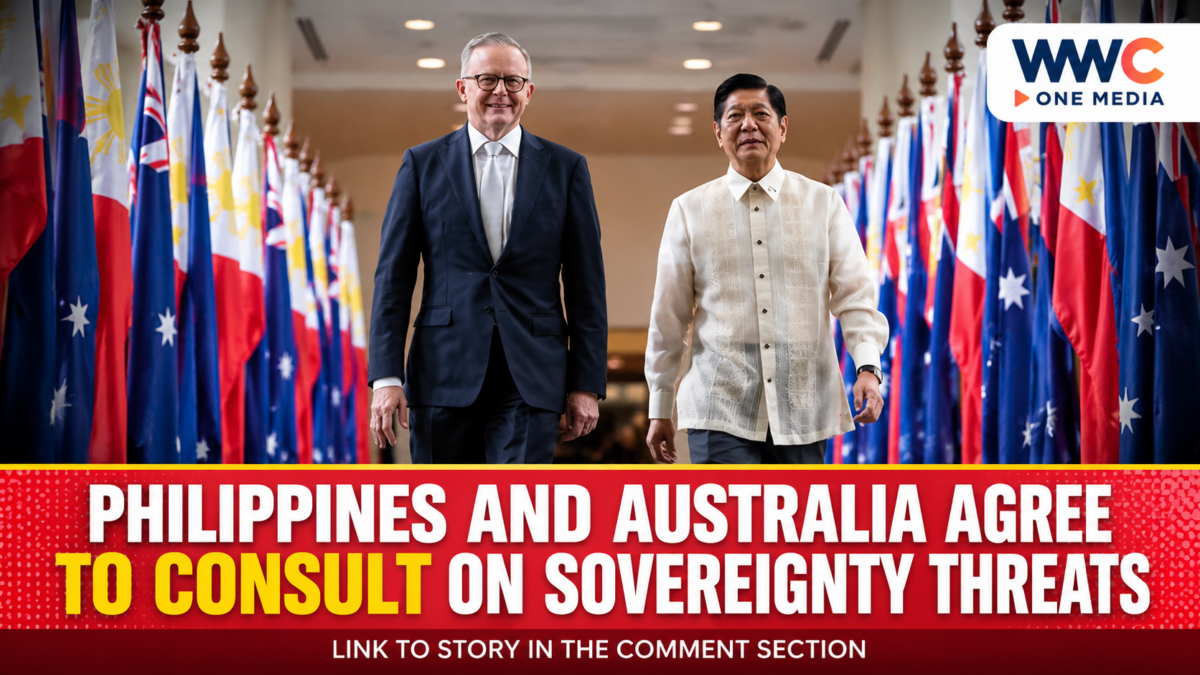
The Philippines and Australia have committed to consult each other over situations that could affect either country’s sovereignty or their shared defence and regional security interests, establishing a more explicit channel for high-level security coordination.
The commitment appears in a joint leaders’ statement released during Australian Prime Minister Anthony Albanese’s visit to Manila, where he met Philippine President Ferdinand Marcos Jr. The document outlines plans to strengthen engagement between the two governments, their senior officials and armed forces.
The pledge matters because it gives the countries a stated process for discussing possible security contingencies before deciding what action, if any, may be appropriate. It does not automatically require either government to enter a military conflict or provide an unconditional guarantee of military assistance.
What the Philippines-Australia security commitment actually says
The joint statement, titled Kasandigan: Philippines, Australia Expand Security Ties, reaffirms the Strategic Partnership established in 2023.
Its central security provision says the two countries will consult each other on contingencies that may affect their sovereignty or shared defence and regional security interests. They also agreed to consider appropriate measures in response, consistent with their respective processes.
In practical terms, the commitment establishes a political and diplomatic basis for discussions when either government identifies a situation that could affect important national or shared security interests.
It also calls for stronger engagement among leaders, ministers, senior officials and armed forces.
The wording is important. The statement refers to consultation and consideration of appropriate measures. It does not say that every contingency will trigger a particular military response, nor does it establish an automatic obligation to deploy forces.
For both governments, the distinction allows security coordination to deepen while leaving decisions subject to their respective national procedures.
Why the 2023 Strategic Partnership matters
The new commitment builds on the bilateral Strategic Partnership declared in September 2023.
That relationship provides the broader political framework for cooperation between Manila and Canberra, covering security, economic engagement and regional stability.
The two governments are also marking 80 years of diplomatic relations in 2026. Their relationship has developed through defence exchanges, official visits, maritime cooperation and participation in regional security discussions.
The latest statement seeks to give that relationship a more practical direction by strengthening consultation across several levels of government.
For the Philippines, the arrangement adds another formal avenue for discussing security concerns with a regional partner. For Australia, it reinforces a relationship with a country located along important Indo-Pacific maritime routes.
The two governments’ diplomatic relationship has also developed alongside Australia’s efforts to manage its economic and strategic relationship with China, a balancing act explored in WWC’s report on Albanese’s planned China engagement and its regional security implications.
How the commitment connects to the new defence arrangement
The leaders’ consultation pledge should be distinguished from the Defence Cooperation Arrangement signed in Manila on Nov. 15.
The separate defence arrangement provides a framework for practical cooperation between the two countries’ defence establishments. Its identified areas include maritime awareness and activities, information-sharing, strategic dialogue, planning, training, interoperability and defence infrastructure development.
Australian Prime Minister Albanese witnessed the signing.
The Australian government also announced additional support for maritime-domain awareness and regional maritime partnerships, including capabilities such as aerial and surface drones, secure communications support and operator training.
These measures address operational cooperation. The leaders’ statement, meanwhile, sets out a broader political commitment to consult when security contingencies arise.
Together, the documents point to two related tracks: improving practical defence coordination and strengthening the process through which both governments discuss emerging security concerns.
Neither document should be described as a newly signed mutual-defence treaty.
Why sovereignty and maritime security are central
The commitment carries particular significance for the Philippines because maritime security and sovereign rights remain major concerns in the country’s foreign policy.
The Philippines has repeatedly invoked international law, including the United Nations Convention on the Law of the Sea, in defending its maritime entitlements.
The July 12, 2016 South China Sea arbitral award remains an important legal reference in that position. The tribunal rejected the legal basis for China’s historic-rights claims to resources in areas where those claims exceeded the maritime entitlements permitted under the convention. The ruling did not decide sovereignty over every land feature or establish a final maritime boundary between the Philippines and China.
WWC has previously explained the distinction between maritime entitlements and territorial sovereignty in its coverage of the legal significance and limits of the 2016 arbitral ruling.
Australia’s own public position emphasises respect for sovereignty, territorial integrity, international law and freedom of navigation. During a Manila press conference on Nov. 15, Albanese said Australia’s cooperation was not directed at one country and described it as support for the sovereignty of all countries.
That statement provides context for Canberra’s approach, but it should not be confused with a specific provision of the leaders’ joint statement.
What the agreement could mean for regional security
Analysis: The consultation commitment could make the Philippines-Australia partnership more useful when regional developments require quick diplomatic communication.
Security concerns do not always begin with a direct military confrontation. They can involve maritime incidents, cyber threats, disruptions to important infrastructure or developments that affect regional stability.
A structured consultation process could help the two governments exchange assessments, clarify their positions and consider possible responses before a situation escalates.
However, the effectiveness of the pledge will depend on how both sides implement it. The public statement does not provide a detailed timetable for consultations, a list of triggering events or a specific response mechanism for every possible contingency.
It also does not establish that either country will automatically adopt the other’s position in a dispute.
The wider regional context is important. The Philippines is also working through ASEAN-led diplomacy and other bilateral and multilateral partnerships. Its role as host of the 49th ASEAN Summit places these security discussions within a broader effort to preserve regional stability.
WWC previously examined the wider diplomatic agenda surrounding the Philippines’ hosting of the 49th ASEAN Summit.
The challenge for Manila and Canberra will be to ensure that stronger bilateral coordination complements, rather than weakens, regional diplomatic mechanisms.
What happens next
The next stage will involve turning the leaders’ commitments into regular engagement among ministers, senior officials and defence establishments.
The public statement establishes the direction of cooperation but does not provide a complete implementation schedule, detailed consultation procedures or a list of approved responses to potential contingencies.
Further official announcements will be needed to establish whether the governments adopt additional procedures, schedule specific consultations or announce new joint activities.
For the Philippines, the important measure will be whether the partnership strengthens its ability to protect national interests while maintaining control over its own security decisions.
For Australia, the commitment reinforces its role as a regional partner with an interest in a stable and rules-based Indo-Pacific.
The pledge is a significant diplomatic step, but its practical value will ultimately depend on what both governments do after making it.
Frequently asked questions
What did Marcos and Albanese agree to?
They committed to consult each other on contingencies that may affect their sovereignty or shared defence and regional security interests, and to consider appropriate measures through their respective processes.
Does the commitment mean Australia must defend the Philippines in a conflict?
The published statement does not establish an automatic military response or unconditional obligation to enter a conflict. It commits the countries to consultation and consideration of appropriate measures.
Is this the same as the new Philippines-Australia Defence Cooperation Arrangement?
No. The Defence Cooperation Arrangement is a separate framework for practical defence cooperation, including maritime awareness, information-sharing, training and interoperability.
When did the Philippines and Australia establish their Strategic Partnership?
The two countries established their Strategic Partnership in September 2023.
What happens after the joint statement?
Both governments are expected to pursue stronger engagement among leaders, ministers, senior officials and armed forces. Specific implementation procedures and timelines have not been detailed in the public statement.