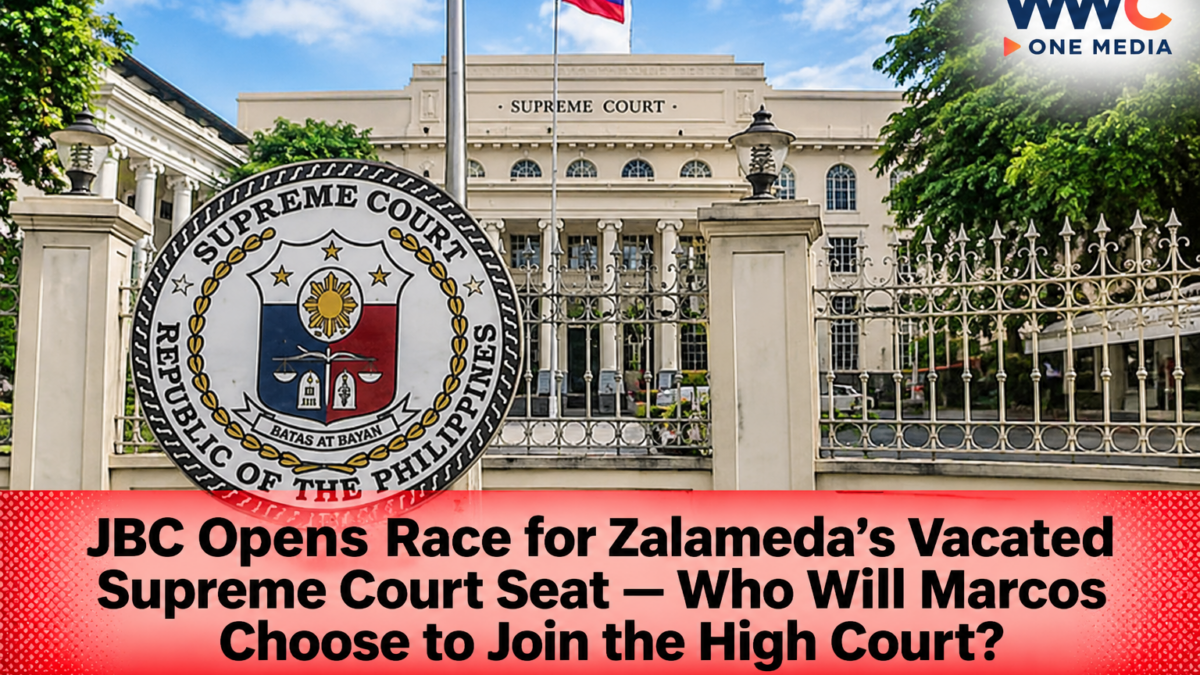
MANILA, Philippines — The race for another seat in the Philippine Supreme Court is officially underway, with the Judicial and Bar Council (JBC) opening applications and nominations for the associate justice position vacated after Rodil V. Zalameda became the country’s 28th chief justice.
Interested applicants and individuals recommended for the position have until December 28, 2026, at 4:30 p.m. to complete their submissions, according to the JBC announcement reported by Philstar and other news organizations.
The vacancy emerged after President Ferdinand Marcos Jr. appointed Zalameda as chief justice on November 5. Zalameda took his oath the following day, succeeding Chief Justice Alexander Gesmundo, who retired upon reaching the mandatory retirement age of 70.
The appointment now creates an opening among the Supreme Court’s 14 associate justice positions.
For Marcos, the selection will mark another opportunity to shape the membership of the country’s highest court. The President will choose from the nominees endorsed by the JBC after the council completes its screening and selection process.
But this is not the only change coming to the judiciary. Another Supreme Court seat is scheduled to become vacant when Associate Justice Amy C. Lazaro-Javier reaches the mandatory retirement age on November 16.
December 28 Deadline: How to Apply for the Supreme Court Position
The JBC has set December 28, 2026, at 4:30 p.m. as the deadline for applications and recommendations for the associate justice vacancy.
According to the Daily Tribune, applicants must complete their registration and submit the required documents through the JBC Online Registration and Application System (O.R.A.S.), accessible through the Philippine Judiciary Platform.
Applicants with existing O.R.A.S. accounts are also reminded to update their personal information and credentials before submitting their applications.
The JBC is responsible for evaluating candidates and recommending qualified nominees for judicial appointments. Its screening process is intended to assess whether applicants meet the constitutional and professional standards required of members of the judiciary.
Interested candidates should consult the council’s official website for the complete application checklist, instructions and any updated requirements.
Official application resources:
- JBC website: https://jbc.judiciary.gov.ph/
- Philippine Judiciary Platform: https://portal.judiciary.gov.ph/
Who Can Become a Supreme Court Associate Justice?
The position is among the most consequential legal appointments in the country because Supreme Court justices decide cases involving constitutional interpretation, government authority, individual rights and major national controversies.
Under Article VIII, Section 7 of the 1987 Constitution, a Supreme Court justice must meet specific qualifications.
A candidate must:
- Be a natural-born citizen of the Philippines.
- Be at least 40 years old.
- Have at least 15 years of experience as a judge of a lower court or in the practice of law in the Philippines.
- Be a person of proven competence, integrity, probity and independence.
Meeting the minimum qualifications does not automatically guarantee nomination or appointment.
The JBC must still evaluate applicants and determine which candidates should be included in the shortlist submitted to the President.
The process is designed to ensure that the selection of Supreme Court members is based on professional qualifications and suitability for judicial service.
Why the JBC Plays a Crucial Role in the Appointment
The Judicial and Bar Council is a constitutionally established body responsible for recommending nominees for appointments to the judiciary.
Its role is especially important because Supreme Court justices are appointed by the President without confirmation from the Commission on Appointments.
Under Article VIII, Section 9 of the Constitution, the President selects an appointee from a list of at least three nominees prepared by the JBC for each vacancy.
This means the President does not simply choose any lawyer or judge for the position. The appointment must come from the council’s official shortlist.
The JBC’s screening process therefore serves as a major safeguard in the judicial appointment system.
It also gives the council an important responsibility: identifying candidates whose legal experience, integrity and independence meet the standards expected of the country’s highest court.
Marcos’ Appointment of Zalameda Created the New Vacancy
The latest application process follows Marcos’ appointment of Zalameda as the 28th chief justice.
Zalameda took his oath on November 6, replacing Gesmundo, who retired on the same date.
Before joining the Supreme Court, Zalameda served for 11 years as an associate justice of the Court of Appeals. He became a Supreme Court associate justice in August 2019 after being appointed by former President Rodrigo Duterte.
His judicial career followed earlier service as a court official and public prosecutor.
The Supreme Court’s official profile also identifies his involvement in judicial administration, procedural reform, court security and access to justice.
During his public interview before the JBC on October 26, Zalameda highlighted the importance of experience and perspective in leading the judiciary.
His appointment left the associate justice position open, prompting the JBC to begin a new application and nomination process.
A Second Supreme Court Vacancy Is Expected on November 16
The appointment process is unfolding alongside another major transition in the Supreme Court.
Associate Justice Amy C. Lazaro-Javier is scheduled to retire on November 16, 2026, upon reaching the mandatory retirement age of 70.
However, her vacancy is being handled separately from the newly opened Zalameda seat.
The Supreme Court announced on October 29 that the JBC had already submitted to Marcos its shortlist of nominees for the position expected to be vacated by Lazaro-Javier.
That shortlist included Court of Appeals justices, Solicitor General Darlene Marie B. Berberabe, Commission on Audit Chairperson Gamaliel A. Cordoba, Commission on Elections Commissioner Ernesto P. Maceda Jr. and other judicial officials.
The distinction matters: the December 28 deadline concerns the associate justice seat opened after Zalameda’s appointment as chief justice. It should not be mistaken for the application deadline or shortlist process involving Lazaro-Javier’s upcoming retirement.
With two separate vacancies being addressed in close succession, the Supreme Court is entering another period of significant personnel changes.
How Long Does the President Have to Fill a Supreme Court Vacancy?
The 1987 Constitution sets a 90-day period for filling vacancies in the Supreme Court.
Article VIII, Section 4(1) provides that vacancies in the high court must be filled within 90 days from their occurrence.
The JBC’s 2020 Revised Rules also state that vacancies in the offices of the chief justice and associate justices must be filled within 90 days from the date they occur.
This is an important distinction from the separate rule for vacancies in the Court of Appeals, Sandiganbayan, Court of Tax Appeals and other courts, where the 90-day period is counted from the official submission of the nominees’ list to the President.
The appointment process for the Supreme Court therefore involves both the JBC’s screening timetable and the constitutional deadline for filling the vacancy.
Why the Next Appointment Matters
A Supreme Court associate justice is not simply another government official.
The justices collectively decide cases that can affect national policies, elections, government accountability, constitutional rights and the balance of power among the branches of government.
The incoming appointee will join the court during a period when several major legal and political issues are receiving national attention.
Recent Supreme Court proceedings have included disputes involving the impeachment process, election laws and government spending.
The composition of the high court matters because its decisions can establish legal interpretations that guide government institutions and affect millions of Filipinos.
For this reason, the JBC’s screening process and the President’s eventual choice will likely receive close attention from the legal community and the public.
The Bigger Question: Who Will Get the Next Seat?
The JBC has opened the door for qualified lawyers and judicial officials to seek the associate justice position vacated after Zalameda’s elevation to chief justice.
The next steps will involve receiving applications, checking qualifications, evaluating candidates and preparing the shortlist for presidential consideration.
Marcos will then have to select an appointee from the JBC’s list within the applicable constitutional period.
At the same time, the expected retirement of Lazaro-Javier means another appointment decision is approaching.
The developments could reshape the membership of the Supreme Court in a relatively short period.
For now, the immediate deadline is December 28. But the bigger question is who will eventually receive the President’s appointment—and what kind of leadership and judicial philosophy the next associate justice will bring to the country’s highest court.