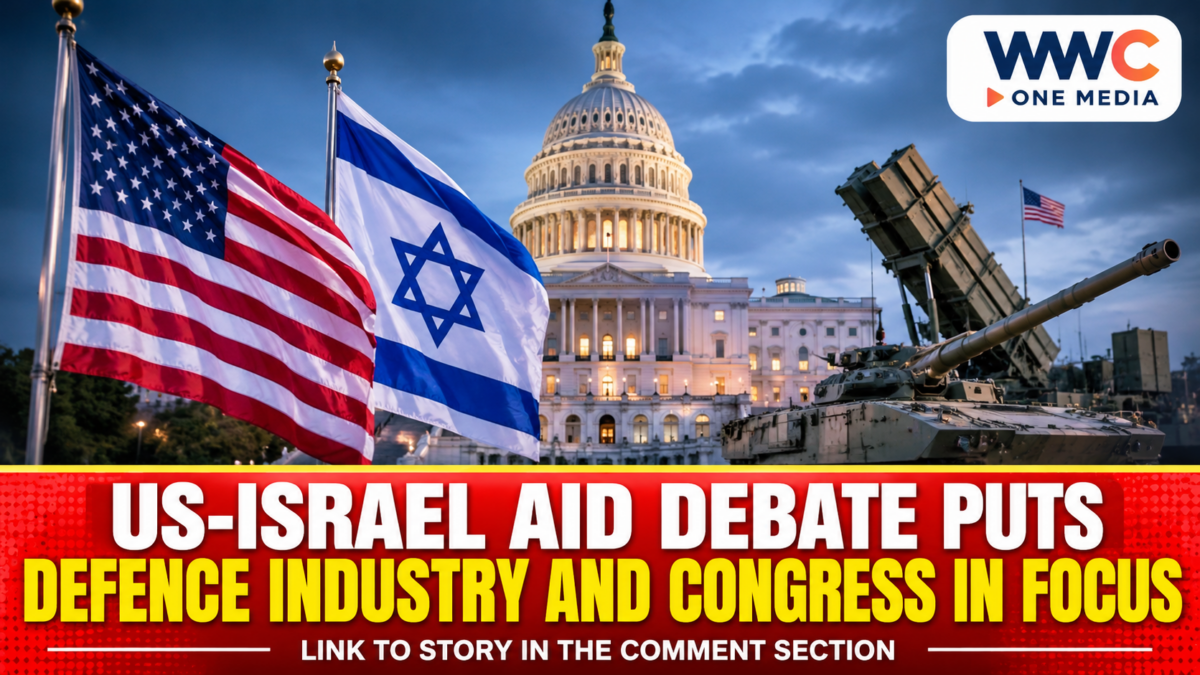
US Ambassador to Israel Mike Huckabee has continued defending the strategic relationship between Washington and Jerusalem as President Donald Trump’s stated plan to end American military assistance before the end of 2026 raises questions about the future of a funding arrangement scheduled to run through 2028. The debate now reaches beyond the annual aid figure: the existing framework also supports purchases from American defence suppliers and joint missile-defence production.
The US-Israel aid arrangement is governed by a 10-year memorandum of understanding signed on September 14, 2016. It outlines US support worth US$38 billion across fiscal years 2019 to 2028, subject to congressional appropriations and the availability of funds. That framework makes any proposed early cutoff a question of budget authority, procurement commitments and bilateral policy—not simply a diplomatic announcement.
For WWC’s November 4 report on Trump’s proposed year-end change, this development is best treated as a substantive update. The central question is whether Washington can change the funding timetable while existing appropriations and the wider defence relationship remain in place.
The 2016 agreement is more than one annual payment
The memorandum divides the US$38-billion framework into two main components: US$33 billion in Foreign Military Financing grants and US$5 billion for cooperative missile-defence programmes over 10 years.
The first component provides US$3.3 billion annually in Foreign Military Financing. The second sets out US support averaging US$500 million a year for joint missile, rocket and projectile-defence programmes.
These are different funding channels. Foreign Military Financing supports eligible purchases of US military goods and services, while the missile-defence component supports cooperative development, production and procurement. Treating the entire US$3.8 billion as one unrestricted annual cash transfer would obscure how the arrangement works.
The memorandum also specifies that US$3.3 billion in annual financing is intended to help Israel acquire advanced capabilities available from the United States. It states that the funding is subject to the appropriation and availability of US funds.
That qualification is important. The memorandum establishes a bilateral framework and funding expectations, but it does not remove Congress from the federal spending process.
American defence suppliers are part of the arrangement
The economic dimension is written into the agreement itself. The memorandum says the United States considers it important that Foreign Military Financing be available to finance purchases of US military goods and services in the United States.
The missile-defence provisions also encourage production in the United States. The agreement says the two governments understand that co-production of parts and components should be maximised, at a level equal to or greater than 50% of US-appropriated production funds, or as negotiated in separate production agreements.
This creates a direct industrial connection between military assistance and American manufacturing. Funds can support procurement, production and cooperation involving US suppliers, rather than functioning solely as general budget support for Israel.
However, the memorandum does not calculate how many American jobs depend on the arrangement. Nor does it provide a national employment estimate, a state-by-state breakdown or a projection of jobs that would be lost if future assistance were reduced.
Claims about the economic consequences of ending the arrangement therefore require separate evidence from defence contractors, procurement records and employment data. The agreement establishes a procurement relationship; it does not quantify its employment impact.
Congress remains central to the funding question
The memorandum’s financial provisions are expressly subject to congressional appropriation and the availability of funds. That means the agreement cannot, by itself, guarantee that every future amount will automatically be released regardless of later budget decisions.
A May 2025 Congressional Research Service report described the same US$38-billion framework and noted that successive administrations had requested US$3.3 billion in annual Foreign Military Financing and US$500 million for joint missile-defence programmes. It also documented additional assistance approved outside the original memorandum, including emergency funding enacted after the October 2023 attacks and the subsequent regional conflicts.
The report recorded US$12.5 billion in total US aid obligations to Israel for fiscal year 2024, including US$6.8 billion in military assistance and US$5.7 billion in missile-defence funding. That exceptional year should not be confused with the regular US$3.8-billion annual framework.
The distinction is essential when assessing proposals to change assistance. Regular funding under the memorandum, supplemental appropriations, weapons sales and deliveries under existing contracts are not identical transactions. A change to one category does not automatically settle the status of the others.
What the latest diplomatic activity establishes
Huckabee participated in an interview published in the programme for an INSS conference on US-Israel relations dated November 24, 2026. The event page identifies him as the interviewee and Hadas Lorber as the interviewer.
That confirms the diplomatic engagement took place, but the accessible event record does not provide a full transcript. It would therefore be inappropriate to attribute additional detailed statements to Huckabee without checking the recording itself.
The broader policy discussion is also unfolding alongside debates over how governments fund security partnerships. WWC has examined Taiwan’s scrutiny of overseas assistance spending, where budget allocations and implementation are separate questions. It has also explained how Japan finances specified costs connected with US forces stationed in the country. These are different arrangements, but they illustrate why defence cooperation should be assessed through its actual funding rules rather than broad political descriptions.
For another comparison, the US security commitment to Taiwan shows how statutory authority, budget allocations and the delivery of military support can represent separate stages of a government commitment.
Why the distinction matters
The debate over US-Israel aid combines at least three separate questions: whether the current funding framework should continue, what congressional action is required to change appropriated funds, and how any change would affect defence procurement and industrial cooperation.
Those questions should not be collapsed into a simple choice between ending the relationship and maintaining it unchanged. Even if future grant assistance were reduced, commercial arms purchases, joint research and other forms of security cooperation could continue under separate arrangements. Conversely, maintaining diplomatic ties would not automatically guarantee that every existing aid allocation remains untouched.
For Israel, the issue concerns the predictability of military financing and the cost of replacing assistance with domestic resources or other procurement arrangements. For the United States, it involves budget priorities, strategic cooperation and the role of domestic suppliers in the defence-industrial base.
For American taxpayers, the relevant test is whether the money is authorised, appropriated, spent for its stated purpose and subject to adequate oversight. The memorandum itself calls for programme information, acquisition plans and annual updates on cooperative defence programmes.
What happens next
The next evidence to watch is any formal US government proposal, congressional action or bilateral document that changes the current funding framework. The public record reviewed here does not establish that the 2016 memorandum has been formally terminated or replaced.
A new agreement, if negotiated, would need to clarify the funding period, the treatment of missile-defence programmes, procurement rules and the role of congressional appropriations. Until those details are published, the existing memorandum remains the clearest documentary reference for the current arrangement.
The immediate issue is therefore not whether the US-Israel relationship has already ended, but whether political calls for a faster transition can be translated into formal budget and procurement decisions.
Frequently asked questions
How much military assistance does the United States provide Israel under the current memorandum?
The 2016 memorandum outlines US$38 billion over fiscal years 2019 to 2028: US$33 billion in Foreign Military Financing grants and US$5 billion for cooperative missile-defence programmes.
Does all US assistance go directly to Israel’s government?
No. The memorandum includes financing for purchases of US military goods and services and separate funding for cooperative missile-defence programmes. The funding is not one unrestricted cash payment.
Does the agreement support American defence companies?
Yes. The memorandum expressly identifies purchases of US military goods and services and encourages US-based co-production of missile-defence components. It does not quantify the number of jobs supported.
Can the US president change the aid arrangement without Congress?
The memorandum makes funding subject to congressional appropriation and the availability of funds. The precise steps for changing existing appropriations or commitments depend on the applicable laws and budget decisions.
Has the 2016 US-Israel memorandum already ended?
No termination or replacement was established in the primary records reviewed for this update. The memorandum covers fiscal years 2019 through 2028.