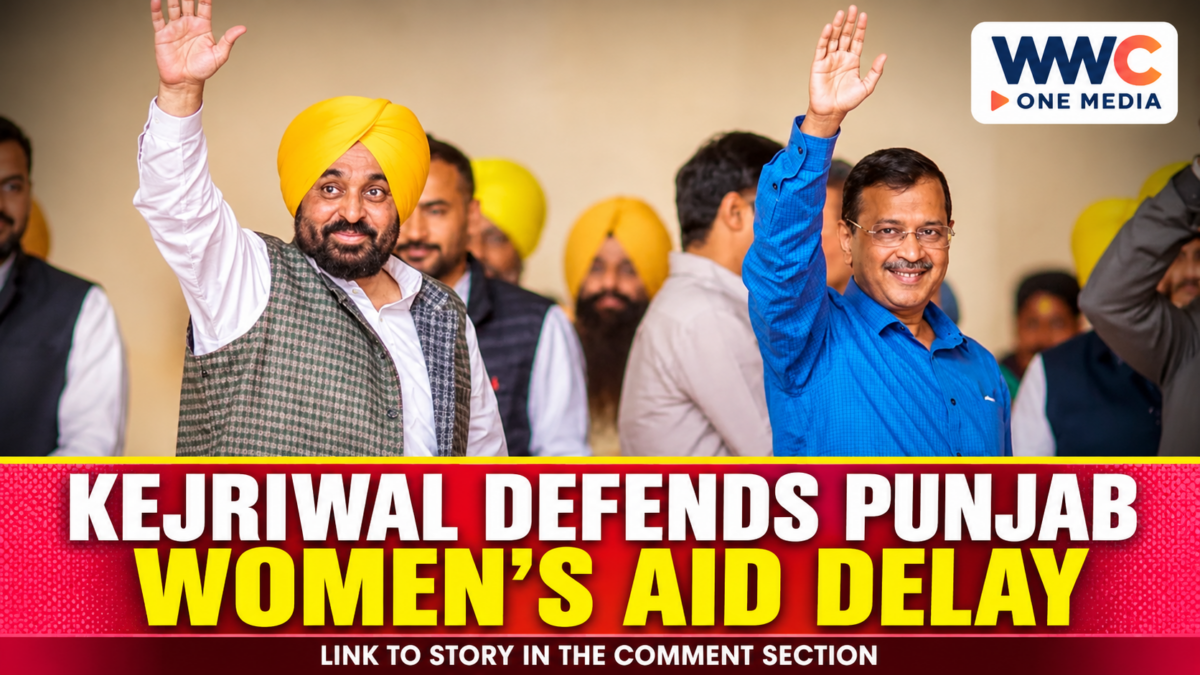
MOGA, Punjab, India — A long-promised cash benefit for women has become a central political issue in Punjab as the state moves towards its 2027 Assembly election, with Aam Aadmi Party (AAP) national convenor Arvind Kejriwal defending why the programme took years to reach implementation.
Speaking at the party’s Khushhaal Punjab Maha Rally in Moga on Nov. 26, 2026, Kejriwal acknowledged that the government took several years to begin transferring money under the Mukh Mantri Mawan Dheeyan Satkar Yojana.
His explanation was direct: the AAP government inherited an empty state treasury and needed time to rebuild public finances.
“Punjab’s treasury was empty,” Kejriwal said, describing the financial condition his party claimed to have encountered when it assumed office.
He argued that the administration had spent four years rebuilding the state’s finances and completing the requirements needed to introduce the programme.
But the explanation also puts the government’s record under greater scrutiny. The assistance was a prominent AAP electoral commitment, and its implementation came during the final year before Punjab’s next Assembly election.
The programme is now formally notified, and the 2026–27 state Budget has earmarked ₹9,300 crore for it. The political question is no longer simply whether the promise has been announced. It is whether the government can deliver payments consistently, demonstrate that the funding is sustainable and convince voters that the delay was justified.
Punjab’s women’s scheme finally moves from promise to payment
The Mukh Mantri Mawan Dheeyan Satkar Yojana was formally notified by the Punjab Government on April 2, 2026, through the Department of Social Security, Women and Child Development.
Under the notified rules, eligible women receive:
- ₹1,000 per month for women outside the Scheduled Caste category.
- ₹1,500 per month for eligible women belonging to Scheduled Caste communities.
The programme applies to women aged 18 and above who are registered resident voters in Punjab and possess valid Aadhaar and state voter identification.
However, it is not an unrestricted payment to every adult woman. The notification excludes regular and retired government employees, certain public-sector and statutory-body pensioners, income-tax payers who paid tax in the previous financial year, serving or former ministers, MPs and MLAs, and their spouses.
The rules also allow more than one eligible woman in a household to receive assistance. Women already receiving social-security pensions can qualify for the new benefit in addition to their existing pension.
This is important because the scheme’s reach depends on its eligibility requirements, not simply the headline promise of financial assistance for women.
The programme is designed to provide predictable household support and strengthen women’s financial independence. But the actual impact will depend on registration, verification and timely payments.
The ₹9,300 crore budget allocation raises the bigger question
Punjab’s 2026–27 Budget, presented by Finance Minister Harpal Singh Cheema on March 8, includes a dedicated allocation of ₹9,300 crore for the women’s assistance programme.
That is a substantial commitment from the state government.
The allocation matters because a monthly benefit becomes a recurring public expenditure. Unlike a one-time grant, the government must continue finding money for payments as long as the programme operates and eligible beneficiaries remain enrolled.
The scale of the commitment also makes implementation transparency important. The government needs to demonstrate how many women have registered, how many have passed verification, how much money has been disbursed and whether the allocated amount is sufficient for the actual beneficiary population.
The budget speech states that the scheme is intended to cover around 97% of adult women in Punjab, subject to the exclusions. That figure is the government’s estimate, not an independently verified count of registered beneficiaries.
The distinction between an allocation and actual expenditure is equally important. Setting aside ₹9,300 crore does not mean the entire amount has already been transferred to women. Actual disbursement figures are needed to assess how much of the allocation has reached beneficiaries.
WWC has also examined how other Indian states structure welfare assistance, including Uttar Pradesh’s expanded mass-marriage support programme. The programmes serve different purposes, but both show why eligibility rules, budget provisions and transparent administration matter when governments promise direct financial support.
Why Kejriwal’s treasury explanation needs financial scrutiny
Kejriwal’s claim that Punjab inherited an empty treasury is a political explanation for the delay. It should not be treated as an established description of the state’s entire financial position without examining audited accounts and fiscal records.
Punjab’s financial condition is a wider issue involving revenue collection, expenditure commitments, borrowing, interest payments and outstanding liabilities.
The state’s 2026–27 Budget provides a formal financial framework for the scheme, but it does not independently prove that the treasury was literally empty when AAP took office in 2022.
That distinction matters. A government can face substantial debt, revenue pressure and limited room for new spending without having no money in its accounts. Likewise, a government may improve revenue collection while still carrying large liabilities.
The Comptroller and Auditor General of India has published a State Finances report for Punjab covering 2023–24. That report examines the state’s fiscal position, budget management and quality of financial reporting. It provides an important basis for evaluating public-finance claims, although it does not by itself establish Kejriwal’s specific explanation for the delay.
A fair assessment therefore requires a comparison of audited financial statements across the years, rather than relying only on a rally speech or a single budget allocation.
The payment schedule is another issue voters will watch
At the Moga rally, Kejriwal said the assistance was being deposited in three-month batches.
He explained that eligible women would receive ₹3,000 for three months, while eligible Scheduled Caste women would receive ₹4,500 for the same period.
He also said that some women had received an earlier instalment while others were still waiting for pending amounts. He announced that the remaining eligible women would receive pending payments on Dec. 1, 2026, before the programme moved to a common three-month payment cycle.
These are statements made by Kejriwal at the rally. The formal notification itself says the timing and frequency of payments will be determined by the High-Level Implementation Committee.
That difference is important for beneficiaries. A monthly entitlement does not necessarily mean a separate bank transfer will arrive every month. Under the payment arrangement described by Kejriwal, money is deposited in quarterly batches.
The government will need to communicate the schedule clearly so that women know when to expect payments and how to check their registration or pending amounts.
Punjab’s 2027 election turns welfare delivery into a political test
The Moga rally was not simply an announcement about a welfare programme. It was part of AAP’s political mobilisation ahead of the 2027 Punjab Assembly election.
Kejriwal urged women to encourage male members of their families to vote for the party, arguing that the continuation of the government’s welfare schemes depended on AAP returning to power under Chief Minister Bhagwant Singh Mann.
He also presented the women’s scheme alongside other government programmes, including free electricity, healthcare and pilgrimage assistance.
This places the cash benefit at the centre of a broader campaign strategy: AAP wants voters to assess its performance through programmes they can directly experience.
The opposition, meanwhile, will have an opportunity to question the timing, cost and implementation of those commitments.
Punjab’s political contest is already taking shape. The return of the Bharatiya Janata Party and Shiromani Akali Dal partnership adds another challenge for the ruling party, as explored in WWC’s coverage of the BJP-SAD alliance ahead of the 2027 Punjab election.
AAP’s performance on welfare delivery will therefore be judged alongside employment, agriculture, public safety, public services and the state’s financial management.
The party’s campaign preparations and policy messaging also form part of a wider political contest across India, including the Samajwadi Party’s preparations for Uttar Pradesh’s 2027 election.
What Happens Next
The immediate test is whether the Punjab Government completes the pending payments it announced for Dec. 1 and maintains a reliable three-month disbursement cycle.
The next test is financial transparency. The administration should publish clear figures on registrations, approved beneficiaries, actual payments and expenditure against the ₹9,300 crore allocation.
For Kejriwal, the political challenge is to show that the delay was the result of genuine fiscal constraints and that the programme can continue without undermining other public commitments.
For women in Punjab, the measure of success is more practical: whether the promised money reaches their bank accounts on time and whether the assistance remains dependable.
The scheme has moved from an election promise to a formally notified programme. But with the 2027 election approaching, the government faces a harder question than whether it can announce a benefit: can it sustain the payments and prove that the money is reaching the women it was designed to support?
Frequently Asked Questions
How much money does Punjab’s women’s assistance scheme provide?
Eligible women receive ₹1,000 per month. Eligible women belonging to Scheduled Caste communities receive ₹1,500 per month.
What is the name of the scheme?
It is called the Mukh Mantri Mawan Dheeyan Satkar Yojana and was formally notified on April 2, 2026.
Who can qualify?
Women aged 18 and above who are registered resident voters in Punjab and hold valid Aadhaar and Punjab voter identification may qualify, subject to the scheme’s exclusions.
How much has Punjab allocated for the scheme?
The Punjab Government earmarked ₹9,300 crore for the programme in its 2026–27 Budget.
Why did Arvind Kejriwal say the scheme was delayed?
At a Nov. 26 rally in Moga, Kejriwal said previous governments had left Punjab’s treasury empty and that the AAP government needed four years to rebuild state finances. This is his political explanation, not an independently established finding.
Are payments made every month?
The notified scheme provides monthly financial assistance, but Kejriwal said at the rally that payments were being deposited in three-month batches: ₹3,000 for other eligible women and ₹4,500 for eligible Scheduled Caste women.