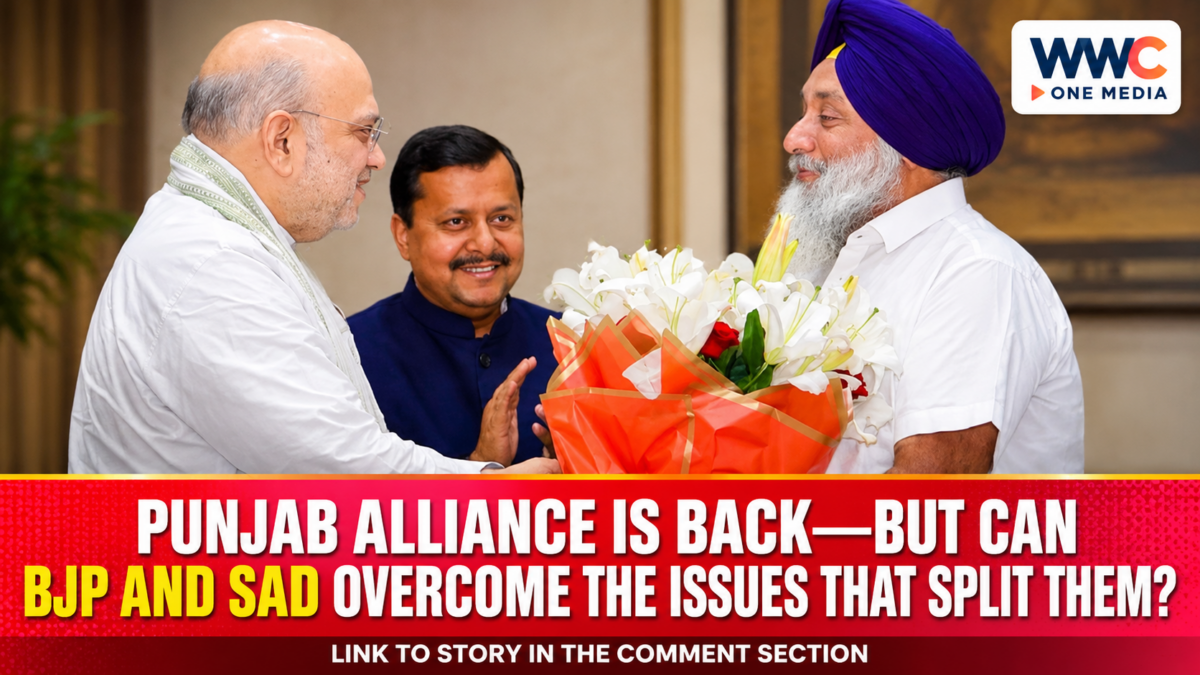
NEW DELHI — The Bharatiya Janata Party (BJP) and the Shiromani Akali Dal (SAD) announced on November 24, 2026, that they will contest Punjab’s 2027 Assembly election together, restoring a partnership that collapsed six years ago. The announcement was made at the BJP headquarters in New Delhi by senior leaders of both parties, including Union Home Minister Amit Shah and SAD president Sukhbir Singh Badal.
The agreement changes the political arithmetic ahead of the next election, but it does not settle the questions that could determine whether the partnership succeeds: how the parties will divide constituencies, how they will address the legacy of their 2020 split and whether their combined support can compete with the political forces that reshaped Punjab’s last Assembly election.
Punjab alliance returns after the farm-law rupture
The BJP and SAD were long-standing partners before their relationship broke down in 2020. The SAD left the National Democratic Alliance during the controversy over the central farm laws, which became a major point of confrontation between the Union government and protesting farmers.
Their reunion therefore carries a political challenge beyond agreeing to contest together. The parties must persuade voters that the reasons for their separation have been addressed or that cooperation now offers a credible path forward.
The November 24 announcement formally puts the two parties on the same side for the 2027 contest. Shah described the SAD as returning to the NDA, while BJP president Nitin Nabin presented the partnership as a natural alliance. Badal also characterised the arrangement as more than an electoral agreement.
Those public statements establish the leaders’ position. They do not, by themselves, show whether farmers, rural voters or former supporters who disagreed with the 2020 split have changed their views.
The political memory of the farm-law confrontation may remain relevant in constituencies where agricultural issues influence voting decisions. The alliance will need to show how it intends to address farmers’ concerns rather than assume that an earlier partnership can simply be restored.
The 2022 result shows how much ground must be recovered
Punjab’s previous Assembly election offers a useful measure of the challenge. The state has 117 Assembly constituencies, and the Election Commission’s statistical records show that the Aam Aadmi Party won 92 seats in 2022, with 42.01% of the valid vote. The Indian National Congress won 18 seats and received 22.98%.
The BJP and SAD contested separately in that election. Their return as partners changes the structure of the next contest, but the 2022 figures should not be treated as a prediction of how voters will behave in 2027.
A combined alliance can pool campaign resources, coordinate candidates and avoid splitting support between former partners. But vote totals from separate parties cannot simply be added together and assumed to transfer automatically to a joint ticket.
Local candidates, turnout, constituency-level alliances and voters’ views of the parties’ records will all matter. The alliance’s practical strength will become clearer when its candidates and constituency arrangements are made public.
WWC has followed wider developments in Indian electoral politics, including the dispute over India’s voter-list revision and the opposition’s campaign. That national debate is separate from Punjab’s alliance negotiations, but it illustrates why election outcomes depend on local political conditions as well as national party strategies.
Seat-sharing and leadership are the next tests
The announcement establishes a joint electoral arrangement, but the details of constituency allocation remain central to its implementation. Punjab has 117 Assembly seats. Both parties will have to decide where each should field candidates, how local organisations will cooperate and how disputes over nominations will be resolved.
The leadership question is also politically significant. Public reporting of the November 24 announcement indicated that the SAD would lead the alliance’s chief ministerial claim if it wins. However, the final distribution of seats and the complete terms of the partnership still require formal clarification.
For the BJP, the challenge is to expand its influence without creating friction with its returning partner. For the SAD, the challenge is to maintain its regional identity and leadership position while campaigning within a national alliance.
The arrangement will be tested not only by senior leaders but also by party workers and prospective candidates in individual constituencies. A partnership announced at the national level still needs an effective organisation on the ground.
Rajoana remains a sensitive legal and political issue
The case of Balwant Singh Rajoana is another subject that can enter Punjab’s political debate, but it must be handled with precision. Rajoana was convicted in connection with the 1995 assassination of then Punjab chief minister Beant Singh. The Supreme Court’s May 3, 2023 judgment records the history of his death sentence and the proceedings concerning a mercy petition submitted on his behalf.
The judgment states that the Ministry of Home Affairs had decided to defer a decision on the mercy petition, citing concerns that consideration could affect national security or create a law-and-order situation. The Court declined to issue further directions at that time, while leaving the competent authority able to reconsider the matter in the future.
That ruling is a record of the position before the Court in 2023. It does not establish that the petition has been decided since then, nor does it establish a new BJP or SAD policy on the matter in November 2026.
The issue is politically sensitive because it involves criminal justice, executive clemency and competing public concerns. Any claim that it has produced a specific internal dispute within the BJP or the alliance needs direct confirmation from the people or institutions involved.
Ravneet Singh Bittu’s political position and public comments also require careful sourcing. Without a verified official statement or primary record establishing a particular position by Bittu on Rajoana or the alliance negotiations, it would be misleading to attribute a specific role or disagreement to him.
What the reunion could mean for Punjab voters
For voters, the alliance creates another organised option in a contest expected to involve the ruling AAP, Congress and other political groups. Its significance will depend on whether the partners can present a common programme on employment, agriculture, public services, drug-related problems and economic development.
The leaders have publicly identified drug-related concerns and corruption as priorities. Those are campaign commitments, not proof that the alliance has agreed on detailed policies, funding plans or measurable targets.
WWC’s coverage of India’s youth-led political movement and its confrontation with authorities provides a wider reminder that public confidence in political institutions is shaped by more than party announcements. Voters will assess what parties propose, how they explain their past decisions and whether their promises are credible.
The alliance also has to manage the difference between national and state-level priorities. The BJP brings a nationwide political organisation, while the SAD’s identity is rooted in Punjab’s regional and Sikh political history. Cooperation may broaden the alliance’s reach, but it will require a balance that both organisations can defend to their supporters.
What happens next
The immediate next steps are the release of a seat-sharing arrangement, clarification of leadership roles and publication of a joint campaign platform. Until those details are settled, the November 24 announcement should be understood as a political agreement to contest together, not as a complete election strategy.
The 2022 result shows the scale of the challenge, while the 2020 split explains why the reunion carries political baggage. The alliance can combine organisational resources, but it cannot automatically combine voter loyalties.
For Punjab, the real test will come when the parties move from a joint announcement to decisions about candidates, policies and the unresolved issues that still shape the state’s political debate.
Frequently asked questions
1. Have the BJP and SAD officially reunited for the 2027 Punjab election?
Yes. The parties announced on November 24, 2026, that they will contest the 2027 Punjab Assembly election together.
2. Why did the BJP and SAD split in 2020?
The SAD left the National Democratic Alliance during the controversy over the central farm laws.
3. How many seats are there in the Punjab Assembly?
The Punjab Legislative Assembly has 117 seats.
4. Who won the 2022 Punjab Assembly election?
The Aam Aadmi Party won 92 of the 117 seats in the 2022 election.
5. Has Balwant Singh Rajoana’s mercy petition been decided?
The Supreme Court’s May 2023 judgment records that the Union government had deferred a decision at that time. The judgment does not establish a later decision, so the current status requires an updated official record.