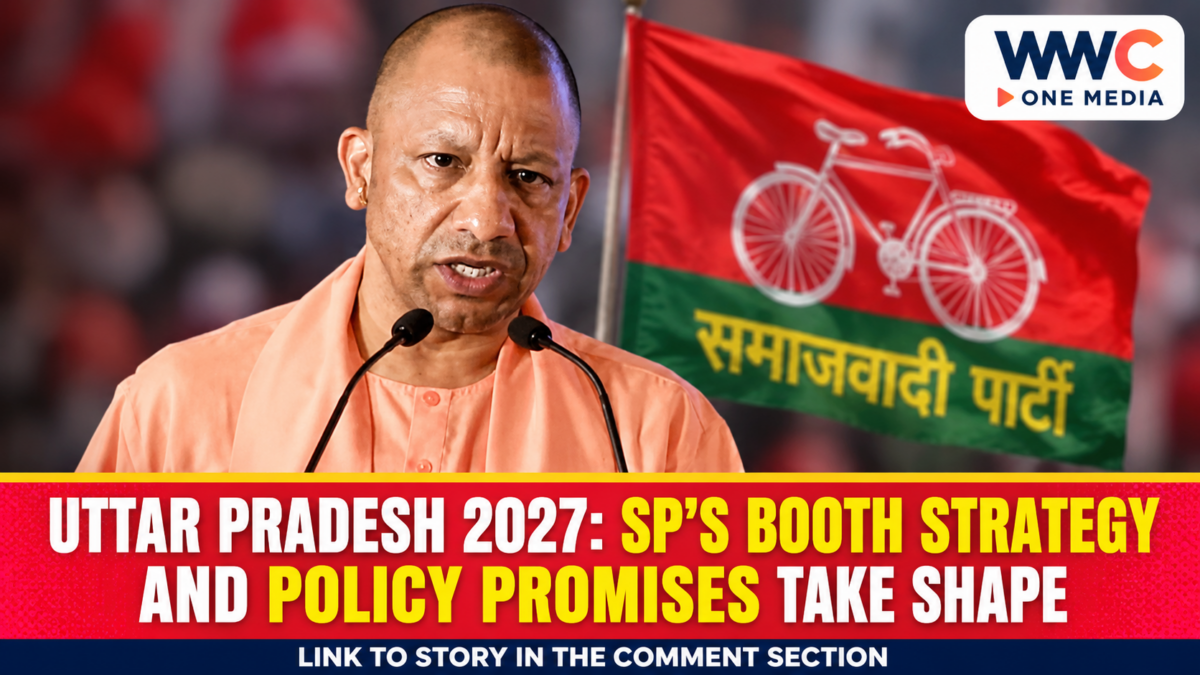
Lucknow, India — November 26, 2026. The Samajwadi Party has set out a campaign direction for the 2027 Uttar Pradesh Assembly election built around booth-level organisation, its PDA political framework and a series of proposed welfare commitments, according to its own 2026 party publications. The documents provide a clearer view of the opposition party’s stated preparations, although they do not establish how voters will respond or whether its proposed policies can be implemented.
The material matters because Uttar Pradesh is one of India’s most politically consequential states, and the next Assembly election will test the ruling Bharatiya Janata Party and its opponents. For the Samajwadi Party, the challenge is to turn its published campaign priorities into an organisation capable of competing across constituencies — and to explain how its promises would work if it formed the next government.
The party’s September bulletin offers a particularly useful record. It describes a strategy centred on strengthening individual polling booths, mobilising younger workers and building support through the PDA framework. It also records policy proposals announced by party president Akhilesh Yadav. These are the party’s stated positions, not independently verified measures of public support or guaranteed future government programmes. samajwadiparty.in+2
Uttar Pradesh 2027: SP puts booth organisation at the centre
The Samajwadi Party’s September 2026 bulletin places booth-level organisation at the heart of its campaign narrative. It describes an effort to strengthen the party’s presence at individual polling stations and mobilise younger party workers ahead of the 2027 contest.
The publication connects this organisational approach to the party’s PDA framework — an acronym it uses for Pichhda, Dalit and Alpsankhyak, referring to backward communities, Dalits and minorities. The bulletin also discusses women and other groups within the party’s broader social-justice message.
This is more than a campaign slogan in the party’s own documentation. The bulletin presents booth organisation as a practical political priority: building local-level activity, maintaining worker participation and connecting the party’s message with communities across the state.
But a party publication cannot independently demonstrate that its claimed support is widespread. Its descriptions of enthusiasm, public backing and electoral momentum should be understood as political messaging unless supported by independent polling, verified membership data or election results.
That distinction is important for readers assessing campaign claims before the election.
The party has put a women’s welfare proposal on record
One of the clearest policy commitments in the September bulletin is the proposed Stree Samman-Samriddhi Yojana, announced by Akhilesh Yadav on August 26, 2026, at the party’s state headquarters in Lucknow.
The bulletin says the proposed scheme would provide women with ₹40,000 annually under a Samajwadi Party government. It also states that the party intends to include the proposal in its Assembly election manifesto and implement it in phases if it forms the government in 2027.
The publication records the presence of Mainpuri MP Dimple Yadav at the announcement. It also describes additional proposals involving education, public transport and schools. samajwadiparty.in
The proposal raises questions that voters would reasonably expect the party to answer before polling day: who would qualify, how many beneficiaries would be covered, how much the programme would cost, what budget would fund it and how the payments would be administered.
An annual payment promise is easy to communicate during a campaign. Delivering it requires a funding plan, eligibility rules, administrative capacity and a system for monitoring whether the intended beneficiaries receive support.
The bulletin establishes that the proposal was announced. It does not provide a complete fiscal assessment or prove that the programme would be affordable under a future state budget.
PDA is the party’s broader political framework
The September publication repeatedly links the booth campaign to PDA. The party presents the framework as a coalition of social groups that it believes can form the basis of a wider electoral movement.
The bulletin also describes proposed priorities involving recruitment calendars, examinations free from paper leaks, a legal guarantee for farmers’ minimum support prices and timely payments. These are presented as elements of the party’s intended roadmap for a future government. samajwadiparty.in
The political significance lies in the attempt to connect social representation with specific policy concerns. A campaign built around identity and representation still needs to address questions of employment, education, agriculture and public services.
Whether the framework can attract voters beyond the party’s existing base remains an open electoral question. The party’s own publication cannot settle that question, and its optimistic descriptions should not be mistaken for independent evidence of an election outcome.
WWC has previously examined how political disputes over India’s electoral process can become a test of public confidence. Its report on India’s voter-roll controversy and the limits of official evidence discusses why allegations, administrative records and proven findings must be kept separate.
Campaign promises will need more than slogans
The party’s February and September bulletins show that its 2027 preparations have been visible in its own communications for months. The February publication discussed Akhilesh Yadav’s visits and the party’s effort to prepare for the next election. The September issue goes further by presenting booth-level mobilisation and policy proposals together. samajwadiparty.in+1
That progression gives voters a basis for examining the party’s campaign priorities. It does not establish that the party has completed its organisational work, reached a final alliance agreement or secured support from particular communities.
The policy side deserves equal scrutiny. The proposed women’s payment, recruitment commitments and agricultural measures would have different budgetary and administrative requirements. A serious manifesto should explain those details rather than relying only on headline promises.
The same standard should apply to the ruling party. Government performance claims and opposition promises both need to be assessed against measurable outcomes.
WWC’s coverage of India’s debate over GDP growth and political claims illustrates why political statements should be tested against the relevant data rather than accepted as complete explanations.
The alliance question remains separate from the party’s campaign plan
The immediate political discussion surrounding the Samajwadi Party and Congress concerns their relationship ahead of the 2027 election. However, the official Samajwadi Party bulletins reviewed for this report do not establish the precise state of current seat-sharing negotiations, whether either party has formally ended an alliance, or the details of candidate announcements described in secondary reporting.
That matters because political criticism by a rival is not proof that an alliance has broken down. Nor does a party’s campaign preparation, by itself, establish that it has abandoned negotiations with another party.
The distinction is especially important in a pre-election period, when public statements can be used to shape perceptions of strength, unity and readiness.
WWC’s earlier report on Rahul Gandhi’s detention during protests over India’s voter-list revision provides further context on the wider political environment involving opposition parties and electoral institutions. It is separate from the specific question of an SP-Congress seat-sharing agreement.
What happens next
The next meaningful evidence will come from formal party announcements, published manifestos, candidate lists, documented alliance decisions and the Election Commission’s election schedule and records.
For the Samajwadi Party, the central test is whether its booth-level strategy becomes demonstrable local organisation and whether its policy proposals are developed into detailed, costed commitments. For Congress and other opposition parties, any decision on coordination or seat-sharing should be judged by official announcements rather than political predictions.
The ruling BJP will also face scrutiny over its own record and campaign programme. Voters will ultimately compare competing claims with the performance of the state government and the practical detail behind each party’s promises.
The documents currently available establish that the Samajwadi Party is publicly preparing for 2027 and has placed specific proposals on record. They do not determine who will win, whether the opposition parties will contest together or whether the proposed welfare measures will be implemented.
Frequently asked questions
What is the Samajwadi Party’s main campaign focus for Uttar Pradesh 2027?
Its September 2026 bulletin highlights booth-level organisation, youth mobilisation and the PDA political framework.
What is the Stree Samman-Samriddhi Yojana?
It is a proposed Samajwadi Party welfare programme announced by Akhilesh Yadav on August 26, 2026. The party publication says it would provide women ₹40,000 annually under a Samajwadi Party government.
Has the Samajwadi Party published its full 2027 election manifesto?
The reviewed September bulletin says the proposed women’s scheme would be included in the party’s Assembly election manifesto. It is not itself the complete manifesto.
Does the party bulletin prove that the SP-Congress alliance has ended?
No. The reviewed party publications establish the Samajwadi Party’s campaign messaging and proposals, not the formal status of seat-sharing negotiations or an alliance termination.
When is the next Uttar Pradesh Assembly election?
The political contest discussed in the party’s publications is the 2027 Assembly election. The precise polling dates should be taken from the Election Commission’s official schedule when announced.