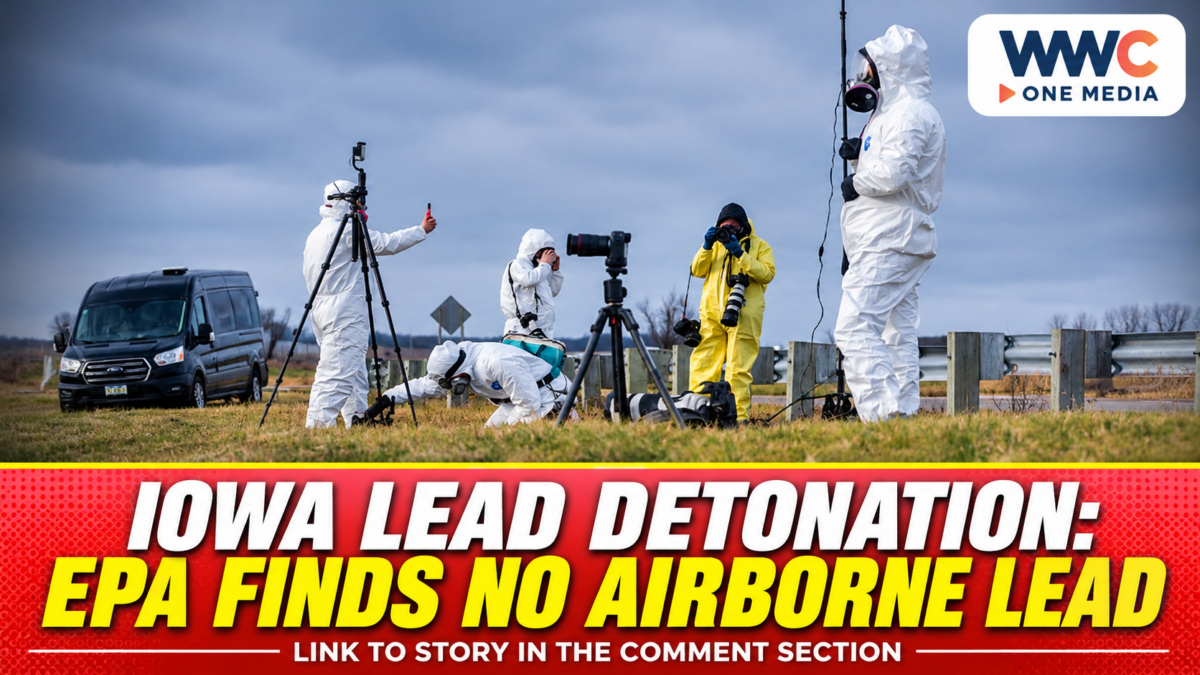
MIDDLETOWN, Iowa — Nov. 27, 2026 — The US Army has destroyed a deteriorating stockpile of lead azide at the Iowa Army Ammunition Plant, but the environmental safety of nearby communities is still being assessed as federal teams collect samples from homes, farms, playgrounds and water sources.
The controlled detonation took place on Wednesday, Nov. 25, at the military installation in Middletown, Iowa. Initial monitoring produced an encouraging result: the US Environmental Protection Agency (EPA) reported that its real-time air monitors detected no airborne lead following the operation.
However, the absence of detected airborne lead does not establish that every surrounding property, water source or agricultural area is free from contamination.
In its Nov. 26 update, the EPA reported collecting 1,591 environmental samples before the detonation and more than 1,000 additional samples afterwards. Laboratory results from the post-detonation testing were expected to begin arriving as early as Nov. 27.
The immediate explosive hazard has been addressed. The next question is whether the environmental testing will confirm that the operation left no contamination requiring further action.
Why the US Army Destroyed the Lead Azide Stockpile
The Iowa Army Ammunition Plant became the centre of a public safety operation after inspectors identified severe deterioration and crystallisation affecting approximately 68 drums of stored lead azide.
The US Army reported that the material represented more than 9,700 pounds of net explosive weight and was stored inside earth-covered magazines at the installation.
Lead azide is a sensitive primary explosive. The Army said the crystallised material had become vulnerable to friction, vibration, heat and shock, creating the risk of an uncontrolled detonation.
Moving the drums, opening their containers or attempting chemical neutralisation was considered unsafe after the material had deteriorated.
Following a multi-agency technical evaluation, the Army approved an in-place controlled detonation carried out by military explosive ordnance disposal specialists from the 71st Ordnance Group.
The decision involved two competing public safety concerns: leaving unstable explosive material in storage and managing the environmental risks associated with destroying it.
WWC previously examined the dispute over the Iowa Army detonation and the safeguards for nearby communities, including the emergency environmental permit and the concerns raised before the operation.
EPA Reports Zero Airborne Lead — But Testing Is Not Finished
The EPA’s initial post-detonation announcement reported zero detection of airborne lead on its real-time monitoring equipment.
The agency’s Nov. 26 update said those monitors continued to report zero airborne lead throughout the region after the operation.
That is an important early finding, particularly because airborne particles were one of the potential exposure pathways identified before the detonation.
But air monitoring is only one part of an environmental assessment.
Lead-containing particles may settle on soil, dust, buildings, outdoor equipment or other surfaces. Water sources and agricultural properties also require appropriate testing before authorities can draw broader conclusions about environmental conditions.
The EPA said it had collected 1,591 air, water, soil and dust samples before the detonation. After the operation, its personnel and contractors collected more than 1,000 additional samples.
More than 130 structures that had been sampled before the detonation were tested again. The agency also collected samples from homes, public parks with playgrounds and every drinking-water intake identified in the pre-detonation plume model.
Nearby farms were sampled before and after the operation in coordination with the US Department of Agriculture. The EPA also reported extensive sampling across the Mississippi River watershed.
The scale of the programme demonstrates why the initial air-monitoring result should not be treated as the final environmental verdict.
Homes, Farms and Water Supplies Remain Part of the Assessment
The EPA’s sampling programme extended beyond the immediate military installation.
Its Nov. 26 update identified schools, playgrounds, day-care facilities and churches among the locations scheduled for additional sampling. The agency also said it would conduct another round of drinking-water sampling and continue testing agricultural ponds in Missouri.
The testing was not limited to lead. The EPA also collected information on volatile organic compounds and particulate matter that could potentially have been released during the operation.
Samples were sent to the EPA’s Region 7 laboratory in Kansas City, Kansas, mobile laboratories at the site and private laboratories working under contract.
For nearby residents, the distinction between an initial monitoring result and completed laboratory testing matters. A reassuring reading from an air monitor cannot independently establish the condition of every property or water source.
The same principle applies to other environmental incidents. WWC’s coverage of the Maine firefighting-foam incident and its potential chemical risks examined why identifying a possible chemical release is not the same as proving that a particular community has been exposed.
The Iowa operation requires the same evidence-based approach: identify where samples were collected, establish what the laboratory results show and determine whether any location requires further action.
Why Lead Exposure Requires Particular Attention
Lead is a toxic metal that can affect human health, with particular concern for young children and pregnant women.
Iowa Health and Human Services warned before the detonation that exposure could occur through breathing lead-containing particles or swallowing dust that settles on hands, toys, food and other surfaces.
Its Nov. 24 health alert identified children younger than six and women who are pregnant or breastfeeding as groups that may face greater risks from lead exposure.
The agency also explained that environmental sampling would help determine where potential exposure may have occurred and where ongoing risk, if any, might be highest.
This is important because a person may have potential exposure without immediately displaying symptoms. Health officials therefore emphasised assessing exposure circumstances and using appropriate medical guidance rather than relying on visible signs alone.
The concerns do not establish that residents have been poisoned or that the detonation caused illness. Those conclusions require evidence from appropriate testing and medical assessment.
The wider environmental issue is also relevant to cross-border pollution cases. WWC’s reporting on arsenic concerns in rivers shared by Thailand and Myanmar illustrates why the location, timing and results of environmental samples matter when evaluating possible exposure.
The Emergency Disposal Is Complete, but the Environmental Review Continues
The EPA issued an emergency permit authorising the Army to store and treat the hazardous lead azide through in-place detonation. The permit requires monitoring and sampling before, during and after the operation, public notifications, cleanup measures and reporting.
That regulatory framework is important because completing the explosive disposal does not automatically close the environmental responsibilities associated with it.
The Army’s operation addressed the immediate danger posed by the unstable material. The EPA’s continuing work is intended to establish whether the detonation affected surrounding environmental conditions and whether remediation is necessary.
The public also needs clear information about which locations were sampled, which substances were tested, when laboratory results become available and whether any results require additional protective measures.
WWC’s coverage of New Brunswick’s air-quality review of an industrial mill similarly highlights the importance of accessible monitoring information when communities assess environmental risks.
For Middletown, the next meaningful milestone is not another general assurance. It is the publication and explanation of the environmental testing results.
What Happens Next?
As of Nov. 27, the EPA’s latest opened public update was dated Nov. 26. It said laboratory results from post-detonation sampling were expected to begin arriving as early as the following day. The reviewed primary records do not yet establish a complete set of final post-detonation laboratory findings.
The next developments to watch include:
- Laboratory results from post-detonation air, soil, dust and water samples.
- Findings from homes, playgrounds, schools, farms and drinking-water intakes.
- Any additional sampling required by the EPA or other agencies.
- Whether environmental authorities identify locations requiring cleanup or further public-health guidance.
The initial zero-detection result for airborne lead is encouraging. But the final assessment must rest on the broader environmental evidence.
The Army has destroyed the unstable explosive stockpile. Whether the surrounding communities are fully protected will depend on what the continuing tests establish.
Frequently Asked Questions
What happened at the Iowa Army Ammunition Plant?
The US Army conducted a controlled detonation on Nov. 25, 2026, to destroy deteriorating lead azide stored at the installation in Middletown, Iowa.
How much lead azide was involved?
The Army reported approximately 68 drums containing more than 9,700 pounds of net explosive weight.
Did the EPA detect airborne lead after the detonation?
The EPA reported that its real-time air monitors detected no airborne lead following the operation. Its Nov. 26 update said the monitors continued to report zero detection throughout the region.
Does that mean the surrounding area is free from contamination?
No. Air-monitoring results do not establish the condition of every soil sample, water source, building or outdoor surface. Additional environmental testing is necessary.
How many samples did the EPA collect?
The EPA reported 1,591 pre-detonation environmental samples and more than 1,000 post-detonation samples in its Nov. 26 update.
Have final laboratory results been released?
The EPA said on Nov. 26 that it expected to begin receiving post-detonation laboratory results as early as Nov. 27. The primary records reviewed for this update do not establish a complete set of final results.
Why is lead exposure a concern for children?
Lead can harm health and development. Iowa health authorities identified young children and pregnant or breastfeeding women as groups requiring particular attention to potential exposure.