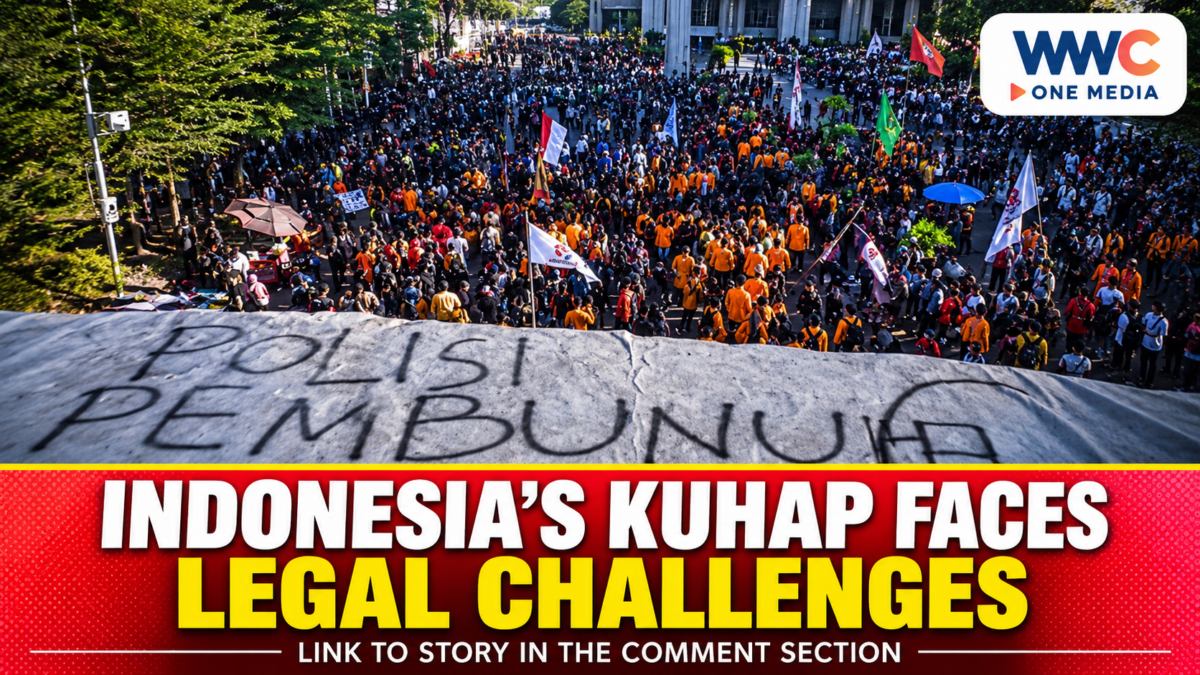
JAKARTA, Indonesia — Indonesia’s overhaul of its criminal justice system is facing a growing constitutional test as lawyers and other petitioners challenge provisions of the country’s new Criminal Procedure Code, arguing that some investigative powers may not have adequate safeguards against abuse.
The law, known as KUHAP, is Law No. 20 of 2025. It replaced the previous Criminal Procedure Code, which had been in force since 1981, and took effect on Jan. 2, 2026.
The legislation was presented as a modernisation of criminal procedure, covering the rights of suspects, defendants, witnesses, victims and people with disabilities. It also revised investigative and prosecutorial powers, introduced new mechanisms for resolving criminal cases and strengthened several procedures for challenging law-enforcement actions.
But its implementation has produced a difficult question: can Indonesia give investigators more effective tools without weakening the protections that prevent arbitrary searches, surveillance, detention and questioning?
The Constitutional Court is now examining several challenges to the law. The cases do not establish that KUHAP is unconstitutional, but they show that its provisions remain subject to judicial scrutiny.
Why Indonesia’s New Criminal Procedure Code Is Controversial
KUHAP is the legal framework governing how criminal investigations and prosecutions are conducted.
It determines how investigators gather evidence, how suspects are questioned, how detention is handled, how prosecutors assess case files and how individuals can challenge certain actions before a court.
Law No. 20 of 2025 was enacted on Dec. 17, 2025, and became effective on Jan. 2, 2026. It revoked Law No. 8 of 1981.
The government and legislature presented the reform as an effort to bring criminal procedure into line with changes in Indonesia’s legal system and developments in information technology.
The legislation covers several major areas, including:
- Stronger rights for suspects, defendants, convicted persons, witnesses, victims and people with disabilities
- Revised authority for investigators and public prosecutors
- Changes to coercive investigative measures
- Guilty-plea procedures and deferred prosecution agreements
- Stronger pretrial review mechanisms
- Restorative justice
- Compensation, rehabilitation, restitution and other remedies
- A strengthened role for advocates
These provisions are important because criminal procedure determines how state power is exercised before a case reaches trial.
The debate is not simply whether investigators need authority to solve crimes. It is whether that authority is sufficiently defined, supervised and open to legal challenge.
Wiretapping Powers Become a Major Constitutional Dispute
One of the most significant challenges concerns Article 136 paragraph (1), which states that investigators may conduct wiretapping for investigation purposes.
Four petitioners — Pardamean Sihombing, Matthew Febrian Otniel Lambok Hutasoit, Eprina Manurung and Christian Adrianus Sihite — brought the provision before the Constitutional Court in Case No. 416/PUU-XXIV/2026.
During a hearing on Nov. 17, 2026, they argued that the provision does not establish sufficient limits concerning the types of offences that justify interception, evidentiary thresholds, judicial authorisation or the duration of surveillance.
Their concern also involves people who may be monitored indirectly.
For example, when investigators intercept a particular telephone number, the surveillance could also capture communications involving people who are not suspects. Those individuals may have no knowledge that their conversations are being monitored.
The petitioners asked the Court to interpret the provision as requiring authorisation from the head of a district court before wiretapping. They proposed an exception for urgent circumstances, subject to a request for judicial approval within 24 hours. If approval were denied, the interception would have to stop and the resulting material could not be used as evidence.
These are arguments submitted by the petitioners, not a final ruling by the Constitutional Court.
The Court gave them 14 days from the Nov. 17 hearing to revise their petition, setting Dec. 1, 2026, at noon Western Indonesian Time as the submission deadline.
The case places privacy and investigative authority directly at the centre of the KUHAP debate.
Detention Rules and Investigation Procedures Face Separate Challenges
Wiretapping is not the only disputed issue.
In Case No. 285/PUU-XXIV/2026, petitioner Rio Andre Winter Siahaan challenged provisions concerning detention under Article 100 paragraph (5).
During a Sept. 10 hearing, the House of Representatives presented its position that detention may be necessary when a suspect or defendant engages in conduct that obstructs legal proceedings.
The examples discussed included deliberately failing to respond to summonses, providing misleading information or unlawfully obstructing the examination process.
The House argued that detention under the provision is preventive rather than punitive. Its position was that detention should address risks to the judicial process, not serve as an advance punishment.
The distinction is important. Detention before a final conviction restricts a person’s liberty, so the legal basis and circumstances must be examined carefully.
Another challenge concerns Articles 27 and 164 paragraph (2), which relate to the legality of terminating investigations.
In Case No. 345/PUU-XXIV/2026, advocates Erlanda Juliansyah Putra and Ahmad Yani challenged those provisions. A Nov. 5 hearing was postponed because the President’s representatives and the petitioners were not ready to present their respective statements and evidence.
The case raises questions about how investigation-termination decisions can be challenged and what legal remedies are available to complainants.
WWC has previously examined Indonesia’s response to protest-related detention and police accountability. The KUHAP dispute takes the issue further by examining the legal framework that governs investigative and detention powers.
Case-File Deadlocks and Pretrial Reviews Add to the Pressure
The Constitutional Court has also heard challenges involving the relationship between investigators and public prosecutors.
In Case No. 313/PUU-XXIV/2026, the petitioner questioned Articles 62 paragraphs (5) and (6), which address disagreements when investigators consider an investigation sufficiently complete but prosecutors believe the case file remains inadequate.
The dispute concerns how long a case can remain caught between investigators and prosecutors and how a final decision should be reached.
At a Nov. 19 hearing, criminal law expert Fachrizal Afandi, presented by the government, defended the framework.
He explained that investigators and prosecutors have different responsibilities and may assess evidence differently. He argued that Articles 58 to 62 provide a mechanism for coordination, returning incomplete case files and eventually resolving disagreements.
He also maintained that prosecutors retain the authority to decide whether a case should proceed to trial.
This is an important counterpoint to the criticism. A criminal justice system must protect suspects from indefinite uncertainty, but it must also prevent weak cases from being forced into court simply because investigators consider their work complete.
Separate petitions, Cases No. 316/PUU-XXIV/2026 and 317/PUU-XXIV/2026, challenge provisions governing repeated pretrial applications and the consequences those applications may have for the progress of criminal proceedings.
These cases illustrate how the new law affects several stages of criminal justice, not just the initial investigation.
Why the Court’s Decisions Could Matter Beyond Indonesia
The KUHAP debate concerns a fundamental question for any justice system: how should the state balance effective law enforcement with individual rights?
Investigators need tools to gather evidence, trace criminal activity and protect victims. But those tools require clear legal boundaries, especially when they involve surveillance, detention or questioning.
For Indonesia, the consequences extend to public confidence in law-enforcement institutions and the courts.
A system that permits effective investigations while providing meaningful legal remedies can strengthen confidence in criminal justice. Conversely, unclear powers and inconsistent safeguards can create uncertainty for suspects, victims, lawyers and investigators.
The debate also comes amid wider scrutiny of police accountability and surveillance in Indonesia. WWC’s coverage of the investigation into alleged illegal surveillance involving senior officials shows why legal limits on interception and access to private communications have become especially consequential.
The issues are not confined to Indonesia. Other ASEAN protest-related detention cases have also raised questions about access to lawyers, the legal basis for arrests and the treatment of people in custody.
Meanwhile, Indonesia’s recent criminal investigation involving alleged political surveillance demonstrates the importance of distinguishing allegations, investigative powers and judicial findings.
The outcome of the KUHAP petitions will therefore matter not only to the people directly involved in the cases, but also to the credibility of Indonesia’s wider criminal justice system.
What Happens Next?
The Constitutional Court has not declared Law No. 20 of 2025 unconstitutional as a whole. The petitions challenge particular provisions, and each case must be assessed on its own legal arguments and evidence.
The immediate next steps include the revised submission in the wiretapping case and further hearings on the other challenges.
The government and legislature have also defended parts of the new framework in court, meaning the proceedings will test both the petitioners’ constitutional objections and the authorities’ explanations of why the provisions are necessary.
The central issue is whether the safeguards in KUHAP are strong enough to ensure that expanded investigative powers remain accountable.
Indonesia’s new Criminal Procedure Code was intended to modernise criminal justice. Its longer-term credibility, however, will depend on how effectively it protects both the public interest in law enforcement and the constitutional rights of individuals.
The real test for KUHAP is not how much power investigators receive. It is whether that power can be exercised lawfully, transparently and under meaningful judicial oversight.