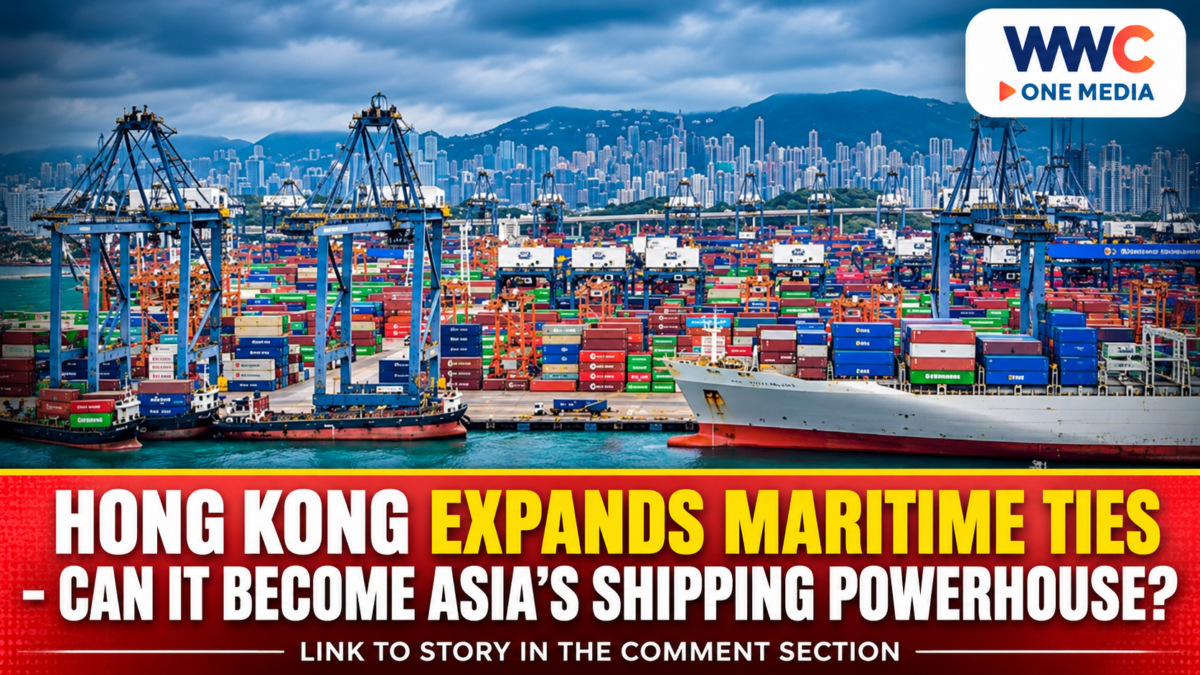
HONG KONG — Hong Kong is expanding its maritime partnerships with mainland Chinese and overseas ports as it seeks to strengthen its position in international shipping, trade finance and cleaner marine-fuel markets.
The strategy became more visible during the 10th Hong Kong Maritime Week, held from Nov. 15 to 21, 2026. The programme brought together more than 18,000 policymakers, industry leaders, maritime organisations and business decision-makers.
Several agreements announced during the event connect Hong Kong with ports in Hainan, Shandong, Guangdong and Greece. Other initiatives focus on green shipping, marine insurance, digital trade finance and logistics corridors.
The direction is clear: Hong Kong wants to compete not only by moving cargo through its port, but also by providing the financial, insurance, legal and professional services surrounding international trade.
But the bigger question is whether these partnerships will translate into more customers, cargo volumes and commercial activity — or remain a collection of agreements that still need to prove their value.
Hong Kong Builds a Wider Port Partnership Network
One of the most important developments is the expansion of Hong Kong’s relationships with other ports.
The city signed a memorandum of understanding with Hainan Yangpu Port to establish a partner-port relationship. A separate agreement with Zhanjiang in Guangdong aims to create Hong Kong’s first Green Energy Corridor, connecting cleaner marine-fuel supply chains with international shipping markets.
Hong Kong also established a partner-port relationship with Greece’s Port of Piraeus and agreed to develop its first Green Shipping Corridor with the European port.
The Port of Qingdao in Shandong was subsequently added to Hong Kong’s partner-port network.
These agreements are intended to support cooperation in port operations, maritime logistics, green shipping and smart-port development. They do not, by themselves, establish new shipping services, guaranteed cargo volumes or completed infrastructure projects.
The city had already signed a strategic cooperation memorandum with Shanghai on Oct. 20. The agreement covers smart ports, coordinated container shipping operations, green and low-carbon shipping, high-end maritime services, intermodal logistics and professional training.
A Shanghai-Hong Kong Express demonstration project was also announced as a practical outcome of that cooperation.
The broader objective is to connect Hong Kong more effectively with mainland industrial and logistics centres while maintaining access to international shipping networks.
The Maritime Economy Already Supports Thousands of Jobs
Hong Kong’s maritime ambitions build on an established economic base.
The Census and Statistics Department recorded 519 companies in the cross-border water transport industry in 2024, employing 9,869 people.
The industry generated HK$40.589 billion in value added, while total receipts reached HK$157.884 billion.
Value added measures the industry’s contribution to economic output after accounting for intermediate inputs. It should not be confused with total business receipts or the value of all cargo passing through Hong Kong.
The figures demonstrate why maritime services remain important to the city’s economy. Shipping activity supports employment and demand for port services, finance, insurance, logistics, legal advice and other business functions.
Hong Kong also maintains a major international ship registry. During Maritime Week, the International Maritime Organization’s secretary-general described the Hong Kong flag as ranking among the world’s top five by tonnage.
However, the city faces competition from other major maritime centres, including Singapore, Shanghai and established European ports.
The challenge is therefore not simply to maintain its existing position. Hong Kong needs to make its services attractive enough for shipping companies and international traders to choose the city when arranging their cargo movements and commercial transactions.
Project CargoX Connects Shipping Data With Trade Finance
Another important part of the strategy involves financing.
International trade frequently requires companies to pay suppliers, transport cargo, manage inventory and wait for buyers to settle invoices. Smaller businesses can struggle to obtain financing when banks have limited access to reliable information about their shipments and transactions.
The Hong Kong Monetary Authority’s Project CargoX is designed to address some of these difficulties by connecting cargo and trade information with banking services.
The authority launched the CargoX pilot programme in May 2026 with 21 participating banks. Its projects examine how digital cargo and trade records can help banks assess businesses seeking trade finance.
By October, the pilot had enabled the approval of 10 trade-finance loans amounting to HK$180 million.
The initiative also aims to strengthen connections with trade corridors in mainland China and Southeast Asia.
This matters because trade finance is not just a banking issue. When companies can obtain working capital more efficiently, they may be better positioned to purchase goods, fulfil export orders and maintain supply chains.
WWC has previously examined how Bangladesh and Thailand’s new direct shipping connection could improve regional trade. Hong Kong’s CargoX programme addresses another part of the same commercial equation: ensuring businesses can finance the transactions that move through transport networks.
Green Marine Fuels Could Become a New Business
The maritime sector is also facing pressure to reduce greenhouse gas emissions.
Hong Kong is seeking a role in the emerging market for cleaner marine fuels, including through its agreement with Zhanjiang and the creation of a green-fuel trading platform.
A task group announced during Maritime Week will support the development of the platform and explore a price index based on actual transactions.
The initiative is intended to connect fuel suppliers, shipping companies, traders and other participants in the maritime value chain.
Certification is another important issue. Hong Kong’s Transport and Logistics Bureau signed an agreement with the Global Sustainable Transport Innovation and Knowledge Center under China’s Ministry of Transport to promote green maritime fuel certification standards internationally.
The aim is to give buyers and shipping companies greater confidence in the characteristics and environmental claims of fuels being traded.
Hong Kong also signed a separate agreement with Greece’s Port of Piraeus to develop a green shipping corridor.
These initiatives are still at different stages of development. A memorandum or corridor announcement does not mean that all participating vessels already use alternative fuels or that the necessary supply infrastructure is complete.
The commercial test will be whether reliable fuel supplies, transparent certification and sufficient demand can support regular operations.
Insurance and Tax Policy Are Part of the Competition
Hong Kong is also trying to expand the services it provides to shipowners.
During Maritime Week, the Hong Kong Shipowners Mutual Assurance Association issued its first protection and indemnity insurance policy. The policy covered shipowners’ liabilities for a Hong Kong-registered Orient Overseas Container Line vessel equipped to use green methanol as one of its fuels.
Protection and indemnity insurance generally covers certain third-party liabilities arising from vessel operations, including risks involving crew, cargo and other maritime responsibilities.
Expanding this market could help Hong Kong capture more value from ship registration and vessel operations rather than relying only on port activity.
Tax policy is another part of the city’s maritime development agenda. Hong Kong has proposed a half-rate profits tax concession for qualifying physical commodity traders, alongside changes to existing shipping-related tax concessions.
The Inland Revenue (Amendment) (Tax Concessions for Shipping-related Activities and Physical Commodity Trading) Bill 2026 was gazetted and introduced into the legislative process. The proposal should not be treated as an already implemented tax benefit for every commodity trader. Eligibility requirements and the legislative process matter.
For international companies, tax incentives can influence where they establish trading operations. But they are only one factor alongside regulatory certainty, access to financing, skilled professionals, infrastructure and market demand.
WWC’s earlier analysis of Hong Kong’s potential business opportunities from the upgraded China-Switzerland trade agreement examined how the city’s financial and professional services could support international trade. Maritime development follows a similar logic: the city wants to earn more from the services that surround cross-border commerce.
Can Hong Kong Turn Agreements Into More Cargo?
The next stage will be measured by implementation.
Hong Kong needs to demonstrate that its port partnerships generate practical cooperation, that green-fuel initiatives attract commercial participants and that digital financing produces more accessible credit for businesses.
It must also address competitiveness at the operational level. Shipping companies consider port charges, cargo-handling costs, customs procedures, transport connections, reliability and the time required to move goods.
A stronger financial and professional-services sector cannot fully compensate for a port that is too expensive or inefficient for customers.
The same challenge faces other maritime economies. The Philippines’ proposed expressway and roll-on/roll-off reforms show how transport costs and connections between ports can influence the competitiveness of domestic supply chains. Meanwhile, Subic’s proposed ship-repair expansion illustrates how maritime infrastructure investment can create opportunities beyond cargo handling.
For Hong Kong, the objective is to combine its international financial centre, port network and professional-services base into a more integrated maritime business platform.
The city does not have to choose between closer mainland integration and international trade. Its success will depend on whether stronger mainland connections help it serve international customers more efficiently.
Hong Kong has expanded its maritime network. The next test is whether shipping companies will move more business through the city — and pay for the services it wants to become known for.