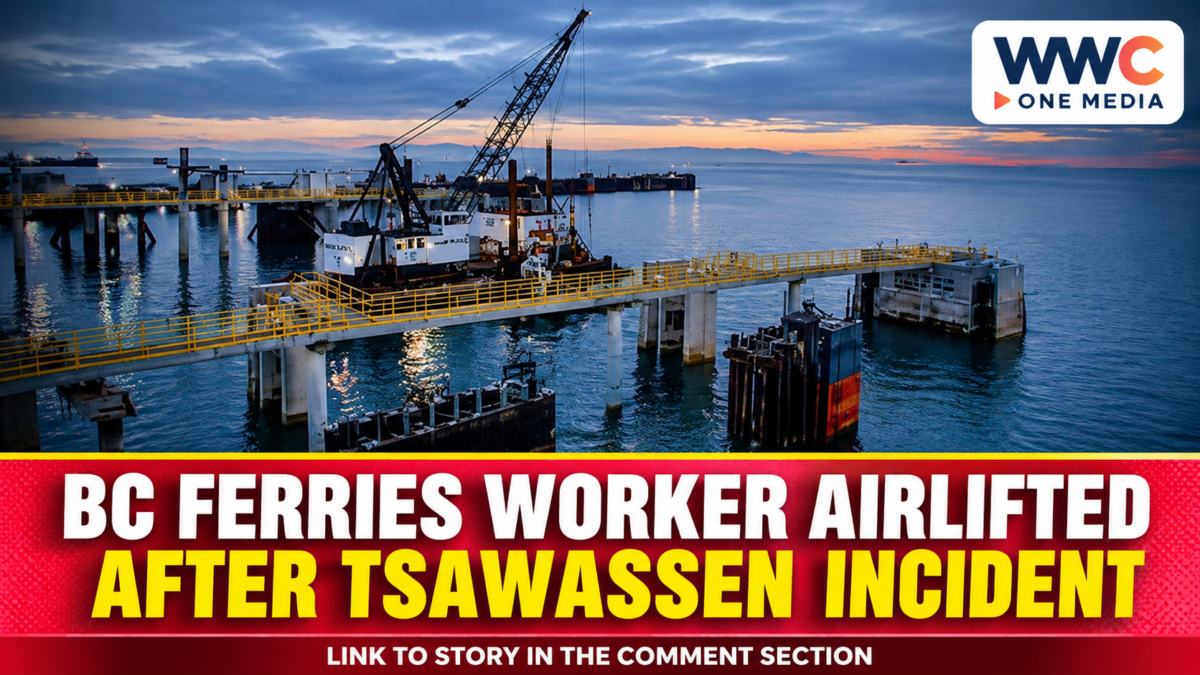
TSAWWASSEN, British Columbia — A workplace incident at the Tsawwassen ferry terminal left a BC Ferries commercial services driver injured and requiring an airlift to hospital, prompting the workers’ union to seek a clearer account of what happened.
The BC Ferry and Marine Workers’ Union confirmed on Nov. 26 that one of its members was injured at the terminal on the morning of Nov. 25. The union said the worker was taken to hospital by air ambulance and that it had since received encouraging news about the member’s condition.
The statement did not identify the worker or disclose the nature of the injuries. It also did not explain what caused the incident.
The union said it would seek a full understanding of the circumstances, while declining to share further personal or medical information out of respect for the member’s privacy.
The incident has placed attention on the safety of workers at one of British Columbia’s major ferry gateways. But the immediate question remains unanswered: what happened at the terminal, and what will the subsequent review establish?
What the Union Has Confirmed
The union’s statement identifies the injured employee as a commercial services driver. It confirms that the incident occurred during the morning of Nov. 25 at the Tsawwassen ferry terminal and that the worker was airlifted to hospital.
The update that the union had received encouraging news about the member’s condition offers a more positive development than the initial hospitalisation report. However, it is not a detailed medical assessment, and no specific diagnosis or recovery timeline has been made public.
The union has also not identified the equipment, vehicle or work activity involved in the incident in its statement.
That distinction matters. A workplace incident can involve several possible operational circumstances, but those possibilities should not be treated as established explanations before the relevant evidence is available.
Union Seeks a Full Account of the Incident
The union said it would be seeking a full understanding of the circumstances surrounding the injury.
That could involve clarifying the sequence of events, the work being performed and any safety procedures relevant to the incident. These are questions for the appropriate review, not findings that can be assumed from the fact that a worker was hospitalised.
The union’s statement did not announce a completed investigation or identify any party as responsible.
The incident also raises a wider workplace-safety question for ferry operations: how are risks managed for employees whose duties take place around vehicles, terminal facilities and active transport operations?
WWC’s earlier reporting on workplace protections and the right to refuse unsafe work examines why safety procedures and clear employer responsibilities matter when workers face occupational risks. The legal framework discussed in that article applies to the Philippines, not British Columbia, but the broader workplace-safety issue is relevant across transport industries.
Why the Tsawwassen Terminal Matters
The Tsawwassen terminal is a major ferry connection in Metro Vancouver, linking the Lower Mainland with destinations including Vancouver Island and the Gulf Islands.
Its operations depend on the coordination of vessels, terminal personnel, commercial services and passenger movements. Workers perform different roles within that environment, making clear safety procedures and effective incident reporting important parts of daily operations.
The terminal’s importance does not establish anything about the cause of this particular injury. Nor does the incident alone demonstrate that the wider ferry operation is unsafe.
However, a serious workplace injury deserves a transparent account of the circumstances once the facts can be established.
WWC has also examined how investigators distinguish confirmed facts from unresolved causes in its coverage of the Ruatoria construction-site collapse in New Zealand. In that case, the distinction between confirmed casualties and an unconfirmed technical explanation was central to responsible reporting.
What Happens Next?
The next important development will be a clearer account of the incident and any findings from the relevant review.
The union has already indicated that it wants to understand the circumstances. Further information from the employer or appropriate workplace-safety authorities could clarify what happened, whether any operational changes are necessary and what steps may help prevent a similar incident.
For now, the confirmed information remains limited: a commercial services driver was injured at the Tsawwassen terminal on Nov. 25, was airlifted to hospital, and the union received encouraging news about the member’s condition the following day.
No cause has been established in the union’s public statement, and no finding of negligence or responsibility has been announced.
WWC’s previous coverage of workplace-safety enforcement following fatal incidents in Singapore provides another example of how workplace incidents can lead to broader scrutiny of safety practices. The circumstances and legal systems are different, but the principle remains: conclusions about responsibility must follow evidence.
The immediate priority is the injured worker’s recovery. The longer-term question is whether the review will identify any safety lessons that should be acted on.
What happened at the Tsawwassen terminal remains unclear. The answers will depend on the evidence gathered, not speculation.