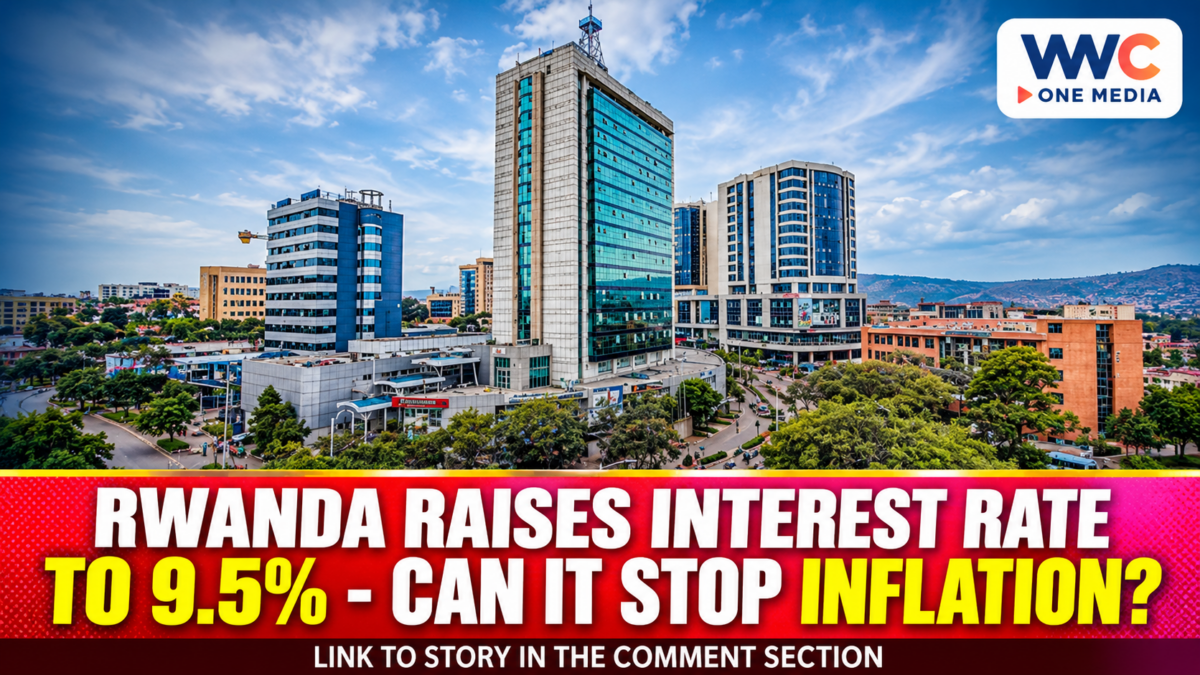
Rwanda has delivered another forceful response to rising prices, increasing its central bank interest rate to 9.5% as inflation accelerates and food costs put mounting pressure on households.
The National Bank of Rwanda (BNR) announced on November 26, 2026, that its Monetary Policy Committee had raised the Central Bank Rate (CBR) by 75 basis points, bringing it from 8.75% to 9.5%. The decision was accompanied by another tightening measure: commercial banks must now maintain a higher reserve requirement, increasing from 5% to 7%.
The two decisions are intended to reduce excess liquidity in the banking system, anchor inflation expectations and prevent rising food and energy costs from spreading more widely across the economy.
The scale of the challenge is evident in the latest price data. Rwanda’s official urban inflation measure reached 19.5% in October, compared with 17.2% in September. The country’s overall national consumer price index, which also incorporates rural prices, increased by 26.5% year on year.
The central bank now expects average inflation to reach 14.4% in 2026 and says prices may not return to its target range until the end of 2027.
For Rwanda, the immediate question is whether tighter monetary policy can slow the increase in prices without placing excessive pressure on households, businesses and economic expansion.
Why Rwanda Raised Its Interest Rate Again
The latest decision is the fourth policy-rate increase in 2026, following earlier adjustments in February, May and August.
The Central Bank Rate influences the cost of money across Rwanda’s financial system. It affects the rates at which commercial banks obtain funds and helps guide the broader cost of borrowing.
By increasing the rate to 9.5%, the BNR is attempting to make financial conditions tighter and reduce the risk that persistent inflation becomes embedded in business pricing and household expectations.
The reserve requirement increase adds another layer to that strategy.
Commercial banks must now keep 7% of the relevant deposit base in reserve, compared with 5% previously. This leaves less of the deposit base available for lending and helps absorb excess liquidity from the banking system.
The measures are designed to complement each other. A higher policy rate influences the price of borrowing, while a higher reserve requirement affects the amount of funds banks can use for lending.
Governor Soraya M. Hakuziyaremye signed the November 26 monetary-policy statement, which said the decisions were intended to help bring inflation back within the target range.
The central bank’s target band is 2% to 8%, with a medium-term objective of 5%.
Food Prices Are Driving the Inflation Problem
Rwanda’s inflation challenge is particularly serious because the pressure is concentrated in essential household expenses.
The National Institute of Statistics of Rwanda reported that urban food and non-alcoholic beverage prices increased by 28.9% year on year in October 2026.
The monthly increase in this category was 7.8%, making food the main contributor to the latest monthly inflation movement.
Vegetable prices were especially significant, rising 56.4% annually and 16.5% during October alone.
Other categories also recorded substantial annual increases:
- Transport: 22.4%.
- Restaurants and hotels: 20.6%.
- Housing, water, electricity, gas and other fuels: 14.2%.
- Miscellaneous goods and services: 18.0%.
The figures show why inflation can become a serious economic and social concern even when overall economic activity remains strong.
Food is a recurring expense. When its price increases rapidly, households have less money available for transportation, education, healthcare, savings and other purchases.
The pressure is not confined to urban areas. Rwanda’s October national CPI increased 26.5% annually, while the rural CPI increased 31.3%. These figures differ from the 19.5% urban inflation rate used for monetary-policy purposes.
That distinction matters: the 19.5% figure should not be mistaken for the increase recorded across the entire country.
Why Higher Interest Rates May Not Solve Everything
The BNR has identified food-supply pressures and adverse weather conditions as important reasons for the upward revision to its inflation outlook.
Fresh food inflation increased from 7.3% to 21.7% during the third quarter of 2026, reflecting higher prices for meat, fruits and vegetables.
This creates a difficult policy problem.
Higher interest rates can moderate credit growth, reduce demand and influence inflation expectations. They cannot directly increase agricultural production, repair damaged crops or improve the availability of food in markets.
The central bank’s own assessment recognises this distinction. It expects monetary tightening to prevent food and energy shocks from spreading into other prices rather than immediately eliminating the underlying supply disruptions.
Weather conditions remain a significant risk. The BNR warned that prolonged El Niño effects could reduce crop output further and keep fresh food prices elevated.
International energy costs are another concern. A prolonged Middle East conflict could push up global oil prices, increasing domestic fuel and transport expenses.
These risks could complicate the inflation outlook even if domestic demand begins to moderate.
Borrowing Costs Are Already Responding
The monetary tightening campaign is beginning to influence Rwanda’s financial markets.
The BNR reported that the interbank interest rate increased from 5.85% in the third quarter of 2025 to 8.44% in the third quarter of 2026.
Retail deposit rates have also increased. The average deposit rate rose by 117 basis points, from 8.66% to 9.83% over the same year-on-year comparison.
However, the average lending rate increased by only 9 basis points, from 15.78% to 15.87%.
This difference is important. Changes in the central bank’s policy rate do not automatically translate into identical increases in every commercial loan.
Banks set lending rates according to funding costs, credit risks, loan terms and market conditions. The transmission of monetary policy therefore takes time and varies between borrowers.
For companies, higher financing costs can influence decisions about expansion, equipment purchases, working capital and investment.
For households, more expensive credit can affect mortgages, personal loans and other borrowing arrangements, depending on the terms of individual agreements.
The adjustment also creates potential benefits for depositors as banks respond to higher interest rates, although the actual returns depend on the product and institution.
Rwanda’s Economy Is Still Growing Strongly
The rate increase is taking place despite strong economic activity.
The National Bank of Rwanda reported that real gross domestic product expanded by 9.4% in the second quarter of 2026, supported mainly by services and industry.
The real Composite Index of Economic Activities increased by 16% in the third quarter, compared with 13.5% during the same period in 2025.
Rwanda’s external trade position also improved. The trade deficit narrowed by 7.4% in the third quarter compared with the same period a year earlier.
Foreign exchange reserves covered 4.2 months of prospective imports at the end of September, exceeding the four-month benchmark cited by the central bank.
The Rwandan franc also remained relatively stable, depreciating by 1.43% against the US dollar between January and September 2026, compared with 4.03% during the corresponding period in 2025.
These indicators provide an important counterpoint to the inflation story. Rwanda is not facing the same combination of weak economic activity and rapidly rising prices that can characterise a stagflation crisis.
Nevertheless, strong growth does not guarantee that households are benefiting from improved purchasing power. If essential prices rise faster than incomes, the cost-of-living burden can remain severe.
WWC’s earlier examination of diverging African interest-rate policies explains why central banks across the continent face different combinations of inflation, currency and financing pressures.
The wider regional outlook also matters. As discussed in WWC’s report on Africa’s growth prospects and exposure to external economic shocks, continued economic expansion does not necessarily protect governments and households from rising debt-service costs, imported inflation and climate-related disruptions.
What Happens Next
The National Bank of Rwanda expects inflation to ease progressively from the second quarter of 2027 and return to its target range by the end of that year.
Food inflation is expected to remain elevated before beginning to decline in the second half of 2027. Energy inflation is projected to start easing in the first half of 2027 as international oil-price pressures moderate.
These are forecasts, not guaranteed outcomes.
The central bank has said future decisions will depend on economic developments and the risks surrounding the inflation outlook. It remains committed to returning inflation sustainably towards its medium-term objective of 5%.
The coming months will therefore be important for three reasons: whether food production and supply conditions improve, whether global energy costs moderate, and whether tighter monetary conditions begin to slow underlying price pressures.
Rwanda’s latest decision also illustrates a broader challenge for African policymakers. Interest-rate increases can help stabilise expectations, but they cannot substitute for improvements in agricultural resilience, logistics, energy supply and food distribution.
The country has chosen a more restrictive monetary stance while its economy continues to expand. Whether that approach succeeds will depend on how quickly inflation responds and whether the cost of borrowing rises faster than economic activity can comfortably absorb.
For now, Rwanda’s 9.5% policy rate sends a clear signal: the central bank is prepared to tighten further if price stability remains at risk.
Frequently Asked Questions
1. What is Rwanda’s central bank interest rate in November 2026?
The National Bank of Rwanda raised its Central Bank Rate by 75 basis points to 9.5% on November 26, 2026.
2. Why did Rwanda increase its policy rate?
The central bank cited persistent inflationary pressures, rising food prices and the need to anchor inflation expectations and return inflation to its target range.
3. What is Rwanda’s inflation rate in October 2026?
The official urban inflation rate reached 19.5% year on year in October. Rwanda’s overall national CPI increased by 26.5%, while rural inflation reached 31.3%.
4. What is Rwanda’s new bank reserve requirement?
The National Bank of Rwanda increased the reserve requirement ratio from 5% to 7%.
5. When does Rwanda expect inflation to return to its target range?
The central bank expects inflation to return to its target range by the end of 2027, although this remains a forecast subject to economic and supply-side risks.