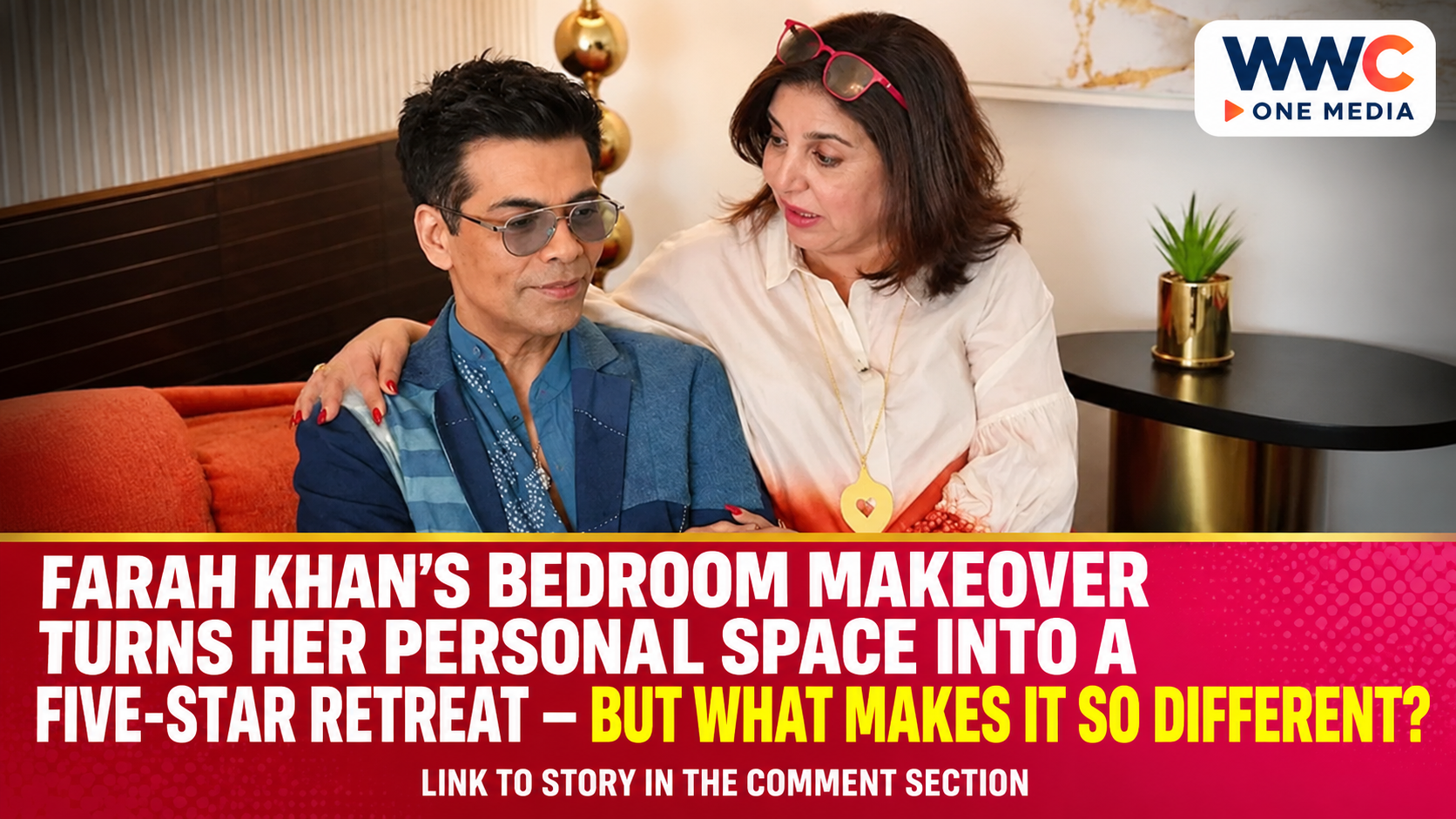
Bollywood filmmaker and choreographer Farah Khan has turned a playful challenge from fellow filmmaker Karan Johar into an ambitious bedroom transformation, embracing the comfort and sophistication of a luxury hotel suite.
The Farah Khan bedroom makeover, introduced in a November 2, 2026, video, brings together elegant furnishings, premium bedding, decorative lighting, carpets and smart home automation.
While the transformation offers another glimpse into celebrity living, it also raises a practical question for homeowners: how much of the luxury hotel experience can be recreated without an extravagant renovation budget?
The answer may lie in thoughtful planning rather than expensive designer labels.
Farah Khan bedroom makeover: From a playful challenge to a luxury retreat
What began with Karan Johar nominating Farah Khan for a bedroom renovation evolved into a project focused on creating a more sophisticated personal sanctuary.
Instead of treating the makeover as a simple furniture replacement exercise, Khan embraced a hotel-inspired design concept that brought different elements of the bedroom together.
Lighting, textiles, furniture and technology became part of the transformation.
The approach reflects an important consideration in residential interior design: a bedroom should be planned around how its occupant lives, rests and uses the available space.
WWC ONE MEDIA previously explored a similar emphasis on residential comfort and thoughtful architecture in its feature on Manila’s Cascade House, where sustainability meets serenity.
Although the two projects have different design concepts, both offer inspiration for homeowners seeking a more personalised living environment.
Creating the atmosphere of a five-star hotel
A hotel-inspired bedroom does not necessarily require an extensive collection of expensive furniture.
Homeowners can begin by developing a consistent visual direction, choosing complementary colours and identifying which furnishings deserve the largest share of the renovation budget.
Consider a neutral foundation of beige, cream, warm brown or soft grey. Introduce contrasting textures through cushions, curtains, rugs and upholstered furniture.
Rather than filling every available corner with decorative objects, leave sufficient space for movement and everyday activities.
Premium-looking interiors can be approached through coordinated materials and carefully selected accessories instead of purchasing everything from luxury retailers.
For further hospitality-inspired design ideas, readers can explore Singapore’s Coliwoo Resort Changi and its transformation into a modern accommodation experience.
The objective is to create a bedroom that feels inviting when its occupant returns home, not simply one that photographs well.
Why lighting and bedding deserve more attention
Khan’s makeover incorporates decorative lighting and luxury bedding as part of its hotel-inspired direction.
These are two areas homeowners can consider upgrading before committing to major structural changes.
Instead of relying entirely on a central ceiling light, consider introducing bedside lamps, indirect lighting or adjustable fixtures to suit different activities throughout the day.
A coordinated bedding arrangement can also serve as the visual centrepiece of a bedroom. Matching pillowcases, a neatly arranged duvet and a carefully selected throw blanket can help establish the desired aesthetic.
When selecting bedding, prioritise personal comfort, fabric suitability, maintenance requirements and the local climate.
Homeowners should also consider how their curtains interact with natural light and whether greater privacy or darkness is necessary.
These decisions should be based on individual preferences rather than an attempt to replicate every element of a celebrity home.
Smart home technology enters the bedroom
One of the more contemporary aspects of Khan’s makeover is the incorporation of smart home technology.
Her makeover description identifies wireless automation for lighting, curtains, fans and air-conditioning.
The idea is to integrate everyday controls into a more convenient living environment, reducing the need to operate each compatible device separately.
For homeowners interested in exploring connected living, WWC ONE MEDIA has also examined LG’s evolving smart home ecosystem and its push towards intelligent automation.
However, a complete automation system need not be the starting point for every household.
Consider beginning with compatible smart lighting or other individual devices that address a specific daily inconvenience.
Before purchasing connected equipment, check compatibility, installation requirements, privacy settings and whether the devices can still operate manually.
Technology should complement the bedroom rather than make ordinary tasks unnecessarily complicated.
Can homeowners recreate the luxury look on a smaller budget?
The most practical approach is to divide the renovation into manageable stages.
Start by examining existing furniture and identifying pieces that can be retained, repaired or refinished.
Next, consider whether the room requires improvements to its layout, storage, lighting or decorative finishes.
For compact apartments, multifunctional furniture and carefully planned storage may be more appropriate than oversized furnishings.
Readers looking for additional inspiration can explore WWC ONE MEDIA’s coverage of IKEA’s home furnishing showcase and space-conscious furniture concepts.
A phased renovation could begin with bedding and lighting, followed by storage improvements and decorative accessories. More expensive upgrades can be considered separately when the budget allows.
Homeowners should also distinguish cosmetic changes from necessary building repairs. Any underlying structural, electrical or moisture-related problems should be properly assessed before new finishes are installed.
What happens next for luxury residential interiors?
Khan’s bedroom transformation offers a starting point for a wider conversation about the relationship between hospitality design, residential comfort and personal technology.
For homeowners across Asia-Pacific, the most useful approach may be to adapt these ideas to their own living conditions, available floor space and financial priorities.
A compact apartment and a spacious celebrity residence do not require identical design solutions.
The goal is not to reproduce someone else’s bedroom exactly, but to create a personal space that is comfortable, functional and visually cohesive.
Farah Khan may have taken her inspiration from a five-star hotel, but homeowners can begin their own transformation with something considerably simpler: a clear design plan and a realistic budget.