
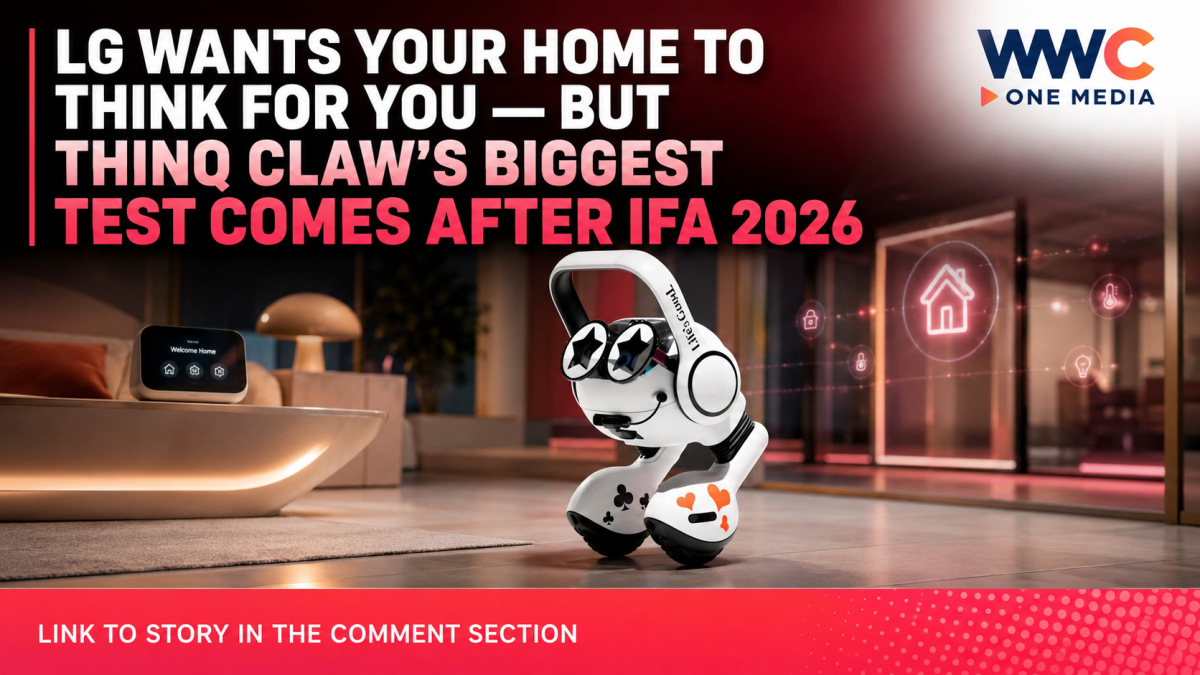
BERLIN — LG Electronics is pushing artificial intelligence deeper into the home, moving beyond AI-powered refrigerators, washing machines and air conditioners toward something far more ambitious: an intelligent system capable of coordinating the entire household.
At the center of that strategy is ThinQ Claw, a new text-based AI agent that LG plans to showcase at IFA 2026 in Berlin from September 4 to 8.
Instead of forcing users to manually control individual devices or build complicated automation routines, LG says ThinQ Claw is designed to understand what people are doing, interpret the context around their routines and then recommend—or help initiate—the appropriate actions across connected appliances and services.
That may sound like another smart-home assistant.
But LG is aiming for something broader.
The company wants its ThinQ ecosystem to evolve from a remote-control platform for appliances into an intelligence layer capable of coordinating the home itself.
From Following Commands to Understanding Context
Most smart homes today still depend heavily on direct commands.
A homeowner might tell an assistant to turn down the air conditioner, start a robot vacuum or switch off the lights. More advanced users can create routines that trigger several devices simultaneously.
ThinQ Claw is being positioned differently.
LG says the AI agent can analyze information including household schedules, appliance usage, environmental conditions and personal preferences before deciding what action may be useful.
Someone preparing to entertain guests, for example, could receive assistance coordinating cooking appliances. The system could also monitor temperature and indoor air conditions ahead of a resident’s arrival home.
ThinQ Claw can work with connected services such as calendars, allowing information outside an individual appliance to influence what happens inside the home. LG also says the agent can remember likes and dislikes over time to make its recommendations increasingly personalized.
That distinction matters.
The goal is no longer simply to make an appliance “smart.” It is to make multiple devices operate as parts of one coordinated system.
LG Has Been Building Toward This for Years
ThinQ Claw is not an isolated experiment.
LG’s broader attempt to turn ThinQ into a comprehensive smart-home ecosystem became much clearer in 2024, when the company introduced the ThinQ ON AI home hub and moved toward supporting devices beyond its own appliance portfolio.
The Verge reported at the time that ThinQ ON was designed to work with technologies including Matter, Thread, Zigbee and Wi-Fi while integrating software from Homey, the smart-home platform developed by Dutch company Athom.
LG acquired a controlling stake in Athom in 2024 as part of its strategy to expand beyond proprietary appliance connectivity.
That investment could now become one of the most important pieces of LG’s AI Home strategy.
Homey’s strength is interoperability—the ability to bring products from numerous manufacturers into one smart-home environment instead of requiring every connected device to carry the LG name.
The scale has continued growing.
The Verge reported this week that Homey’s ecosystem claims compatibility with more than 70,000 devices from over 2,000 brands, with support for major smart-home technologies including Matter, Zigbee, Z-Wave and Thread.
For LG, that potentially gives ThinQ Claw a much bigger playground.
An AI assistant capable of understanding context becomes considerably more useful if it can coordinate lights, thermostats, sensors, entertainment systems and appliances from different manufacturers rather than operating inside a closed ecosystem.
Your Electricity Bill Is Also Part of LG’s AI Plan
LG’s vision extends beyond convenience.
At IFA 2026, the company is also presenting a Home Energy Management System, or HEMS, built around the Homey ecosystem.
The system is designed to coordinate energy generation, storage and consumption by linking devices including smart meters, solar panels, household batteries, electric-vehicle chargers and appliances.
In markets with dynamic electricity pricing, such a system could theoretically move some energy-intensive activities to periods when electricity is cheaper or prioritize stored or solar-generated power at appropriate times.
LG says this could help reduce electricity costs, although actual savings would depend on factors including household usage, local tariffs and energy infrastructure.
The company has not published a universal savings figure.
The energy angle is significant because it provides smart-home technology with a potential benefit beyond convenience.
Homey has already been developing energy-management tools. Previous reporting by The Verge detailed Homey systems capable of monitoring electricity, gas and water consumption, tracking solar generation and EV charging and identifying some of the largest energy-consuming devices in a household.
AI could eventually turn that information into automated decisions rather than simply displaying it on a dashboard.
LG’s AI Ambitions Are Moving Outside the House Too
The same strategy is also being aimed at apartments, shared residential developments and commercial properties.
LG plans to give ThinQ Pro its European debut at IFA 2026.
Unlike the consumer-focused ThinQ experience, ThinQ Pro is intended to help operators manage connected equipment and facilities across multi-family residential and commercial environments.
That gives LG’s strategy another dimension.
The company is no longer positioning AI merely as a premium feature inside individual appliances. It is increasingly treating software, connectivity and automation as infrastructure spanning homes, energy systems and buildings.
But More Intelligence Means More Sensitive Data
There is also an unavoidable challenge.
An AI system becomes more useful as it understands more about its user—but that same capability raises questions about privacy, security and control.
A platform capable of considering calendars, household routines, environmental sensors, appliance activity and personal preferences potentially has access to an unusually detailed picture of everyday life.
LG says its LG Shield security framework is being applied across the AI Home ecosystem to help safeguard connected appliances, services and customer data.
Still, consumer trust could become just as important as technical performance.
The Verge raised similar concerns when LG began showing more autonomous ThinQ concepts in 2024, noting that a home AI capable of learning behavior and independently controlling devices represents a substantially different proposition from conventional smart-home automation.
Giving an AI more autonomy may eliminate tedious commands.
It also means consumers need confidence that the system understands when not to act.
The Biggest Questions Remain Unanswered
For all the futuristic scenarios LG is presenting, ThinQ Claw should still be viewed as an emerging technology rather than a product already available in millions of homes.
As of September 3, LG has not announced consumer pricing, a firm commercialization timetable or Philippine availability for ThinQ Claw. InsiderPH similarly noted the absence of those details in the company’s announcement.
That makes IFA 2026 an important demonstration—but not necessarily the finish line.
LG still has to prove that contextual AI can reliably understand complicated household routines, work across different manufacturers’ products, protect sensitive personal information and provide enough practical value to persuade ordinary consumers to give an algorithm greater control over their homes.
The industry has spent years promising a future in which refrigerators, lights, air conditioners, televisions, robot vacuums and other connected devices finally work together instead of behaving like isolated gadgets.
LG now believes artificial intelligence can become the missing coordinator.
If ThinQ Claw works as envisioned, the next generation of the smart home may require users to press fewer buttons, open fewer apps and create fewer automation rules.
The home could increasingly figure out what needs to happen on its own.
The technology is getting closer. The unanswered question is whether consumers are ready to let it.
WWC ONE MEDIA MJE




Leave a Reply