
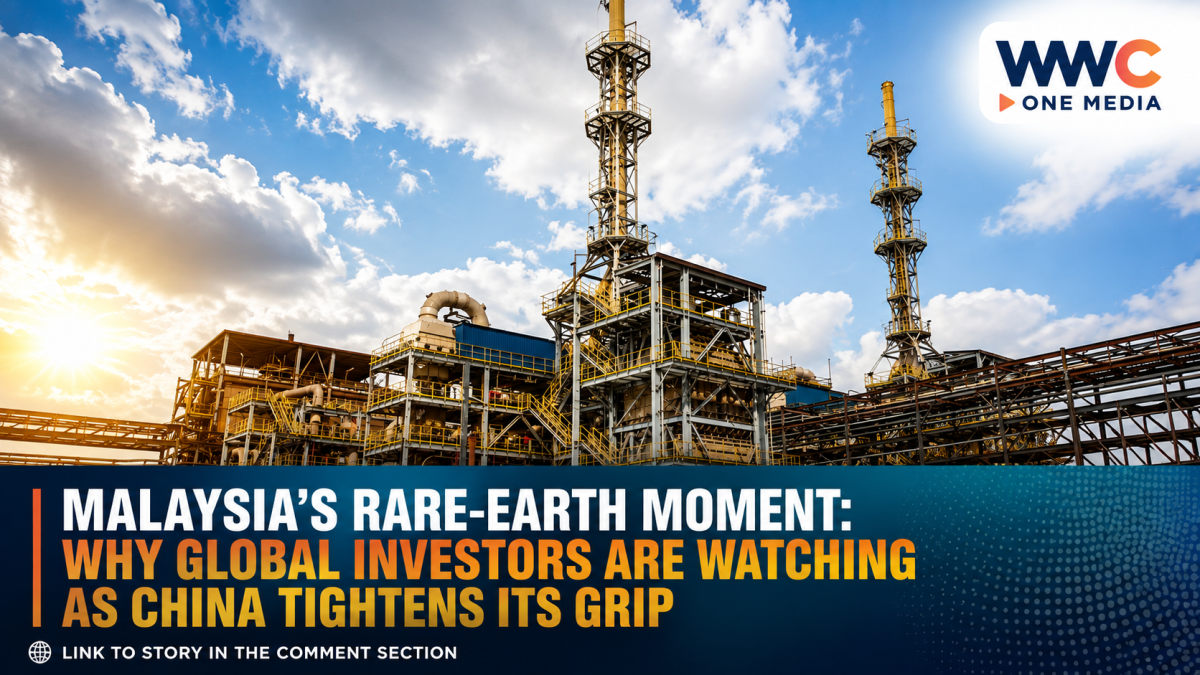
KUALA LUMPUR — Malaysia is emerging as an increasingly important piece of the global critical-minerals puzzle as governments and manufacturers look for alternatives to supply chains heavily concentrated in China.
The spotlight is particularly intense on Malaysia’s rare-earth resources, which could become strategically valuable as China maintains export controls on several rare-earth materials and related products.
But Malaysia’s opportunity comes with a major condition: the country wants to build more of the value chain at home rather than simply export raw minerals.
That strategy could determine whether Malaysia becomes a major regional processing hub—or remains a promising resource holder that struggles to turn its geological potential into large-scale production.
Why Malaysia is suddenly in the spotlight
Malaysia is estimated to have about 16.1 million tonnes of in-situ non-radioactive rare-earth resources, according to Malaysian government studies cited by The Star and CNA. Those resources are spread across 10 states.
Rare earths are a group of 17 elements used in products ranging from electronics and electric vehicles to renewable-energy equipment and advanced manufacturing.
The strategic concern is that production and processing are highly concentrated globally. The OECD says China accounts for around 70% of global rare-earth production and more than 90% of some critical-mineral processing chains, making diversification increasingly important for governments and manufacturers.
That concentration has become even more significant since Beijing introduced export controls.
China’s restrictions changed the calculation
China introduced export controls on seven medium and heavy rare earths in April 2025, including dysprosium, terbium, yttrium and several others. The measures require exporters to obtain licenses for covered products.
Beijing subsequently announced broader controls in October 2025. Some elements of that later package were suspended, but the original April controls remain an important part of the current supply-chain picture. S&P Global reported in June 2026 that restrictions on several heavy rare earths and related magnets were still in effect, while another wave of controls was scheduled for November 2026.
China says its measures are export controls rather than blanket bans and argues that they are intended to protect national security and fulfill international non-proliferation obligations.
For manufacturers, however, the message is clear: access to critical minerals can no longer be treated simply as a commercial issue.
Malaysia already has a head start
Malaysia isn’t starting from zero.
Australian company Lynas Rare Earths operates a major processing facility in Pahang. CNA reported that the Malaysian operation produces more than 5% of global rare-earth output, while the U.S. Geological Survey identifies Lynas Malaysia as the largest producer of separated rare earths outside China.
The facility’s importance has also increased because Malaysia has developed expertise in rare-earth separation and processing.
In May 2025, the Lynas facility became the first commercial refinery outside China to process heavy rare earths, according to the U.S. Commerce Department.
That gives Malaysia something many potential competitors lack: an existing industrial ecosystem rather than just deposits in the ground.
But there is a catch: Malaysia doesn’t want to become a raw-material supplier
Malaysia imposed a moratorium on exports of raw non-radioactive rare-earth materials beginning January 1, 2024, with the stated objective of encouraging domestic processing and downstream manufacturing.
The policy reflects a broader Malaysian ambition to capture more economic value from its mineral resources.
Instead of shipping ore abroad and importing higher-value products, policymakers want Malaysia to develop activities such as processing, refining, research and development and potentially magnet manufacturing.
That approach could generate greater investment and higher-skilled jobs—but it also creates a bottleneck.
Malaysia needs technology, capital, mining expertise, infrastructure and a reliable supply of ore to make the downstream strategy work.
Global competition is already arriving
The United States and Malaysia signed a Memorandum of Understanding on critical minerals cooperation in October 2025, aimed at developing more secure supply chains and encouraging investment in exploration, extraction, processing, manufacturing and recycling.
The agreement does not mean the United States has exclusive rights to Malaysian rare earths.
Malaysian officials have explicitly rejected that interpretation, saying the country is not legally bound to supply its rare earths exclusively to Washington.
At the same time, China has also shown interest.
Reuters reported in 2025 that China and Malaysia were discussing a potential rare-earth refinery project, although the talks were described as being at an early stage.
More recently, CNA reported that Malaysia said China was prepared to provide technical and technological assistance for rare-earth processing, with proposed cooperation involving state-linked companies.
That leaves Malaysia in a strategically unusual position.
Washington wants more diversified supply chains. Beijing remains the dominant force in rare-earth processing. And Malaysia has resources and an existing processing base that both sides have reasons to watch.
Malaysia is now weighing a difficult choice
In August 2026, Malaysian authorities said they were considering whether to ease restrictions on exports of some unprocessed rare earths.
The discussion reflects pressure from states and investors who see an opportunity to capitalize on booming global demand.
But such a move would have to be balanced against Malaysia’s longstanding goal of developing domestic value-added industries.
The dilemma is straightforward:
Export raw materials now and attract buyers—or keep them at home and try to build a bigger industry around them.
There is no easy answer.
The biggest obstacle may be getting the minerals out of the ground
Malaysia’s estimated resource base is substantial, but resources are not the same as economically recoverable reserves or actual production.
CNA reported that industry participants have warned Malaysia’s ambitions could run ahead of practical realities, including environmental concerns, licensing issues, investment requirements and technological limitations.
The Star similarly highlighted licensing bottlenecks, weak upstream supply and insufficient processing capacity as potential constraints on Malaysia’s plans.
That distinction is crucial.
Having millions of tonnes of rare-earth resources underground does not automatically translate into a competitive supply chain.
Malaysia still has to demonstrate that it can mine responsibly, process economically and consistently supply international manufacturers.
The bigger Southeast Asian story
Malaysia’s rare-earth push comes as countries across the world attempt to reduce vulnerabilities created by concentrated critical-mineral supply chains.
The International Energy Agency has warned that critical-mineral supply chains face growing risks from geographic concentration, while the OECD has highlighted the importance of diversification for energy, digital and defense-related industries.
For Southeast Asia, that creates an opening.
If Malaysia succeeds in developing a competitive and environmentally responsible critical-minerals industry, it could become an important link between mineral resources, Asian manufacturing and global technology supply chains.
But the race is not simply about who has the minerals.
It is increasingly about who can process them, manufacture products from them and guarantee reliable supply.
And that is where Malaysia’s next move could become especially important.
The minerals may already be underground. The real question is whether Malaysia can turn them into strategic industrial power before the global race moves on.
WWC ONE MEDIA G.A




Leave a Reply