
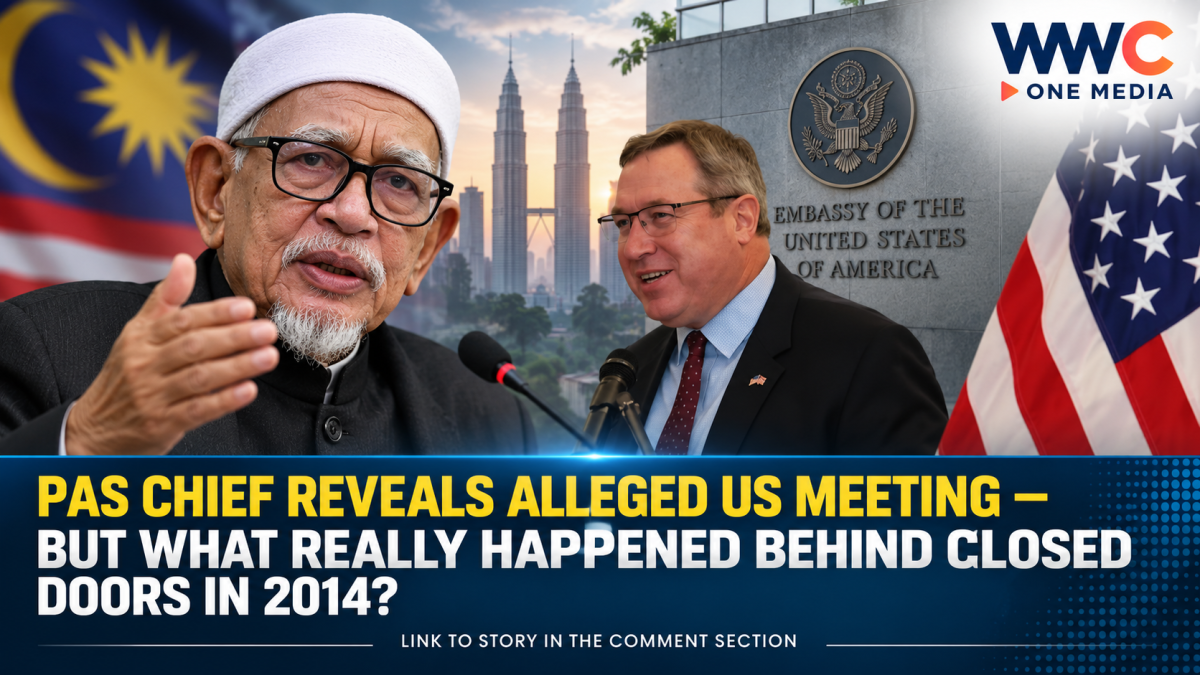
KUALA LUMPUR, Malaysia — The United States Embassy in Malaysia has firmly denied allegations that Washington once attempted to influence the country’s political leadership, following an explosive claim by PAS president Abdul Hadi Awang that US representatives had offered to help his party topple Malaysia’s government more than a decade ago.
In a statement issued on Sunday, September 6, US Embassy chargé d’affaires David H. Gamble Jr said the United States had “never sought to decide Malaysia’s political leadership,” dismissing allegations suggesting otherwise as false.
The controversy erupted after Hadi, president of Parti Islam Se-Malaysia (PAS), alleged during the party’s annual congress that US representatives had offered assistance to PAS in an effort to remove Malaysia’s government around 2014.
Hadi Claims US Offered Help — Embassy Pushes Back
According to reports cited by Channel NewsAsia, Hadi said several PAS leaders were invited to meet representatives of the US Embassy in Kuala Lumpur while PAS was still part of the Pakatan Rakyat opposition coalition.
He alleged that discussions included the possibility of PAS receiving assistance to topple the then Barisan Nasional-led government and take over the administration. Hadi said PAS rejected any form of foreign interference.
However, the US Embassy has categorically rejected the broader allegation that it attempted to determine or influence who should lead Malaysia. The embassy’s response has now intensified debate over foreign involvement, political diplomacy and sovereignty in Malaysia.
PAS Leader Confirms Meeting, But Gives Different Account
The controversy became more complicated after PAS assistant secretary-general Takiyuddin Hassan reportedly confirmed that a meeting with US Embassy representatives did take place.
However, his account appeared more limited than Hadi’s broader allegation.
According to Malaysian media reports, Takiyuddin said the discussion involved questions about whether PAS had plans to topple the Barisan Nasional government. He said PAS representatives did not reveal whether the party intended to do so.
That distinction is now at the heart of the controversy: while PAS leaders acknowledge the meeting occurred, the US Embassy strongly denies ever seeking to determine Malaysia’s political leadership.
Question About Malaysia’s Next Prime Minister?
Hadi also claimed that the US ambassador to Malaysia at the time separately asked him who PAS would nominate as prime minister should the party take power.
He reportedly responded by asking which political leader the United States would support.
Another report said Hadi described US representatives as seeking information about PAS’ possible choice for prime minister, further fueling questions about what exactly was discussed during the alleged meetings.
The alleged events were said to have occurred around 2014, during the period of former US President Barack Obama’s visit to Malaysia.
Political Firestorm Grows in Malaysia
The dispute has triggered fresh political controversy in Malaysia, where foreign interference remains a highly sensitive issue.
Critics of Hadi’s allegations have challenged him to substantiate the claims, with one Malaysian lawmaker even calling for legal action to settle whether the accusations against the United States have any factual basis.
At the same time, the US Embassy’s unusually direct denial has placed the spotlight back on the alleged 2014 meetings and the differing accounts of what was discussed.
For now, several key facts remain clear:
- PAS leaders acknowledge that meetings with US Embassy representatives took place.
- Hadi alleges the US offered assistance related to changing Malaysia’s government.
- Takiyuddin’s reported account describes discussions about whether PAS planned to topple the government.
- The US Embassy denies ever trying to determine Malaysia’s political leadership.
The conflicting accounts mean the political dispute is unlikely to disappear anytime soon.
What Happens Next?
The controversy could place increasing pressure on PAS leaders to provide additional details or evidence supporting Hadi’s allegations.
It may also raise broader questions about the line between normal diplomatic engagement — including discussions with opposition politicians — and what political leaders may interpret as foreign influence.
As Malaysia’s political debate intensifies, the biggest unanswered question remains:
Was the 2014 meeting simply a diplomatic conversation about Malaysia’s political future — or something far more controversial?
The US Embassy says the allegation of attempting to determine Malaysia’s political leadership is false. Hadi, meanwhile, has maintained that foreign representatives raised the possibility of helping PAS change the government.
Until more evidence emerges, the controversy remains a clash of sharply conflicting accounts.
WWC ONE MEDIA J.M.S


Leave a Reply