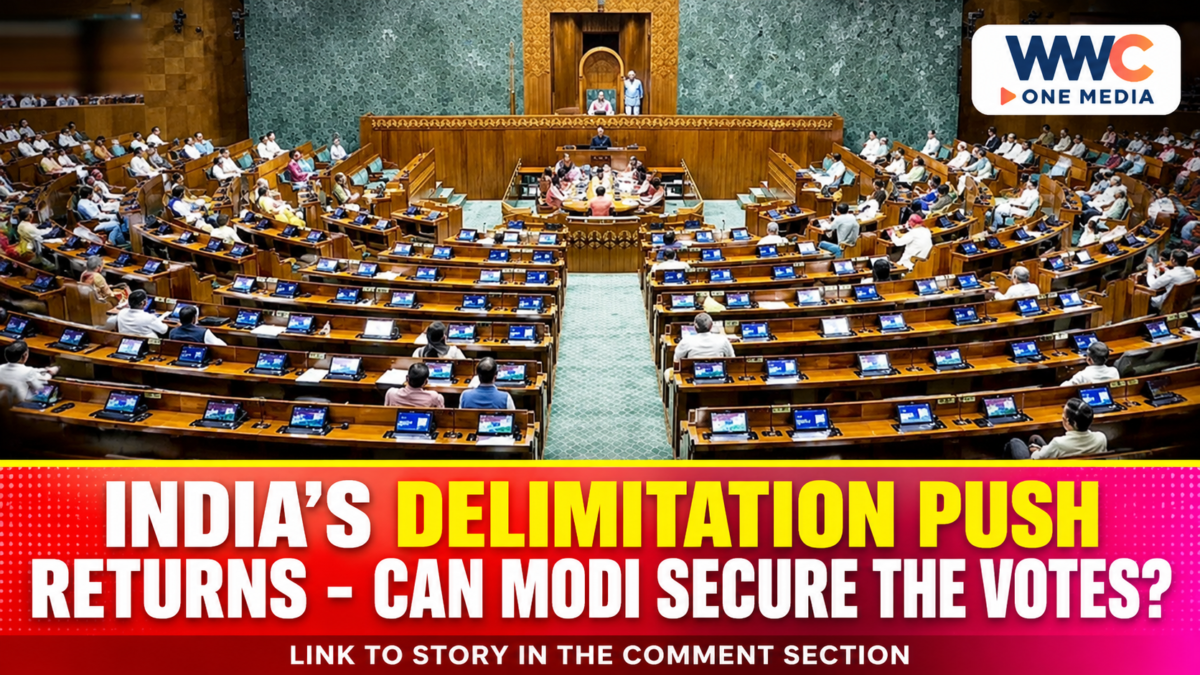
NEW DELHI, India — India’s political battle over parliamentary representation is heading back to the national legislature, with the government preparing for another attempt to advance its proposed delimitation framework and women’s reservation agenda.
The government has requested the Lok Sabha to reconvene on November 30, 2026, and the Rajya Sabha on December 2. The sittings could conclude on December 3, depending on parliamentary business.
The announcement has revived questions about whether Prime Minister Narendra Modi’s government can secure enough support for a package that could reshape the size of the Lok Sabha, redraw electoral constituencies and change the timetable for implementing women’s reservation.
But a parliamentary meeting does not automatically mean the controversial bills will return. The government has described the purpose of the proposed sittings as essential government business without publicly specifying the legislative agenda.
The political challenge is significant: the government’s earlier constitutional amendment package failed in the Lok Sabha in April. Any renewed attempt must address the parliamentary arithmetic and concerns about how changes in representation could affect India’s states.
Why India’s Delimitation Debate Matters
Delimitation is the process of determining electoral constituency boundaries. Depending on the governing constitutional and legislative framework, it can also involve adjusting how many seats are allocated to states.
India currently has 543 elected Lok Sabha constituencies. The Election Commission of India says the existing parliamentary constituencies were determined using the 2001 Census under the Delimitation Act, 2002.
Article 82 of the Constitution provides for the readjustment of parliamentary seats and constituency boundaries after a census, through a process determined by Parliament. However, constitutional amendments have postponed the need for a fresh readjustment until publication of the relevant figures from the first census taken after 2026.
That arrangement has made the next delimitation exercise politically sensitive.
States have experienced different population-growth patterns. A redistribution based on population can therefore raise concerns that states with faster population growth could gain a larger share of parliamentary representation, while states that have moderated population growth could see their relative influence decline.
For southern states, the issue is not simply how many additional MPs Parliament may have. It is whether their existing share of national representation will be protected.
The Earlier Bill Failed to Clear Parliament
The latest political manoeuvring follows a major setback for the government in April.
Three connected proposals were introduced in the Lok Sabha on April 16, 2026:
- The Constitution (One Hundred and Thirty-First Amendment) Bill, 2026.
- The Union Territories Laws (Amendment) Bill, 2026.
- The Delimitation Bill, 2026.
The constitutional amendment proposed changes to the framework governing parliamentary representation and women’s reservation. The Delimitation Bill set out a proposed structure for a commission to readjust seat allocations and redraw constituency boundaries.
The proposals were linked. The constitutional changes were intended to provide the legal framework for the wider exercise.
The parliamentary record subsequently classified the constitutional amendment as not passed. The two related bills were not proceeded with.
That outcome is central to the current debate. The April proposals did not become law, and their provisions cannot be treated as the rules currently governing Indian elections.
The government would need to secure the required parliamentary approval for any new constitutional amendment. Under Article 368, a constitutional amendment must receive a majority of the total membership of each House and at least two-thirds of members present and voting.
The requirement makes support from outside the governing coalition potentially important. A government may have enough votes to pass ordinary legislation but still fall short of the threshold required for constitutional change.
DMK and NCP Support Remains a Political Question
The latest political debate has focused on whether regional parties could reconsider their positions if the government provides stronger assurances about state representation.
The Dravida Munnetra Kazhagam (DMK), based in Tamil Nadu, has been particularly concerned about the possibility that population-based redistribution could reduce the state’s relative influence in the Lok Sabha.
The Nationalist Congress Party (Sharadchandra Pawar), or NCP (SP), is also part of the political calculations surrounding the proposed package.
The government’s potential support from regional parties has become a subject of political reporting. However, reported negotiations and claims about pledged votes should not be confused with formal party decisions.
No publicly examined legislative agreement or formal party resolution establishes that the DMK or NCP (SP) has committed to supporting a revised delimitation bill.
The distinction matters because political flexibility is not the same as a guaranteed vote. Parties may express willingness to examine a proposal while still demanding written safeguards, published bill provisions and assurances that their states will not be disadvantaged.
The wider opposition landscape is also changing ahead of state elections. The Samajwadi Party’s preparations for the 2027 Uttar Pradesh Assembly election, including its published booth-level campaign strategy and policy priorities, illustrate the importance of regional political calculations in the months ahead. Those preparations do not establish the party’s position on the delimitation package.
The Women’s Reservation Issue Adds Another Layer
The delimitation debate is closely connected to women’s representation in Parliament and state legislative assemblies.
The Constitution (One Hundred and Sixth Amendment) Act, 2023, provides for reserving approximately one-third of seats for women in the Lok Sabha and state legislative assemblies.
However, Article 334A links the implementation of that reservation to a delimitation exercise undertaken after publication of the relevant figures from the first census taken after the amendment’s commencement.
The government’s 2026 constitutional amendment proposal sought to change that framework.
This is why the two subjects have become politically intertwined. Delimitation concerns how constituencies and representation are structured, while women’s reservation concerns who will occupy a designated share of legislative seats.
The government has argued that the reservation should be implemented sooner. Critics have raised questions about the proposed changes to representation and whether the process could disadvantage particular states.
The two issues are related, but they are not identical. Support for women’s reservation does not automatically mean support for every proposed change to the delimitation framework.
What Happens Next in Parliament?
The immediate development to watch is the publication of the formal parliamentary business for the reconvened sittings.
The government has not publicly confirmed in its announcement which bills will be taken up. A fresh delimitation proposal would require lawmakers to examine the actual text, including its seat-allocation provisions, constitutional changes and safeguards for state representation.
The April legislative setback remains an important reference point. WWC’s earlier examination of why India’s delimitation bills remained stalled explains why the distinction between an introduced bill and an enacted law matters.
The government’s broader political challenge will be to demonstrate that a revised proposal can secure the required constitutional majority while addressing concerns from states and regional parties.
For the BJP, the coming parliamentary proceedings could become a test of its ability to build consensus beyond its own political base. The party’s wider positioning ahead of the 2027 Uttar Pradesh election adds another layer to the political environment, as explored in WWC’s report on the BJP’s unresolved leadership question in the state.
For the opposition and regional parties, the challenge is to determine whether the government’s eventual proposal offers sufficient protection for state representation without delaying the constitutional commitment to women’s political participation.
The Real Test Is the Final Bill
India’s delimitation debate is returning at a time when parliamentary representation, population policy and women’s political participation are all under scrutiny.
The government may be confident that a revised political strategy can produce a different result from April. But confidence is not the same as a confirmed majority, and reported negotiations are not equivalent to formal support.
Until a new bill is published and the parliamentary agenda is confirmed, the central questions remain unanswered: how many seats will be proposed, how will the allocation be calculated, and what protections will be offered to states concerned about losing their relative share?
The next parliamentary sittings may provide the first indication of whether the government has found a workable compromise.
The outcome could shape the future structure of India’s national legislature. But the decisive test will be whether the final proposal can win the constitutional support required to become law.
Frequently Asked Questions
What is delimitation in India?
Delimitation is the process of redrawing electoral constituency boundaries and, where authorised by law, adjusting the allocation of legislative seats.
When will India’s Parliament reconvene?
The government has requested the Lok Sabha to reconvene on November 30, 2026, and the Rajya Sabha on December 2. The sittings could conclude on December 3, subject to parliamentary business.
Why did the earlier delimitation proposal fail?
The Constitution (131st Amendment) Bill, 2026, was not passed in the Lok Sabha in April. The related Delimitation Bill and Union Territories Laws (Amendment) Bill were not proceeded with.
Why are southern Indian states concerned?
States with slower population growth are concerned that a future population-based redistribution could reduce their relative share of seats and influence in the Lok Sabha.
Has the DMK agreed to support the new delimitation proposal?
No formal commitment to support a revised bill has been established in the public primary records reviewed for this article. Any reported negotiations should be distinguished from a confirmed party decision.
Is women’s reservation already part of India’s Constitution?
Yes. The Constitution (106th Amendment) Act, 2023, provides for approximately one-third reservation for women in the Lok Sabha and state legislative assemblies. Article 334A sets the conditions for its implementation.
Can the government pass a constitutional amendment with a simple majority?
No. Article 368 requires a majority of the total membership of each House and at least two-thirds of members present and voting.