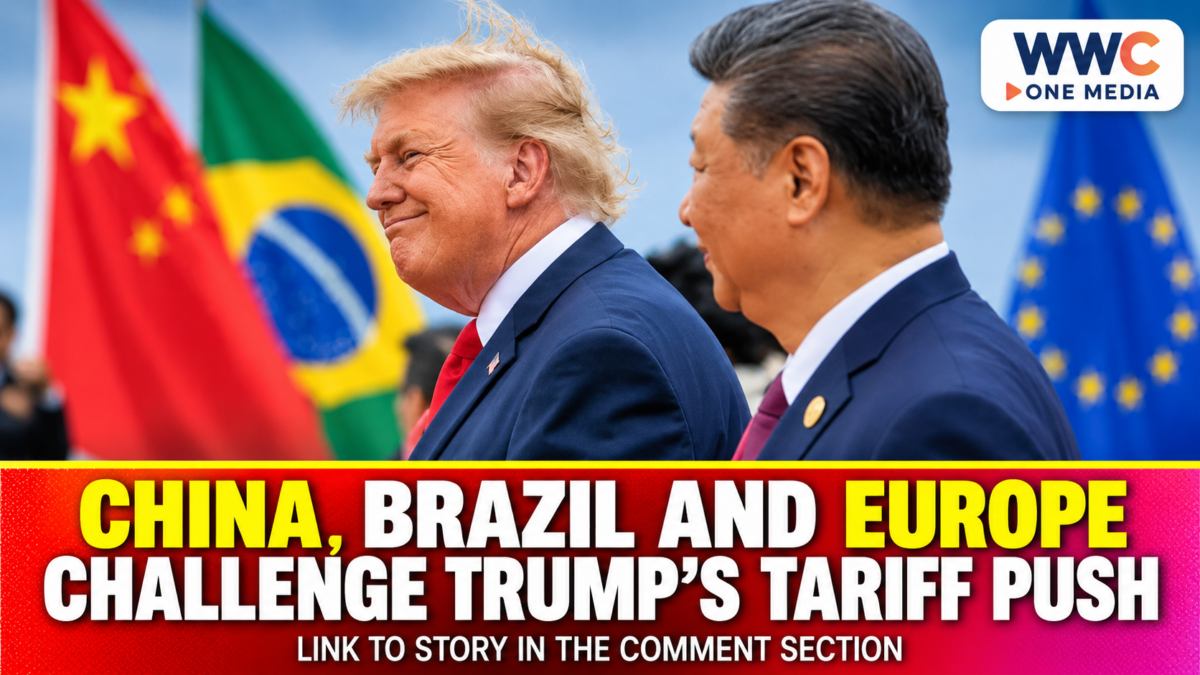
WASHINGTON, BEIJING AND BRUSSELS — Nov. 27, 2026 — President Donald Trump’s latest trade offensive is facing resistance from major economic partners after Washington proposed new tariffs involving China and the European Union while separately seeking additional duties on Brazilian sugar and aircraft.
The proposals have reopened disagreements over industrial policy, market access and the limits of existing trade agreements. China has rejected Washington’s argument that industrial overcapacity justifies the measures, Brazil has warned that it will not yield to tariff pressure, and the European Union expects the United States to respect the tariff commitments made under their 2025 trade framework.
The dispute is significant because it involves three major trading partners with extensive commercial relationships with the United States. It also comes while governments and businesses are still adjusting to previous rounds of tariffs and changes in global supply chains.
But the latest measures are not yet final. They involve separate legal proceedings under Section 301 of the US Trade Act of 1974, and the proposed duties remain subject to further consideration.
Washington targets 14 economies over manufacturing capacity
On Nov. 25, the Office of the United States Trade Representative (USTR), led by Jamieson Greer, announced determinations involving 14 economies under investigations into what Washington describes as structural excess capacity and production in manufacturing sectors.
The economies are China, the European Union, Singapore, Switzerland, Indonesia, Malaysia, Cambodia, Thailand, South Korea, Vietnam, Taiwan, Bangladesh, Japan and India.
The investigations began on March 11, 2026, and originally covered 16 economies. Mexico and Norway were included in the investigations, but the USTR said it had not made determinations on them at this stage.
The US government argues that certain industrial policies, government support and production practices in the economies covered by the findings create structural excess capacity and restrict opportunities for American manufacturers.
The USTR has proposed additional tariffs as a response, but the rates and product coverage differ by economy.
For China, the proposal includes duties of up to 20% on goods not identified in specified annexes, subject to exemptions and the treatment of existing duties. It also proposes tariffs of up to 10% on products identified in Annex A, with certain products in Annex B eligible for exemptions.
For the European Union, Washington proposed a 15% tariff rate on goods, net of most-favoured-nation rates and existing Section 301 duties, with exemptions for certain products.
These are proposed actions, not confirmation that every shipment from China or the EU will immediately face a new additional charge.
Businesses must also consider existing duties, product exclusions and any adjustments resulting from trade commitments.
China rejects Washington’s overcapacity argument
Beijing has strongly opposed the justification behind the latest proposal.
At a Nov. 26 press conference, Chinese Foreign Ministry spokesperson Guo Jiakun said the issues should be addressed through consultation based on equality, mutual respect and mutual benefit.
He also rejected the US description of industrial overcapacity, saying it should not be used as a pretext for political manipulation.
China said it would continue taking necessary steps to defend its legitimate rights and interests.
The disagreement comes as Washington and Beijing attempt to maintain a fragile trade understanding reached in Kuala Lumpur on Oct. 30, 2025.
The USTR’s latest proposal says its China tariff calculations take account of the commitments and 20% tariff rate announced under that arrangement.
That makes the new proposal particularly sensitive. Both governments have an interest in preserving trade negotiations, but the latest action creates another point of friction over how existing commitments should be interpreted.
The wider relationship already includes disputes over agricultural purchases, critical minerals and supply-chain security. WWC previously examined the pressure on the US-China trade arrangement over rare-earth exports and American farm purchases.
The latest tariff proposal adds another issue that could complicate efforts to maintain stable commercial relations.
Brazil faces a separate tariff dispute
Brazil’s situation is different from China’s and the European Union’s.
It was not included among the 14 economies covered by the Nov. 25 structural excess-capacity determinations. Instead, Washington separately proposed changes to an existing Section 301 action involving Brazil.
The USTR is considering higher duties on certain raw and refined sugar imports entering the United States outside quota limits. It is also proposing to end the existing exemption for finished aircraft from Brazil and impose a 10% ad valorem duty on those imports.
The aircraft proposal is significant for Brazilian aerospace manufacturer Embraer. Finished aircraft are Brazil’s fourth-largest export to the United States, according to the USTR.
The sugar proposal would apply on a nondiscriminatory basis to certain out-of-quota imports. Washington said the measure was intended to increase pressure on Brazil to address the practices identified in its investigation.
Brasília strongly rejected the move.
In a statement issued on Nov. 25, Brazil’s Presidential Communication Secretariat said the government believed the new recommendation was intended to pressure changes in domestic regulatory measures involving the Pix payment system, digital trade and preferential agreements.
Brazil also said it had been negotiating with Washington for more than a year and had not received the terms of reference for a potential economic and trade agreement despite repeated requests.
The government said it would continue pursuing a negotiated solution while reserving the option of taking action through the World Trade Organization and adopting reciprocal measures.
That response places the dispute beyond a disagreement over individual products. It raises questions about whether trade negotiations are being linked to domestic regulatory decisions.
Brazil is already challenging US duties at the WTO
The latest proposal also comes amid a separate dispute between Brazil and the United States at the World Trade Organization.
On Nov. 24, the WTO Dispute Settlement Body considered Brazil’s request for a panel to examine additional US duties imposed on Brazilian products under two earlier Section 301 investigations.
The duties at issue include an additional 25% ad valorem duty on Brazilian products, subject to exemptions, and a separate additional 12.5% duty linked to an investigation involving allegations concerning forced labour.
Brazil argued that the measures were inconsistent with US obligations under the General Agreement on Tariffs and Trade 1994 and the WTO’s Dispute Settlement Understanding.
The United States objected to Brazil’s request. The WTO body took note of the statements and agreed to return to the matter if a requesting member wished to do so.
This does not mean a WTO panel had already been established. It means Brazil’s request remained unresolved at that meeting.
The distinction is important because the WTO dispute concerns earlier duties, while the latest USTR announcement proposes further changes involving sugar and aircraft.
Europe says the existing trade agreement matters
The European Union is also challenging the basis for Washington’s proposed action.
The EU-US trade framework agreed in 2025 established a 15% tariff ceiling for covered European goods. The European Commission’s published account of the agreement describes the 15% rate as an overall ceiling and outlines the bloc’s expectation that the United States will honour the agreed terms.
The new USTR proposal puts that commitment under scrutiny.
Washington’s proposed 15% rate for EU goods is described as net of most-favoured-nation rates and existing Section 301 duties, with exemptions for certain products. The European position, meanwhile, is that the agreed ceiling must be respected when duties are considered together.
The difference is commercially important. A headline rate does not necessarily tell an exporter the final customs charge. The combined treatment of existing duties, exemptions and the agreement’s terms will determine the actual cost.
The EU and the United States have one of the world’s largest trade and investment relationships. Their bilateral trade in goods reached €910.6 billion in 2025, while trade in services totalled €865.2 billion in 2024.
A prolonged dispute could therefore affect manufacturers, suppliers and businesses on both sides of the Atlantic.
Businesses face another period of trade uncertainty
For companies operating across international supply chains, the immediate challenge is determining which proposals could affect their products and when.
The proposed duties are not uniform. Their application depends on the economy involved, product classification, existing tariff treatment and the exemptions specified in the relevant notices.
That is particularly important for sectors such as aerospace, agriculture, electronics, machinery and consumer goods.
Brazilian aircraft manufacturers could face higher costs if the proposed 10% duty on finished aircraft is adopted. Sugar exporters could also face changes in the treatment of out-of-quota shipments.
Chinese manufacturers and exporters will need to monitor the proposed product-specific rates and exemptions. European companies must assess how the new proposal interacts with the existing US-EU tariff framework.
Asian exporters also have reason to watch developments closely. WWC’s coverage of the potential impact of the latest US tariff proposals on seafood imports explains why product exemptions and country-specific treatment matter to businesses supplying the American market.
The wider trade confrontation is also part of a longer pattern of disputes involving Washington and major trading partners. WWC previously reported on the escalation of US-Canada tariff tensions, illustrating how quickly trade disagreements can develop into wider diplomatic and commercial challenges.
What happens next?
The USTR has opened a public process for the proposed actions. Written comments and requests to appear at the hearings are due by Jan. 5, 2027. Hearings are scheduled to begin on Jan. 25, 2027, continuing as appropriate.
The proposals will therefore face further scrutiny before any final decision is made.
China is likely to continue pressing for negotiations and the implementation of existing understandings. Brazil has reserved its options under the WTO framework and its domestic reciprocity measures. The European Union will be watching whether the United States applies the 2025 trade agreement’s tariff ceiling as the bloc interprets it.
The central question is whether the latest round of tariff pressure will produce negotiated changes or deepen disagreements among major trading partners.
For businesses, the immediate priority is to avoid treating proposed duties as final charges. For governments, the next stage will test whether trade negotiations can still resolve disputes before they become more expensive and difficult to reverse.
Frequently asked questions
Which countries are facing the latest US tariff proposals?
The new structural excess-capacity determinations cover China, the European Union, Singapore, Switzerland, Indonesia, Malaysia, Cambodia, Thailand, South Korea, Vietnam, Taiwan, Bangladesh, Japan and India.
Is Brazil included in the 14-economy investigation?
No. Brazil faces a separate proposed modification to an existing Section 301 action involving certain out-of-quota sugar imports and finished aircraft.
What tariffs is the United States proposing for China?
The USTR proposal includes duties of up to 20% on certain Chinese goods and up to 10% on products identified in Annex A, subject to exemptions and existing tariff arrangements.
What new duties could affect Brazilian exports?
The USTR is considering higher duties on certain out-of-quota raw and refined sugar imports and a 10% ad valorem duty on finished aircraft from Brazil.
Has the European Union accepted the new US tariff proposal?
The EU has maintained that the 2025 trade framework’s 15% overall tariff ceiling must be respected. The USTR’s new proposal describes its 15% rate using a different calculation that accounts for existing duties and exemptions.
Have the proposed tariffs already taken effect?
No. The latest measures are proposals subject to public comments and hearings. The USTR has set Jan. 5, 2027, as the deadline for written comments and Jan. 25, 2027, for the start of hearings.
Could the dispute lead to retaliation?
Brazil has explicitly reserved the possibility of reciprocal measures and action through the WTO. China has said it will defend its legitimate rights and interests. The eventual response from each government will depend on further negotiations and decisions.