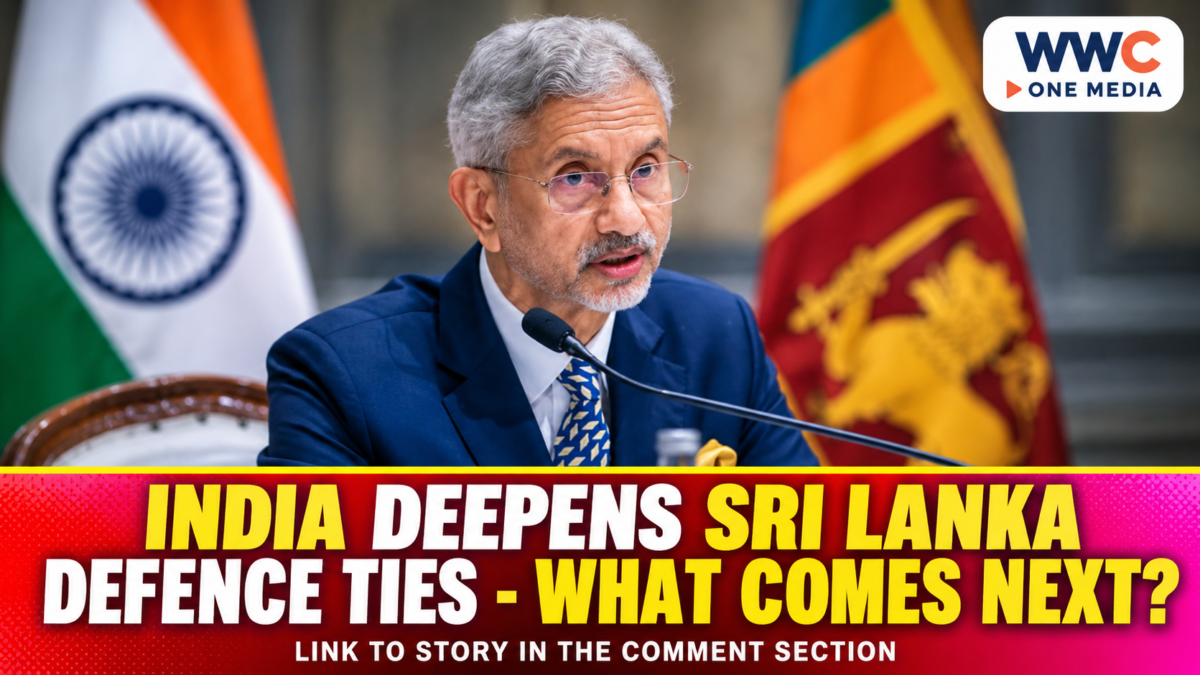
India is strengthening its defence relationship with Sri Lanka as both countries expand military training, maritime security coordination and regional cooperation across the Indian Ocean.
Indian External Affairs Minister S. Jaishankar described the relationship as having a long history of defence collaboration, pointing to cooperation involving aircraft, ships and dry docks. His remarks come as several bilateral and regional security initiatives move forward, giving the partnership a more practical dimension.
The developments matter beyond New Delhi and Colombo. The Indian Ocean is a major international trade corridor, and cooperation on maritime safety, search and rescue, trafficking and other cross-border threats can affect the security of shipping routes used by economies across Asia, Africa and Europe.
However, the growing relationship also raises questions about the scope of military cooperation, Sri Lanka’s strategic independence and the unresolved accountability issues surrounding its armed forces.
Jaishankar Highlights a Wider Defence Partnership
In an interview published on Nov. 25, Jaishankar described India and Sri Lanka as having a long record of defence collaboration.
He said: “We have a long and very good history of defence collaboration. Different parts of it are unfolding as we speak.”
He also pointed to cooperation involving aircraft, ships and dry docks, while identifying training and capacity building as important parts of the relationship.
The remarks did not announce a new defence agreement or specify a new aircraft or naval vessel transfer. They instead described cooperation already developing across military capabilities and infrastructure.
The comments follow a period of more visible defence engagement between the two governments.
In April 2025, India and Sri Lanka signed a Memorandum of Understanding on defence cooperation during Indian Prime Minister Narendra Modi’s visit to Colombo. Subsequent official announcements have documented further agreements and military activities.
The partnership is therefore not limited to diplomatic statements. Its practical elements include military training, equipment-related cooperation and maritime coordination.
Military Exercises Put Cooperation Into Practice
One of the clearest examples is Exercise Mitra Shakti XII, the annual joint military exercise between the Indian Army and Sri Lanka Army.
The 12th edition took place at the Army Training School in Maduru Oya from Nov. 13 to 26, 2026. India sent a 170-member defence contingent, while the Sri Lankan contingent included 17 officers and 153 personnel of other ranks.
The programme focused on battalion-level combat team tactical operations in a counter-insurgency environment, including coordination between participating forces.
The Sri Lanka Army reported that the final validation demonstration took place on Nov. 25. It involved a simulated assault on a fortified village, with combined units conducting coordinated manoeuvres and close-quarter battle drills.
The exercise is designed to improve operational coordination and professional understanding between the two armies. It is a bilateral training programme, not evidence of a new military alliance or a deployment for an active United Nations operation.
WWC ONE MEDIA previously examined the exercise in its report on India’s 170-member contingent participating in Mitra Shakti 2026.
The wider defence relationship also includes coast guard cooperation. On Nov. 3, the Indian Coast Guard and Sri Lanka Coast Guard held their ninth high-level meeting in Mirissa, Sri Lanka.
Their discussions covered marine pollution response, maritime search and rescue, maritime law enforcement, capacity building and technical assistance.
A separate development followed later in the month. Indian Coast Guard Ship Sujay visited Trincomalee from Nov. 23 to 25, with its specialist pollution-response team conducting practical training for Sri Lanka Coast Guard personnel on the operation and deployment of pollution-response equipment.
These activities show how the relationship extends beyond conventional military exercises to maritime safety and environmental response.
New Agreements Expand Equipment and Training Cooperation
India’s Defence Minister Rajnath Singh visited Sri Lanka in September 2026, where he met President Anura Kumara Dissanayake and senior Sri Lankan officials.
During the visit, the two countries exchanged memoranda of understanding covering the upgrading of six L70 guns for the Sri Lanka Air Force and cooperation between their National Cadet Corps and National Defence Colleges.
The upgrade of the six L70 guns falls under a Government of India grant. The equipment had previously been provided to the Sri Lanka Air Force by India.
The two governments also virtually inaugurated three Bailey bridges constructed by Indian defence personnel.
These announcements illustrate several layers of defence engagement: equipment maintenance and upgrading, institutional training, military education and infrastructure support.
The Sri Lankan Ministry of Defence also recorded discussions on maritime cooperation, regional security and drug trafficking. President Dissanayake said Sri Lanka expected India’s fullest support in combating drug trafficking in the Indian Ocean.
He also reiterated that Sri Lanka would not allow its territory to be used for activities inimical to India’s security interests.
That position is significant for New Delhi because Sri Lanka sits close to important Indian Ocean shipping routes. Cooperation with Colombo can help address maritime threats that cross national boundaries, although the precise operational arrangements depend on the governments involved.
Colombo Security Conclave Adds a Regional Dimension
India’s defence relationship with Sri Lanka is also developing alongside wider regional security cooperation.
The Colombo Security Conclave held its eighth National Security Advisor-level meeting in the Maldives on Nov. 25, 2026.
The meeting brought together delegations from the Maldives, India, Sri Lanka and Bangladesh. Australia and Malaysia participated as guest countries, while Mauritius joined virtually.
The participating member states — Maldives, India, Mauritius and Sri Lanka — signed the agreed minutes and adopted a 2026–2027 Roadmap of Cooperation.
The roadmap identifies five areas of cooperation:
- Maritime safety and security
- Countering terrorism and radicalisation
- Combating trafficking and transnational organised crime
- Cybersecurity and protection of critical infrastructure and technology
- Humanitarian assistance and disaster relief
The framework matters because regional security is no longer limited to naval operations. Governments also face cyber threats, organised crime, trafficking networks and disasters that require coordination between multiple agencies.
The roadmap provides a structure for planned activities, training and information-sharing. It does not establish a collective-defence treaty or automatically commit participating countries to military intervention.
The Indian Ocean’s wider strategic importance is also drawing attention from other international partners. WWC has examined the European Union’s engagement in strengthening Indian Ocean maritime security and protecting global trade routes.
Defence Cooperation Does Not Remove Sri Lanka’s Accountability Questions
The expansion of military ties also takes place against a difficult historical background.
Sri Lanka’s armed conflict ended in 2009, but allegations involving serious human rights violations and enforced disappearances remain part of the country’s unresolved accountability debate.
A 2024 report by the Office of the United Nations High Commissioner for Human Rights examined enforced disappearances in Sri Lanka and identified continuing shortcomings in investigations, prosecutions and the rights of victims and families.
In November 2025, the UN Committee on Enforced Disappearances also identified obstacles to overcoming impunity and ensuring the effective realisation of victims’ rights.
These findings do not establish that every member of Sri Lanka’s armed forces was responsible for violations. They do, however, demonstrate why military cooperation can be viewed alongside questions about accountability, institutional reform and human rights.
The latest remarks from Jaishankar did not address these issues. Nor did the September agreements announce a new mechanism for investigating past violations.
For international partners, this creates a broader policy question: how can security cooperation strengthen regional stability while maintaining attention to human rights obligations and accountability?
Sri Lanka’s other security partnerships also demonstrate that Colombo is engaging with several international partners. WWC has reported on China–Sri Lanka police cooperation and the country’s security modernisation efforts.
India’s partnership with Sri Lanka is therefore part of a wider diplomatic environment in which the island must manage its relationships while protecting its own national interests.
What Happens Next?
The next stage will depend on how the announced initiatives are implemented.
The Colombo Security Conclave’s 2026–2027 roadmap provides a framework for cooperation, while the military exercises and Coast Guard engagements offer practical examples of existing collaboration.
Further developments could involve training, maritime information-sharing, equipment support and coordinated responses to cross-border threats. However, the latest statements do not confirm a new aircraft purchase, naval vessel transfer or permanent Indian military deployment in Sri Lanka.
The relationship will also be shaped by Sri Lanka’s approach to sovereignty, its other international partnerships and its domestic priorities.
For India, maintaining close cooperation with Sri Lanka supports its wider regional engagement and maritime security objectives. For Colombo, the challenge is to obtain practical benefits while ensuring that defence partnerships remain consistent with national interests.
The question is no longer whether India and Sri Lanka cooperate on defence. They clearly do. The more important issue is how far that cooperation will develop — and whether it can strengthen Indian Ocean security without creating new political or accountability concerns.
Frequently Asked Questions
1. What did S. Jaishankar say about India-Sri Lanka defence ties?
India’s External Affairs Minister described the relationship as having a long history of defence collaboration, citing cooperation involving aircraft, ships, dry docks, training and capacity building.
2. What is Exercise Mitra Shakti 2026?
It is the 12th edition of the annual joint military exercise between India and Sri Lanka. The 2026 edition took place at Maduru Oya from Nov. 13 to 26.
3. What defence agreements did India and Sri Lanka exchange in September 2026?
The two countries exchanged memoranda covering the upgrading of six L70 guns for the Sri Lanka Air Force and cooperation between their National Cadet Corps and National Defence Colleges.
4. What is the Colombo Security Conclave?
It is a regional security cooperation platform involving India, Sri Lanka, the Maldives and Mauritius, with Bangladesh also participating in the November 2026 meeting. Its areas of cooperation include maritime security, counterterrorism, trafficking, cybersecurity and disaster response.
5. Does the expanding relationship mean India will deploy troops permanently in Sri Lanka?
The announcements reviewed do not establish a permanent Indian military deployment in Sri Lanka. Joint exercises, training and equipment cooperation should not be interpreted as proof of such a deployment.
6. Why is Sri Lanka important to Indian Ocean security?
Sri Lanka’s location makes it relevant to maritime transport and regional security. Cooperation with India and other partners covers issues such as search and rescue, maritime law enforcement, trafficking and marine pollution response.