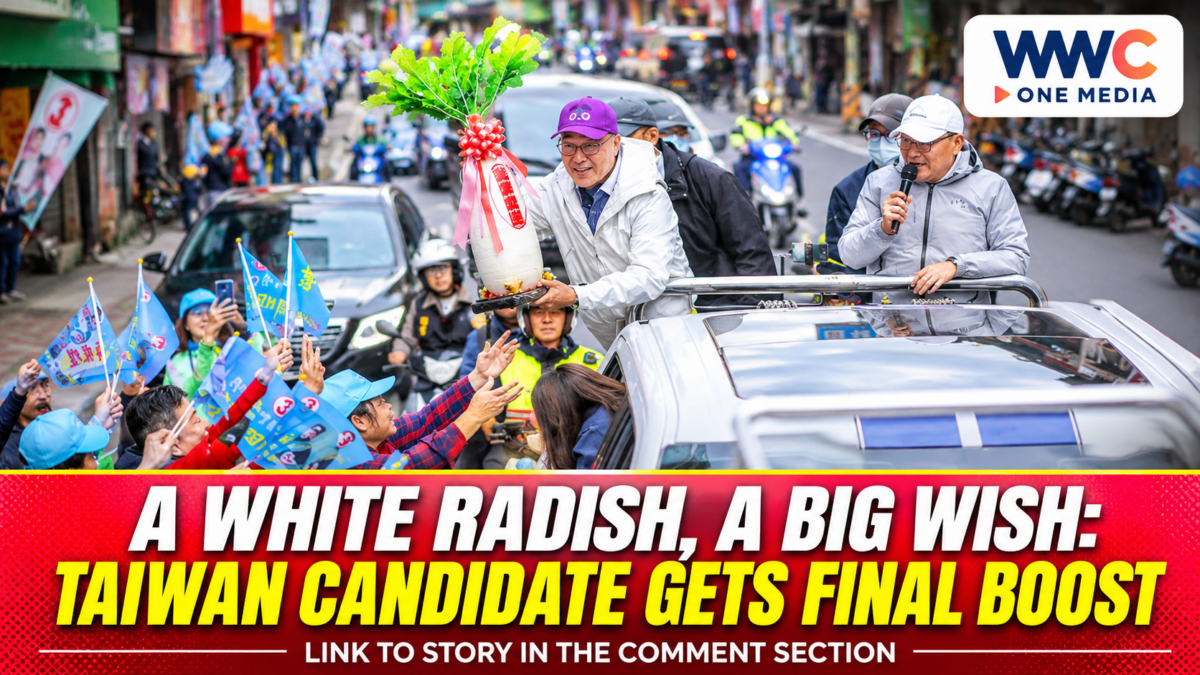
NEW TAIPEI CITY, Taiwan — A white radish has become an unexpected campaign-day symbol for Kuomintang (KMT) mayoral candidate Lee Shu-chuan, who received a decorative version from a supporter during a motorcade ahead of Taiwan’s Nov. 28 local elections.
Lee, accompanied by New Taipei City Mayor Hou You-yi, held up the fake radish while travelling through New Taipei City on Nov. 25. The gift carried a familiar message in Taiwanese culture: good fortune and a wish for success.
The gesture may have been light-hearted, but it came during the final days of a closely watched election campaign in one of Taiwan’s most populous municipalities.
Why a white radish carries a political message
In Taiwan, a white radish can represent more than a food ingredient. The expression 好彩頭 (hǎo cǎi tóu) conveys the idea of a good beginning, favourable fortune or a promising outcome.
The symbolism is especially familiar during celebrations and occasions when people wish someone success. In campaign settings, supporters sometimes give candidates auspicious items as gestures of encouragement.
The radish presented to Lee was therefore a symbolic show of support rather than a policy announcement or an official campaign pledge.
Similar gestures have appeared during the current election season. A separate campaign event in New Taipei City also featured supporters presenting white radishes as a good-luck offering to Lee and other political figures.
These moments show how local customs can become part of Taiwan’s political campaign culture, where candidates interact with supporters through gifts, greetings and public appearances.
Who is Lee Shu-chuan?
Lee Shu-chuan (李四川) is the KMT candidate contesting the New Taipei City mayoral election.
The official candidate announcement issued by the New Taipei City Election Commission lists three candidates for the city’s fifth mayoral election: Su Chiao-hui (蘇巧慧), Su Hui-huang (蘇輝煌) and Lee Shu-chuan.
Lee’s published election bulletin records previous public-service roles including deputy mayor of Taipei, deputy mayor of Kaohsiung and deputy mayor of New Taipei City. His experience in local administration and public works forms part of his public profile as he seeks the mayor’s office.
Hou You-yi, who appeared alongside Lee during the motorcade, is the incumbent New Taipei City mayor.
The campaign appearance should not be interpreted as evidence of an election result. The symbolic gift reflects a supporter’s gesture, not a measure of voter preference or a prediction of victory.
New Taipei City race enters its final stretch
The New Taipei City mayoral contest is part of Taiwan’s nationwide local elections scheduled for Saturday, Nov. 28, 2026.
The New Taipei City Election Commission set the official campaign period from Nov. 13 to Nov. 27, with permitted campaign activities scheduled between 7 a.m. and 10 p.m. daily.
That makes Nov. 25 part of the final stretch before campaigning ends.
The broader election covers local leadership positions across Taiwan, including mayors, county and city officials, councillors and other representatives. The Central Election Commission has listed 11,051 positions to be filled across the nationwide vote.
For readers following the wider political contest, WWC ONE MEDIA has examined the stakes of Taiwan’s November 28 local elections and the political road to 2028.
The scale of the vote also extends beyond the mayoral races. Taiwan’s election authorities have reported 19,100 qualified candidates competing for the available local positions, making the election a major exercise in local representation.
WWC’s Taiwan election countdown and voter figures provide further context on the number of candidates, positions and voters involved.
More than campaign symbolism
Campaign motorcades are a familiar feature of election periods in Taiwan. They allow candidates to move through neighbourhoods, meet residents and make visible appeals for support.
Small gestures during these appearances can carry cultural meaning. Food items, traditional decorations and auspicious gifts can help supporters express encouragement in ways that are immediately recognisable to local audiences.
But campaign symbolism and electoral performance remain two different things.
A candidate may receive a warm reception during a motorcade without that reception necessarily translating into votes. The outcome will depend on voters’ assessments of candidates, their platforms, local issues and the broader political environment.
The distinction is particularly important in a competitive municipal contest. New Taipei City is a major population centre, and its next mayor will be responsible for local administration and public services.
WWC has also examined the importance of electoral safeguards in its report on Taiwan’s election security and concerns over unlawful campaign financing.
What happens next?
The official campaign period ends on Nov. 27, one day before voters head to the polls.
The white radish may have offered Lee a memorable moment during the final campaign days, but the decisive test will come at the ballot box.
For now, the gift stands as a small example of how Taiwanese cultural traditions can find a place in modern political campaigning.
The wish behind the radish is clear: good fortune. Whether that wish becomes an electoral victory will be decided by New Taipei City voters on Nov. 28.