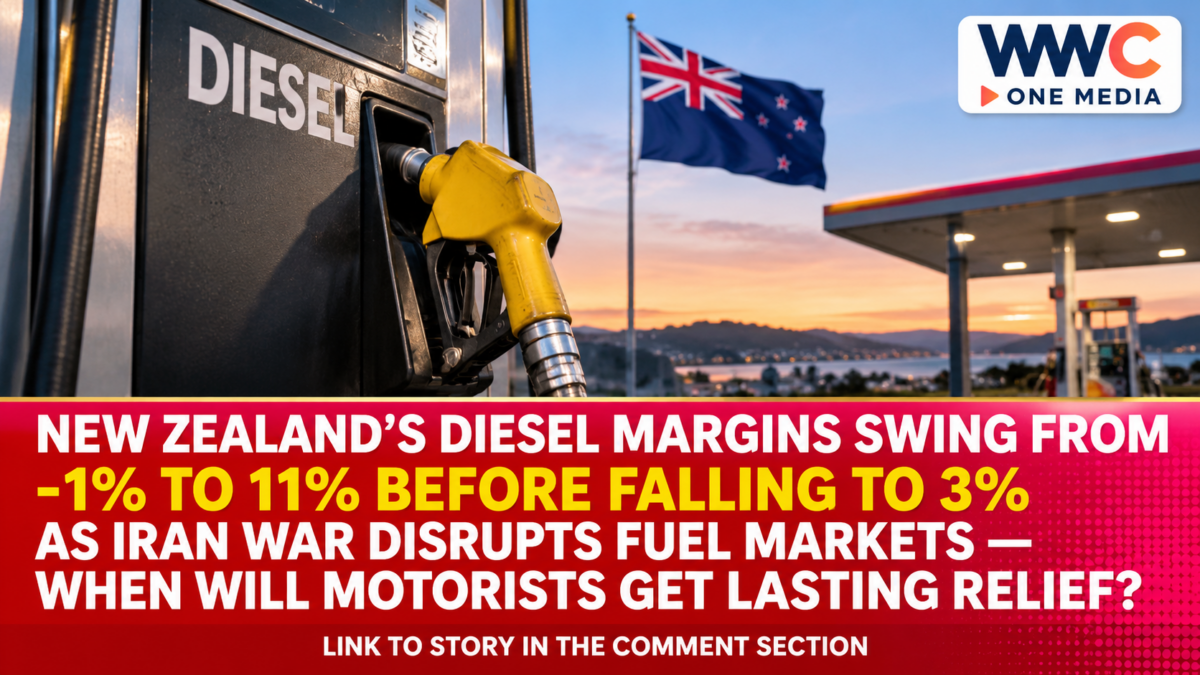
WELLINGTON, New Zealand — New Zealand’s fuel industry is facing renewed financial pressure as the conflict involving Iran continues to disrupt international petroleum markets, with diesel retail margins falling to 3% of the average advertised pump price during the third quarter of 2026.
The latest quarterly monitoring findings from New Zealand’s Commerce Commission reveal that diesel margins initially dropped to -1% during the first quarter before recovering to 11% in the second quarter and subsequently contracting again.
The fluctuations highlight the complicated relationship between international energy costs, domestic fuel pricing and the expenses associated with supplying petroleum products to consumers.
For motorists, transport operators and agricultural businesses, the central question remains whether improvements in international oil markets will translate into sustainable relief at the pump.
New Zealand Fuel Margins Reveal an Unstable Energy Market
The September-quarter assessment represents the Commerce Commission’s third quarterly fuel monitoring exercise since the outbreak of conflict in the Middle East in late February 2026.
Throughout these reporting periods, the cost of bringing imported petroleum products into New Zealand has climbed to unusually high levels.
Diesel retail margins experienced a particularly dramatic adjustment during the first three quarters.
During the January–March period, the estimated margin stood at -1%. It recovered to 11% between April and June before declining to 3% during the July–September quarter.
The latest figure remains substantially below the historical level of approximately 11%. Diesel wholesale margins were also slightly negative during the September quarter.
The results suggest that the improvement recorded earlier in the year did not represent a sustained recovery in diesel margins.
Higher Fuel Margins Do Not Automatically Mean Higher Profits
One of the most important distinctions in the Commerce Commission’s findings is that fuel margins should not be confused with corporate profitability.
The estimated margin does not represent the amount that fuel companies retain as net earnings.
Supplying petroleum products involves numerous expenses, including international freight, insurance, terminal operations, storage and domestic distribution.
The Commission’s importer cost model incorporates various industry-informed assumptions to estimate these expenses. However, additional costs associated with delivering fuel to consumers must also be considered when evaluating company profitability.
Consequently, neither a temporary improvement in retail margins nor a subsequent decline establishes the overall financial performance of an individual fuel importer.
Determining whether companies have earned excessive profits would require more detailed financial evidence.
For consumers, the more immediate issue is whether retail pricing remains competitive and whether reductions in underlying costs are eventually reflected in advertised pump prices.
Why the Iran War Continues to Affect New Zealand’s Fuel Supply
New Zealand’s exposure to Middle Eastern energy disruptions extends beyond its direct trade with the region.
The country no longer imports Middle Eastern crude oil for domestic refining. Instead, Asian refineries provide the overwhelming majority of its imported petrol, diesel and aviation fuel.
Before the Iran conflict, these refineries relied heavily on crude supplies from Gulf producers.
Disruptions to those supply chains can therefore affect New Zealand even when its fuel shipments originate elsewhere in Asia.
New Zealand’s Treasury recorded Brent crude reaching US$138 per barrel in early April 2026, following major disruptions to global oil supplies.
Higher crude prices subsequently affected refined petroleum markets.
The broader uncertainty surrounding international energy supplies has also been explored in WWC ONE MEDIA’s coverage of ANZ’s oil price forecast amid the Iran war.
Even when benchmark crude prices decline, the cost of delivering refined petroleum products may not fall by the same amount.
That distinction is particularly important for economies dependent on imported fuel.
Fuel Market Volatility Threatens Businesses and Household Spending
New Zealand’s exposure to petroleum prices creates economic challenges extending beyond service stations.
In its May 2026 monetary policy assessment, the Reserve Bank of New Zealand identified higher energy costs as a significant source of inflationary pressure.
Petroleum-related expenses can influence agricultural production, freight services, aviation and the transportation of consumer goods.
Businesses facing higher operating expenses may respond by increasing prices, reducing investment or absorbing costs through lower earnings.
Households, meanwhile, may have less money available for discretionary purchases when essential transportation expenses increase.
New Zealand’s Treasury also identified higher fuel costs as a factor that could weaken purchasing power and delay the country’s economic recovery.
International developments remain an important variable, particularly when diplomatic announcements produce significant changes in commodity prices.
WWC ONE MEDIA previously examined this volatility in its coverage of global oil price declines amid renewed US–Iran peace negotiations.
However, international benchmark movements alone cannot establish when New Zealand motorists will experience substantial and sustained reductions in retail fuel prices.
Commerce Commission Intensifies Fuel Price Monitoring
New Zealand’s government has directed the Commerce Commission to maintain close oversight of domestic fuel pricing in response to the Middle East conflict.
Alongside its quarterly assessments, the Commission is publishing fortnightly fuel monitoring updates examining changes in retail prices and the estimated costs of importing petroleum products.
The government has also issued guidance concerning fuel surcharges imposed by businesses.
These charges must reflect genuine additional fuel expenses rather than serve as a mechanism for recovering unrelated costs or artificially increasing margins.
Businesses are expected to disclose applicable surcharges clearly before customers complete their purchases.
The government has warned that misleading or unjustified surcharges could raise concerns under the Fair Trading Act.
However, the existence of regulatory monitoring does not establish that any specific fuel importer has engaged in unlawful pricing practices.
Asia-Pacific Energy Security Remains Under Pressure
New Zealand’s experience forms part of a broader energy security challenge confronting petroleum-importing economies across the Asia-Pacific.
New Zealand’s foreign affairs ministry has identified South Korea, Taiwan, Thailand and the Philippines among the Asian economies particularly exposed to disruptions involving Middle Eastern energy supplies.
The consequences may vary depending on each economy’s petroleum reserves, domestic energy resources and ability to diversify imports.
Energy security also depends on the reliability of transportation and distribution infrastructure.
WWC ONE MEDIA’s coverage of fuel distribution disruptions and shortages in Bali examines how logistical problems can affect local access to petroleum products.
Such incidents should not automatically be attributed to the Iran conflict. Nevertheless, they illustrate why the physical delivery of fuel matters alongside international commodity prices.
What Happens Next for New Zealand Fuel Prices?
The Commerce Commission is scheduled to release its next fortnightly fuel monitoring update on Dec. 10, 2026.
The figures will provide additional information about whether changes in international import expenses are being reflected in domestic retail prices.
The evolution of international diplomatic negotiations will also remain relevant to the broader energy outlook, as explored in WWC ONE MEDIA’s coverage of Qatar’s continuing mediation between the United States and Iran.
For motorists and businesses, sustained relief will depend on more than a temporary reduction in international oil prices.
Import expenses, distribution costs and competitive retail pricing will all influence the eventual outcome.
New Zealand’s diesel margins have already experienced significant fluctuations during 2026. Whether the market can establish greater stability as 2027 approaches remains an important question for consumers and businesses.
Frequently Asked Questions
Why are New Zealand fuel margins changing in 2026?
The Middle East conflict has disrupted international petroleum markets and increased volatility in the costs associated with importing refined fuels.
What is New Zealand’s latest quarterly diesel retail margin?
The diesel retail margin stood at 3% of the average advertised pump price during the September 2026 quarter, compared with 11% during the June quarter.
Are higher fuel margins the same as higher profits?
No. Fuel margins do not account for every expense associated with supplying petroleum products and cannot independently establish net profitability.
Why does the Iran war affect New Zealand fuel prices?
New Zealand relies heavily on Asian refineries for imported petroleum products. These refineries have historically depended on Middle Eastern crude oil supplies.
When will New Zealand release its next fuel monitoring update?
The Commerce Commission’s next fortnightly monitoring report is scheduled for December 10, 2026.