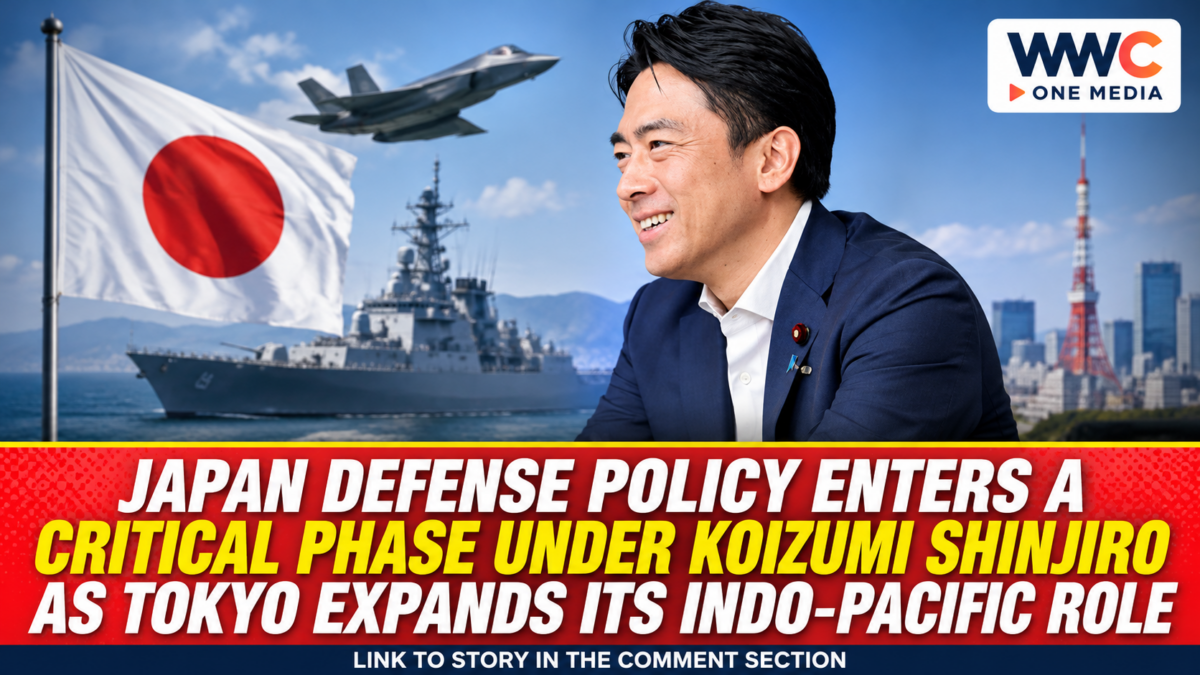
TOKYO, Japan — November 26, 2026 — Japan’s Defense Minister Koizumi Shinjiro is overseeing a significant period of security-policy development, with the government preparing to revise its central defense documents while expanding military cooperation with the Philippines, India, Australia and other regional partners.
The policy agenda includes a new Defense AI Vision, stronger military coordination with Southeast Asian countries and changes to Japan’s approach to defense equipment transfers. These initiatives are unfolding as Tokyo prepares to announce revisions to three major national security documents before the end of 2026.
The developments provide a clearer measure of Koizumi’s responsibilities than political reputation alone. His influence will ultimately be assessed through the policies adopted, the resources committed and the ability of Japan’s defense institutions to translate diplomatic agreements into operational capabilities.
For the Philippines and other Indo-Pacific countries, the direction of Japan’s defense policy matters because Tokyo is increasingly participating in regional security arrangements that involve maritime surveillance, military logistics, joint exercises and information sharing.
Japan Defense Policy Faces a Major Strategic Review
Koizumi was reappointed as Japan’s defense minister on September 18 following a cabinet reshuffle. In his announcement, he identified the revision of the country’s Three Strategic Documents as a major responsibility for the ministry.
The documents include the National Security Strategy, the National Defense Strategy and the Defense Buildup Program. Together, they establish the government’s broad security priorities, military objectives and plans for strengthening defense capabilities.
Japan’s Ministry of Defense has established a Promotion Headquarters for the Transformation of Defense Capabilities to coordinate work connected with strengthening national defense and preparing the document revisions.
Its published activities include assessments of Japan’s existing defense strategy, future military requirements, cooperation with allies and the changing nature of warfare.
Koizumi has emphasized that the review must proceed with urgency, reflecting the government’s intention to complete the revisions before the end of the year.
The significance extends beyond administrative restructuring. Changes to these documents could influence procurement priorities, military planning, international partnerships and the allocation of public resources.
The final documents will therefore be an important test of whether Japan intends to maintain its current security framework or introduce more substantial changes to its defense posture. Japan Ministry of Defense+1
Why Koizumi Is Expanding Japan’s Regional Defense Relationships
One of the clearest developments under Koizumi is the increasing emphasis on practical cooperation with regional partners.
During the 13th ASEAN Defense Ministers’ Meeting-Plus in Cebu on October 29, he outlined three priorities: improving regional awareness, sustaining capabilities during emergencies and maintaining direct communication between countries.
His address also emphasized ASEAN’s central role in regional security discussions.
Koizumi highlighted Japan’s coastal radar assistance to the Philippines as an example of improving maritime awareness. He also discussed the importance of communications systems and cooperation that can continue functioning during major disruptions.
These priorities reflect a broader understanding of security. Military strength does not depend solely on the number of ships, aircraft or weapons available. It also depends on whether countries can share information, coordinate decisions and maintain essential services during a crisis.
The minister’s approach also places importance on direct diplomatic engagement rather than relying exclusively on formal statements.
For the Philippines, this is particularly relevant because Japan has become an increasingly important defense and security partner.
WWC has previously examined the Philippines-Japan defense logistics agreement and the supplies and services it allows both militaries to exchange. mod.go.jp+1
The Philippines Is Becoming a More Important Defense Partner
Japan’s expanding relationship with Manila provides one of the clearest examples of its regional security agenda.
On October 28, Koizumi met Philippine Secretary of National Defense Gilberto C. Teodoro Jr. in the Philippines.
Their joint statement reaffirmed opposition to unilateral attempts to change the status quo through force or coercion in the East China Sea and South China Sea.
The two governments also reviewed progress under their Reciprocal Access Agreement and Acquisition and Cross-Servicing Agreement.
The defense statement specifically recognized Japanese Self-Defense Forces participation in the May 2026 Balikatan exercises, including live-fire training involving surface-to-ship missiles.
It also confirmed that the logistics agreement had been applied during the October Doushin-Bayanihan bilateral exercise, when Japan’s Air Self-Defense Force received supplies from the Philippine Air Force.
Another important development concerns a possible transfer of an Abukuma-class destroyer to the Philippine Navy.
The two defense ministers agreed to aim for the transfer of the first vessel at the earliest possible date following its expected decommissioning in the coming years. They also discussed education, training, maintenance and long-term support.
The governments additionally agreed to continue discussions on transferring one TC-90 aircraft to the Philippines by the end of Japan’s fiscal year 2027.
These arrangements are not immediate equipment deliveries. They require further coordination between the governments and the relevant military organizations.
The Philippines is also receiving wider Japanese security assistance, including coastal radar and surveillance equipment. WWC previously covered Japan’s ¥4.3-billion assistance package for Philippine maritime monitoring. Japan Ministry of Defense+1
Four-Country Cooperation Adds Another Layer to Japan’s Strategy
Japan’s defense diplomacy is not limited to bilateral relationships.
On October 28, defense leaders from Australia, Japan, the Philippines and the United States met in Cebu during the ASEAN Defense Ministers’ Meeting-Plus.
Their joint statement, released on November 10, outlined plans to strengthen deterrence, improve interoperability and expand regional military cooperation.
One of the proposed initiatives is the establishment of a Combined Coordination Center in the Philippines.
The four countries also committed to coordinating defense investments to support Philippine territorial defense, strengthening high-level consultations and expanding the scope and frequency of combined exercises.
The framework builds on existing activities, including Balikatan and Keen Sword.
For Japan, these arrangements offer another channel through which its defense forces can work with regional partners.
For the Philippines, the proposed coordination center could improve communication and planning among participating countries. However, the announcement does not itself establish a new collective-defense treaty.
The wider regional picture was also visible during the Quad leaders’ meeting in Manila on November 17. Japan, the United States, Australia and India discussed maritime surveillance, cybersecurity, supply chains and advanced technology cooperation.
WWC has examined the maritime and technology initiatives announced during the Manila Quad summit. Japan Ministry of Defense+1
Defense AI Is Becoming Part of Japan’s Military Planning
Another important element of Koizumi’s agenda is the integration of artificial intelligence into defense operations.
In a November 15 press conference, he announced that the Ministry of Defense and Japan Self-Defense Forces were preparing a new Defense AI Vision, with publication targeted for the end of November.
The proposed strategy is intended to outline how AI could be used across defense operations.
Koizumi identified several reasons for reviewing the existing approach. AI can support decision-making through the analysis of large volumes of information, but the technology can also create new security risks, including cyberattacks that exploit AI.
The ministry plans to review its Basic Policy on Promoting the Utilization of AI, which was formulated in July 2024.
This suggests that Japan wants its defense institutions to adapt to changes in technology rather than rely entirely on existing operational procedures.
Analysis: AI could improve information processing, surveillance analysis and administrative efficiency. However, its military use also raises questions about cybersecurity, reliability, human supervision and accountability.
The practical value of Japan’s proposed vision will depend on whether it establishes clear operational standards and safeguards, rather than simply announcing greater interest in AI.
As of November 26, the November 15 announcement still identified the end of November as the target publication period. Japan Ministry of Defense
Why Japan’s Defense Agenda Matters Beyond Tokyo
Japan’s expanding security partnerships reflect the importance of regional coordination in an Indo-Pacific environment where maritime access, supply chains and military communications are closely connected.
Koizumi’s November engagements included defense discussions with India and preparations for a Japan-Singapore ministerial meeting.
The November 19 Japan-India joint statement covered cooperation in maritime security, military exercises and the potential use of Indian firing ranges for Japan Self-Defense Forces training, including activities involving surface-to-ship missiles.
The two countries also discussed strengthening mine-countermeasure capabilities and exploring possibilities for cooperation in naval shipbuilding and design.
These arrangements show that Japan is developing several defense relationships at the same time, rather than relying on a single partnership.
For the Philippines, the consequences could include more opportunities for training, equipment cooperation, logistics support and maritime information sharing.
Analysis: Stronger regional partnerships can improve coordination, but they also require clear communication, compatible procedures, sustainable funding and respect for each country’s legal obligations.
The success of Japan’s strategy will depend not only on the number of agreements signed but on whether those agreements deliver measurable improvements in security cooperation. Japan Ministry of Defense+1
What Happens Next
The immediate milestone is the planned completion of Japan’s Three Strategic Documents revision before the end of 2026.
The Ministry of Defense is also expected to publish its Defense AI Vision by the end of November.
Both developments will provide a more concrete indication of the government’s future military priorities and how technology, regional cooperation and defense capabilities fit into its long-term plans.
For the Philippines, attention will remain on the implementation of agreements with Japan, including the proposed destroyer transfer, TC-90 aircraft cooperation and the development of stronger military information-sharing arrangements.
Koizumi’s record will ultimately be measured by what these policies deliver. Japan has already established an extensive agenda of regional engagement, but turning commitments into lasting capabilities will require sustained implementation.
The next phase of Japan’s defense strategy will therefore be less about announcements and more about whether its institutions and regional partners can translate those commitments into practical results.
Frequently Asked Questions
1. Who is Koizumi Shinjiro?
Koizumi Shinjiro is Japan’s defense minister and a member of the House of Representatives representing Kanagawa Prefecture.
2. What are Japan’s Three Strategic Documents?
They are the National Security Strategy, National Defense Strategy and Defense Buildup Program, which guide Japan’s security priorities and military development.
3. How is Japan strengthening defense cooperation with the Philippines?
The two countries are expanding joint exercises, logistics cooperation, equipment discussions, maritime security coordination and information-sharing arrangements.
4. Will Japan transfer a destroyer to the Philippines?
The two governments have agreed to aim for the transfer of the first Abukuma-class destroyer after its expected decommissioning in the coming years. The transfer is subject to further coordination.
5. What is Japan’s Defense AI Vision?
It is a planned Ministry of Defense strategy outlining how artificial intelligence could be used by Japan’s defense ministry and Self-Defense Forces.